to the Board of Management, and, with special donations, built a commodious bath house for the use of the colonists.
In 1895 the Ezra Society of Berlin, upon a proposition of the writer, bought 50 dulums of land in the vicinity, divided it into five equal lots, and presented them to the five most deserving families of Poelim (workers) after providing each lot with a brick dwelling and stable. This new street was named Ezra.
At the time that the colony was founded, Baron Edmund de Rothschild had started the building of his now famous wine cellars at Rishon-le-Zion. The craze for viniculture was then at fever heat, so that during the first two years of its existence Rehoboth was pretty well covered with vineyards, but when the vines yielded their fruit, it became evident that the colonists did not possess the necessary means for the building of an adequate wine cellar. On representation, Baron Edmund de Rothschild agreed to accept the Rehoboth grape in his Rishon-le-Zion cellars, but the administration stopped the further development of this culture, and instead began planting a large number of almond trees. The Yechidim, however, continued to plant the grape, and the unwisdom of this policy was shown in 1895 when Baron de Rothschild reported that the sale of the wine was very slow, and that he could no longer accept grapes from colonies not under his protection.
The situation was, therefore, critical. The writer proceeded to Warsaw, held a meeting of the M'nucho W'nachlah, and they determined that their own colony should not fail; and, spurred by the necessity of making a strong effort in order to save the entire Palestinean colonization movement, it was decided, with the help of other prominent members of the Chovevi Zion, to establish a national company for the sale of the wine. In this wise, the now well known Carmel Wine Company was started, and the products of the colonies spread over Europe. The colonists, however, mistaking the enterprise, began over-producing. Consequently Baron de Rothschild had to reduce the price of the grape. The owners of Rehoboth, being still resident in Europe, were not much affected by this sudden change, but the Yechidim were left without means. The Russian Chovevi Zion came to the rescue of several, and the Jewish Colonization Association advanced loans to twenty-three families.
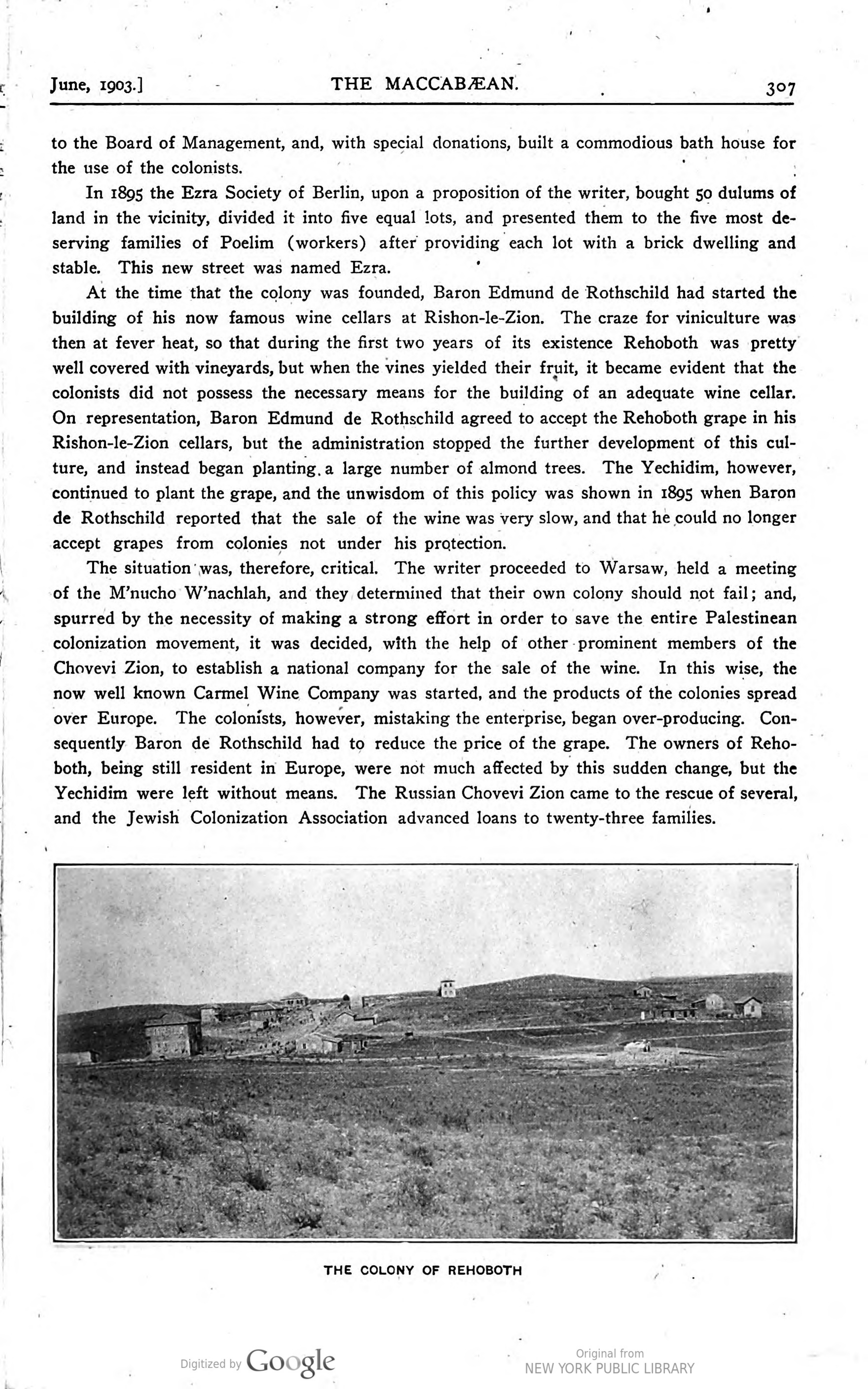
THE COLONY OF REHOBOTH