and Moses Maisner had begun to lecture. In 1893 Rev. G. Liebermann had resigned as preceptor; Prof. A. Joshua Joffé was appointed in his stead.
The fifth Biennial Convention was held in the seminary building, March 8,5656 (1896). Branches of the Association had been established in Baltimore,largely through the instrumentality of the late Dr. Aaron Friedenwald, Buffaloand Syracuse.11 The venerable Dr. Morais spoke of the founders as follows:“ . . . Love for the Law stirred them up to create a seat of learning sound andbroad; resting on foundations laid by righteousness.”12
The sixth Biennial Convention met in the Mickve Israel synagogue, Philadelphia, March 20, 5658 (1898).¹³ Since the last meeting, Sabato Morais had passed away and Mr. Blumenthal now gave expression to the sentiments of loss and mourning as follows: "But to us at the Seminary the passing away of Dr. Morais has been an especially grievous loss. It was unto him as the apple of his eye. He saw in it the possibility of placing Judaism here in America on a firm foundation in line with the Judaism of other times and other lands; that it should be not a thing apart, not an American Judaism, but Judaism in America. . . ."¹⁴
Dr. Morais bequeathed his library of seven hundred Hebrew works to the Seminary. Besides, Baroness de Hirsch donated $6,000 to the Seminary, the
11 "The Report contained an essay, "Prolegomena to a Grammar of the Hebrew Language," by Samuel David Luzzato. Translated from the Italian by S. Morais, LL.D.
12 "Fifth Biennial Report," p. 30.
13 "The Report contained an essay, "Sabato Morais: a Memoir," by Henry S. Morais, with copies of resolutions passed on Doctor Morais' demise, and "Bachya: The Jewish Thomas à Kempis. A chapter in the History of Jewish Ethics," by Joseph Herman Hertz, Ph.D., and additional notes by George Alexander Kohut.
14 "Sixth Biennial Report," p. 12. Rev. Henry S. Morais says in Ibid., pp. 86, 87: "But greater achievements were reserved for old age. Doctor Morais had long witnessed with grief the growth of a destructive element in the Jewish camp. At times he thought that radicalism had been tempered. . . . He had, therefore, felt some hope originally of a theological institution of the West. . . . But these expectations were, ere long, rudely dissipated. Bold enunciations of unbelief proceeded thence, a mischievous spirit was asserting itself right from the center of that institution in the West; and the climax was capped by the so-called Pittsburg Conference, and its undermining pronunciamento. The day for action had now come; any delay meant danger, ruin perhaps, to the future of historical, of Biblical Judaism in America. Hence, the call came for immediate steps looking toward the establishment of a strong counteracting agency in the metropolis of the United States; of a force that would combat a growing evil; of a theological college whose graduates should come forth Jewish ministers, preaching the Word of God and believing it, practicing it, living by it. That call was not in vain. . . . The Jewish Theological Seminary was planted in the City of New York, in January, 1886 [really 1887]. . . . Then, further on, its motto is, "To learn and to teach, to observe and to do." Mr. Jacob H. Schiff headed the Morais Endowment Fund with a subscription of $5,000.
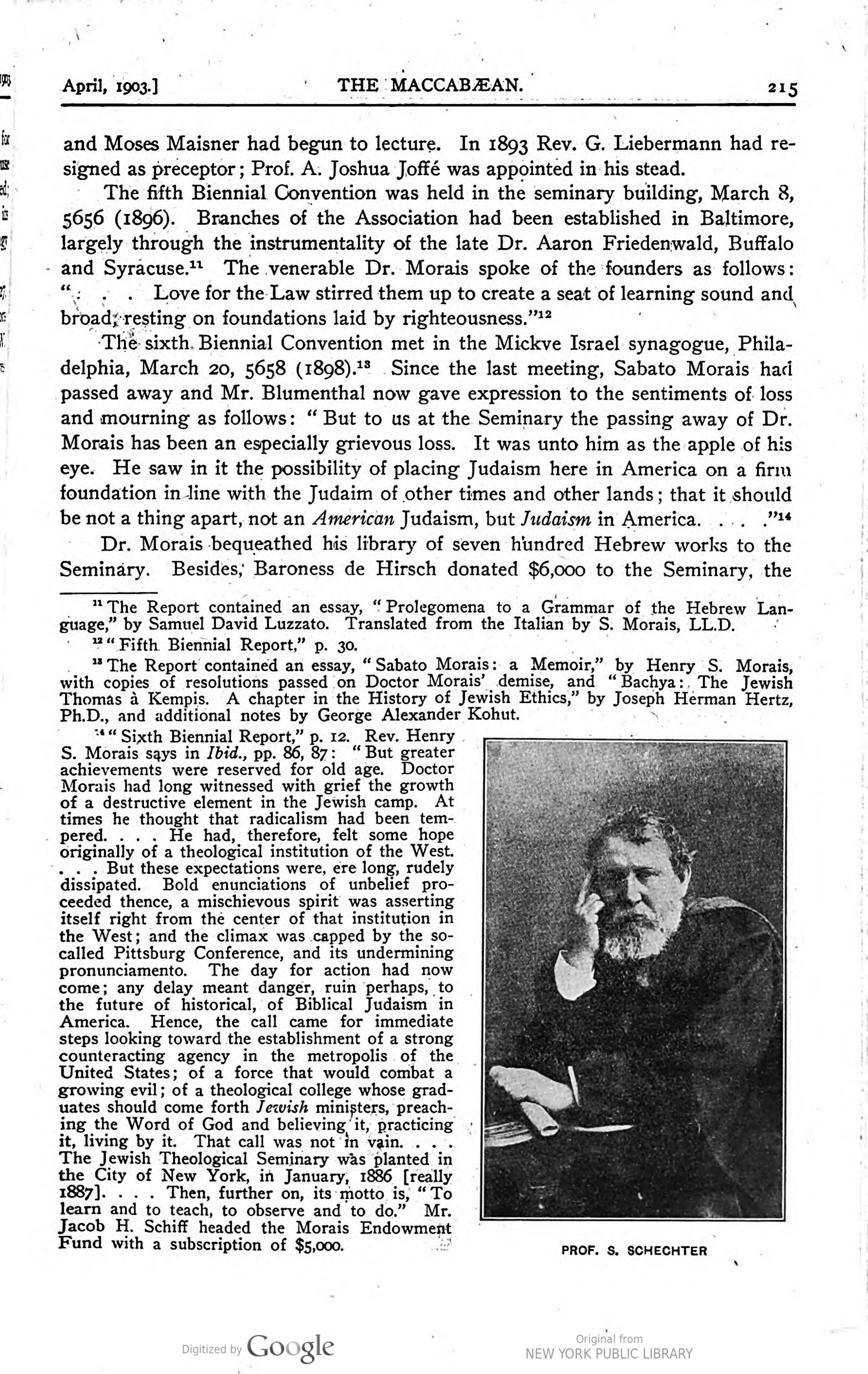
PROF. S. SCHECHTER