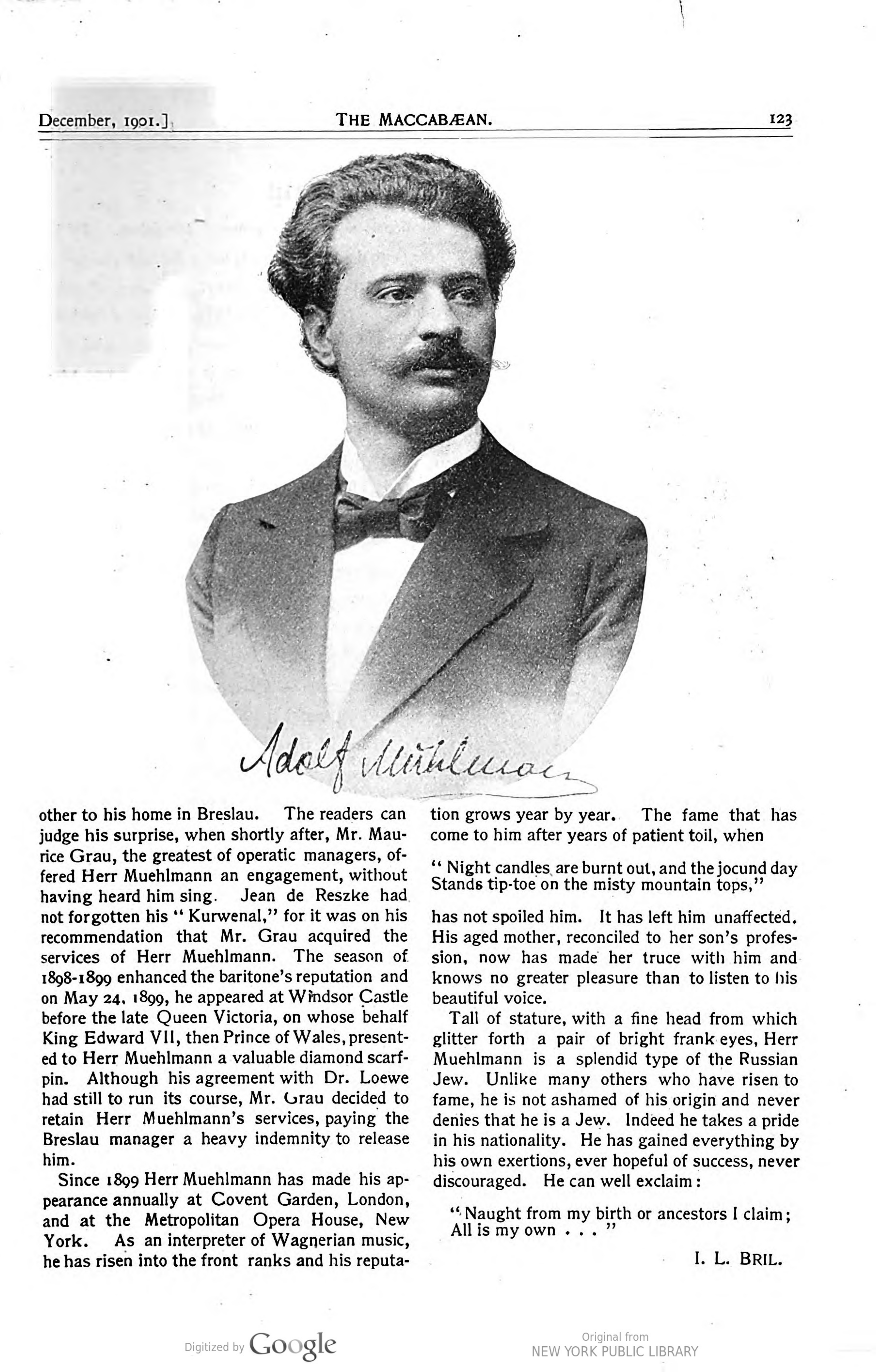
other to his home in Breslau. The readers can judge his surprise, when shortly after, Mr. Maurice Grau, the greatest of operatic managers, offered Herr Muehlmann an engagement, without having heard him sing. Jean de Reszke had not forgotten his “Kurwenal,” for it was on his recommendation that Mr. Grau acquired the services of Herr Muehlmann. The season of 1898-1899 enhanced the baritone’s reputation and on May 24, 1899, he appeared at Windsor Castle before the late Queen Victoria, on whose behalf King Edward VII, then Prince of Wales, presented to Herr Muehlmann a valuable diamond scarfpin. Although his agreement with Dr. Loewe had still to run its course, Mr. Grau decided to retain Herr Muehlmann’s services, paying the Breslau manager a heavy indemnity to release him.
Since 1899 Herr Muehlmann has made his appearance annually at Covent Garden, London, and at the Metropolitan Opera House, New York. As an interpreter of Wagnerian music, he has risen into the front ranks and his reputa-
tion grows year by year. The fame that has come to him after years of patient toil, when
"Night candles are burnt out, and the jocund day Stands tiptoe on the misty mountain tops,"
has not spoiled him. It has left him unaffected.His aged mother, reconciled to her son's profession, now has made her truce with him andknows no greater pleasure than to listen to hisbeautiful voice.
Tall of stature, with a fine head from which glitter forth a pair of bright frank eyes, Herr Muehlmann is a splendid type of the Russian Jew. Unlike many others who have risen to fame, he is not ashamed of his origin and never denies that he is a Jew. Indeed he takes a pride in his nationality. He has gained everything by his own exertions, ever hopeful of success, never discouraged. He can well exclaim:
“Naught from my birth or ancestors I claim; All is my own . . .”