No. 51. — "Die Welt" — Page 7.
(continued from page 6)
…turning-point of its history was to help decide, were to expect that it would be an Areopagus of experienced men bleached by the years, leaders of the people, of "Gerontes", as befitted such a moment, a strange surprise would be the answer to that expectation. There were almost no old men there. This time it was youth that took the lead. It is an old question, debated since Plato, which is more beneficial to the State, to the community: the rule of hoary age or of vigorous youth, poor in experience. The Jews, out of an ancient, inherited, oriental view of life, had from of old held the aged in great respect. "Skenim" — that was a word synonymous with sages, leaders, judges. "And youths shall lead thee" — was once a curse which a wrathful prophet hurled at his people.
here no longer the connection of the old with the new, the rootedness in the soil. It is no specifically Jewish world, with its mysterious gleam and shimmer, with its undertones losing themselves in the far distance and still vibrating, that lives in these words. A foreign world has thrust itself in like a wedge, displacing the native one, uprooting it...
Will these young champions of the Jewish people, who sought to give a new watchword, to weave a red stripe into the white-and-blue flag, be able to prevail, to lead the people, the great masses, and to bring them to the goal? It is not enough to have unfurled the banner; one must also be able to lead the troops to victory... Has the important moment also found the fitting men?
And the moment was truly significant. A new
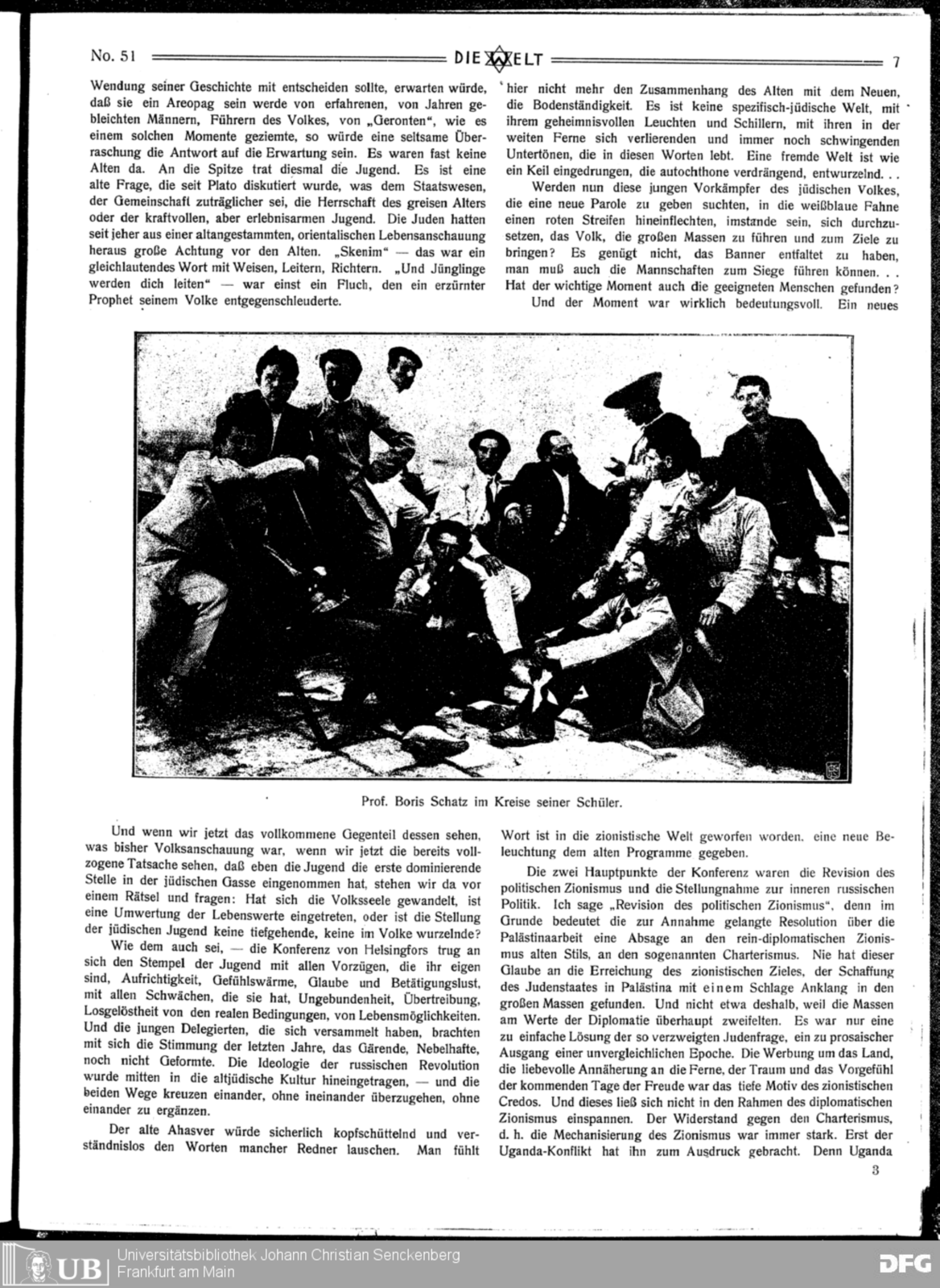
Prof. Boris Schatz in the circle of his pupils.
And if we now see the complete opposite of what was hitherto the people's view, if we now see the accomplished fact that it is precisely youth that has taken the first, dominant place in the Jewish street, we stand before a riddle and ask: Has the soul of the people changed, has a revaluation of the values of life taken place, or is the position of Jewish youth no deep-going one, none rooted in the people?
Be that as it may, — the Conference of Helsingfors bore the stamp of youth, with all the merits that are its own, sincerity, warmth of feeling, faith and eagerness for action, and with all the weaknesses that it has, lack of restraint, exaggeration, detachment from real conditions, from the possibilities of life. And the young delegates who had assembled brought with them the mood of the last years, the fermenting, the nebulous, the not yet formed. The ideology of the Russian revolution was carried into the midst of the ancient Jewish culture, — and the two paths cross each other without passing into one another, without completing one another.
Old Ahasuerus would surely listen, shaking his head and uncomprehending, to the words of many a speaker. One feels
word has been cast into the Zionist world, a new light thrown upon the old programme.
The two main points of the Conference were the revision of political Zionism and the attitude to be taken towards internal Russian politics. I say "revision of political Zionism", for at bottom the resolution adopted on the work in Palestine signifies a renunciation of the purely diplomatic Zionism of the old style, of so-called Charterism. Never has this faith in the attainment of the Zionist goal, the creation of the Jewish State in Palestine, at a single stroke, found response in the great masses. And not because the masses doubted the value of diplomacy in general. It was only too simple a solution of the so ramified Jewish question, too prosaic an issue to an incomparable epoch. The wooing of the land, the loving approach to the distance, the dream and the foreboding of the coming days of joy were the deep motive of the Zionist credo. And this would not let itself be fitted into the framework of diplomatic Zionism. The resistance to Charterism, that is, to the mechanisation of Zionism, was always strong. Only the Uganda conflict brought it to expression. For Uganda
3