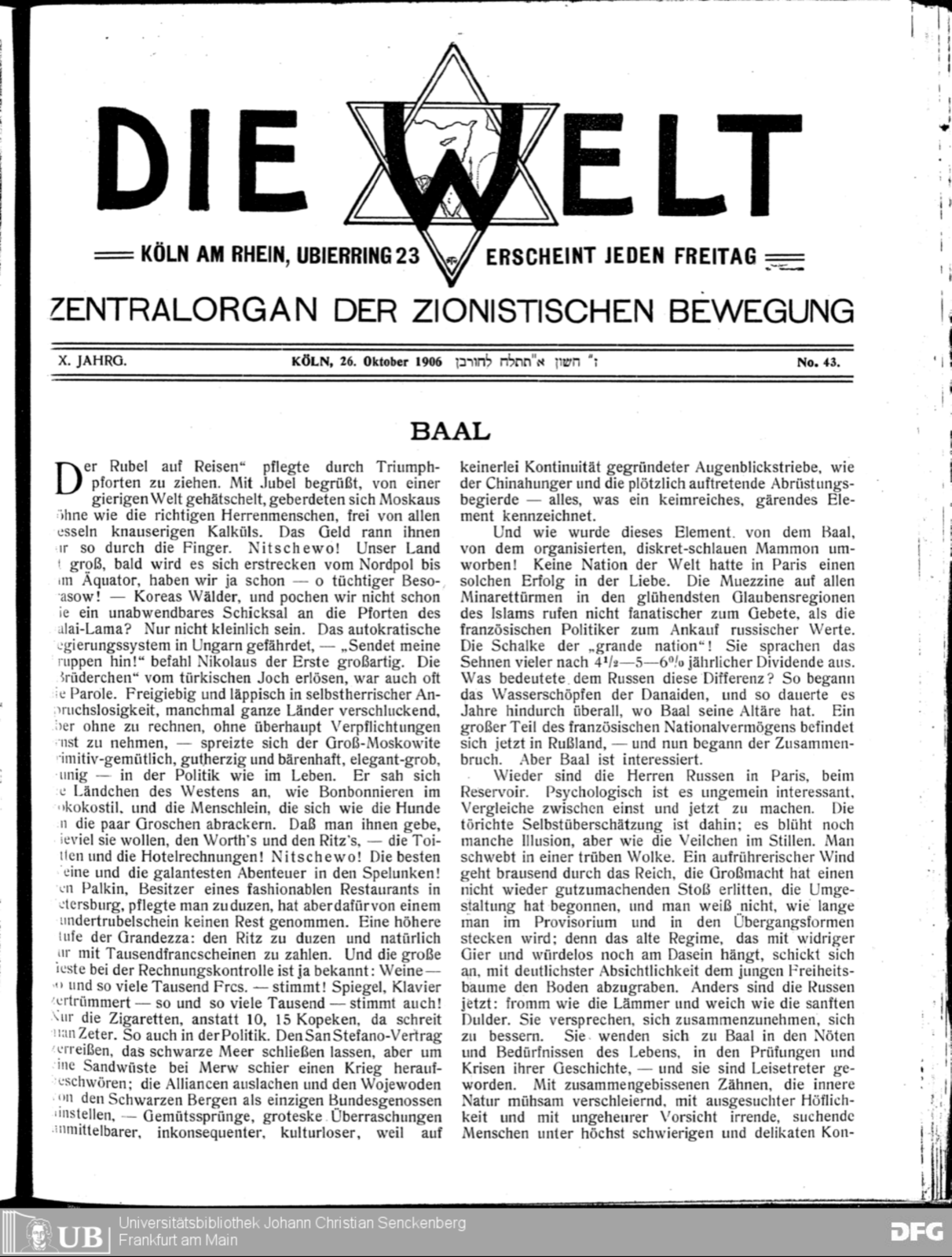
DIE WELT
= COLOGNE-ON-RHINE, UBIERRING 23 = APPEARS EVERY FRIDAY =
CENTRAL ORGAN OF THE ZIONIST MOVEMENT
Vol. X. COLOGNE, 26 October 1906 7 Cheshvan, 1838 after the Destruction No. 43.
BAAL
The Rouble on its Travels" used to pass through triumphal arches. Greeted with jubilation, petted by a greedy world, the sons of Moscow bore themselves like true lords of creation, free of all the fetters of niggardly calculation. Money simply ran through their fingers. Nitschewo! Our land is great, soon it will stretch from the North Pole to the Equator; have we not already — O able Besorassow! — the forests of Korea, and are we not already knocking like an inescapable fate at the gates of the Dalai Lama? Only let us not be petty. The autocratic system of government in Hungary endangered — "Send my troops there!" Nicholas the First grandly commanded. To deliver the "little brothers" from the Turkish yoke was also often the watchword. Open-handed and frivolous in a self-willed unpretentiousness, at times swallowing whole countries, but without reckoning, without taking obligations seriously at all, — the Great Muscovite strutted about, primitive and genial, good-hearted and bearish, elegantly coarse, whimsical — in politics as in life. He looked upon the little lands of the West as upon bonbonnières in the rococo style, and upon the little people who toil like dogs for a few pence. Let them be given as much as they want, the Worth's and the Ritz's, — the toilettes and the hotel bills! Nitschewo! The best wines and the most gallant adventures in the dens! A Palkin, owner of a fashionable restaurant in St. Petersburg, one used to address with the familiar "thou," but in return he took no change from a hundred-rouble note. A higher degree of grandeur: to address the Ritz as "thou," and of course to pay only in thousand-franc notes. And the grand gesture at the checking of the bill is well known: wines — so many thousand francs — correct! Mirrors, piano smashed — so many thousand — correct too! Only the cigarettes, 15 kopecks instead of 10, — at that one cries murder. So too in politics. To tear up the Treaty of San Stefano, to have the Black Sea closed, yet over a sandy desert near Merv almost to conjure up a war; to laugh at alliances and to set up the voivode of the Black Mountains as one's only ally, — leaps of temper, grotesque surprises of immediate, inconsistent, uncultured impulses of the moment, uncultured because founded on no continuity whatever, such as the hunger for China and the suddenly emerging craving for disarmament — everything that marks an element rich in germs and in ferment.
And how this element was courted by Baal, by the organised, discreetly cunning Mammon! No nation in the world had such success in love in Paris. The muezzins on all the minarets in the most ardent regions of the faith of Islam do not call to prayer more fanatically than the French politicians called to the purchase of Russian securities. The rogues of the "grande nation"! They gave voice to the longing of many for 4½—5—6% annual dividend. What did this difference mean to the Russian? So began the drawing of water of the Danaids, and so it went on for years, wherever Baal has his altars. A great part of the French national wealth is now in Russia, — and now the collapse has begun. But Baal is interested.
Once more the Russian gentlemen are in Paris, at the reservoir. Psychologically it is uncommonly interesting to draw comparisons between then and now. The foolish self-overestimation is gone; many an illusion still blooms, but like the violets, in secret. One hovers in a murky cloud. A rebellious wind goes roaring through the Empire, the great Power has suffered a blow that cannot be made good, the transformation has begun, and no one knows how long one will remain stuck in the provisional and in transitional forms; for the old régime, which clings still to existence with loathsome greed and without dignity, is making ready, with the plainest deliberateness, to dig away the ground from under the young tree of liberty. The Russians are different now: pious as lambs and soft as meek sufferers. They promise to pull themselves together, to mend their ways. They turn to Baal in the necessities and needs of life, in the trials and crises of their history, — and they have become soft-steppers. With clenched teeth, laboriously veiling their inner nature, with studied courtesy and with enormous caution, erring, seeking men under most difficult and delicate con-