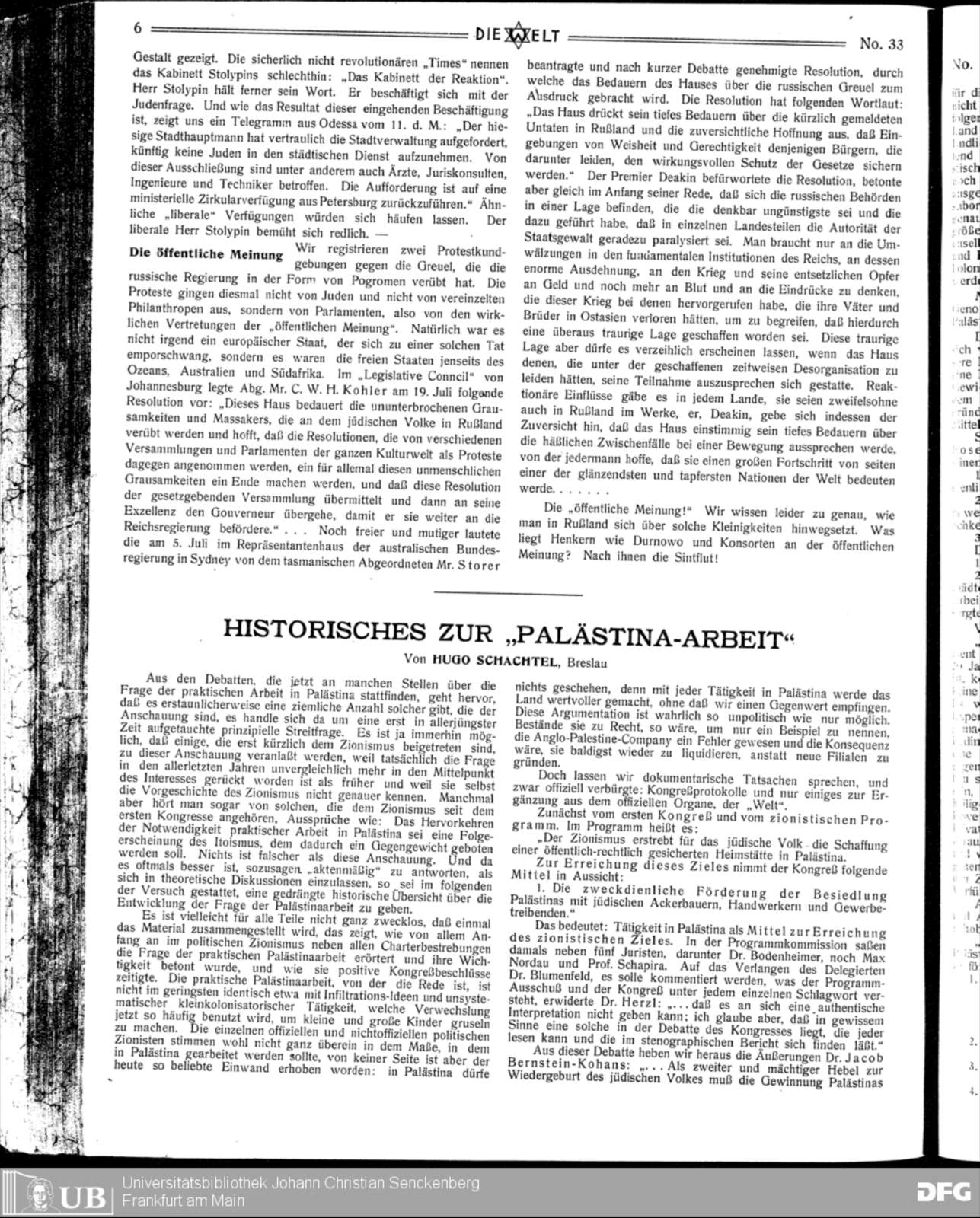
Page 6. — "Die Welt" — No. 33.
(continued from page 5)
…shape shown himself. The "Times," which is certainly not revolutionary, calls Stolypin's cabinet simply "The Cabinet of Reaction." Herr Stolypin, moreover, keeps his word. He is occupying himself with the Jewish question. And what the result of this thorough occupation is, a telegram from Odessa of the 11th inst. shows us: "The Prefect here has confidentially requested the municipal administration henceforth to admit no Jews into the municipal service. This exclusion affects, among others, physicians, legal advisers, engineers and technicians as well. The request is to be traced to a ministerial circular order from St. Petersburg." Similar "liberal" orders could be multiplied. The liberal Herr Stolypin is doing his honest best. —
Public Opinion
We record two demonstrations of protest against the atrocities which the Russian Government has committed in the form of pogroms. This time the protests did not proceed from Jews nor from isolated philanthropists, but from Parliaments, that is, from the true representatives of "public opinion." Naturally it was not any European State that rose to such a deed, but the free States beyond the ocean, Australia and South Africa. In the "Legislative Conncil" of Johannesburg, the member Mr. C. W. H. Kohler on 19 July laid the following resolution before the House: "This House deplores the unceasing cruelties and massacres perpetrated upon the Jewish people in Russia, and hopes that the resolutions adopted as protests against them by various assemblies and parliaments throughout the civilised world will put an end once and for all to these inhuman cruelties, and that this resolution be transmitted to the Legislative Assembly and then passed on to His Excellency the Governor, in order that he may forward it to the Imperial Government." . . . Still freer and bolder was the wording of the resolution moved on 5 July in the House of Representatives of the Australian Federal Government in Sydney by the Tasmanian member Mr. Storer and adopted after a short debate, by which the regret of the House at the Russian atrocities is given expression. The resolution reads as follows: "The House expresses its deep regret at the outrages lately reported in Russia, and its confident hope that counsels of wisdom and justice will secure to those citizens who suffer under them the effective protection of the laws." The Premier, Deakin, supported the resolution, but emphasised at the very beginning of his speech that the Russian authorities found themselves in a situation that was the most unfavourable conceivable, and that had led to the authority of the State power being positively paralysed in certain parts of the country. One need only think of the upheavals in the fundamental institutions of the Empire, of its enormous extent, of the war and its terrible sacrifices of money and still more of blood, and of the impressions which this war had produced among those who had lost their fathers and brothers in Eastern Asia, to understand that an exceedingly sad situation had been created thereby. This sad situation, however, might make it appear pardonable if the House permitted itself to express its sympathy with those who had to suffer under the temporary disorganisation that had been brought about. Reactionary influences existed in every country, and they were no doubt at work in Russia too; he, Deakin, nevertheless cherished the confident hope that the House would unanimously express its deep regret at the ugly incidents attending a movement which everyone hoped would signify a great advance on the part of one of the most brilliant and bravest nations of the world. . . . . .
"Public opinion"! We know only too well, alas, how in Russia such trifles are disregarded. What do hangmen like Durnowo and his confederates care for public opinion? After them, the deluge!
HISTORICAL NOTES ON "PALESTINE WORK"
By Hugo Schachtel, Breslau
From the debates now taking place in a number of quarters on the question of practical work in Palestine, it appears that, astonishingly, there is a considerable number of people who are of the opinion that this is a question of principle which has arisen only quite recently. It is, of course, possible that some who have joined Zionism only lately are led to this opinion because the question has in fact, in the very last few years, been moved incomparably more into the centre of interest than formerly, and because they themselves do not know the earlier history of Zionism very closely. Sometimes, however, one hears even from those who have belonged to Zionism since the First Congress such remarks as: the stressing of the necessity of practical work in Palestine is a consequence of Itoism, to which a counterweight is thereby to be offered. Nothing is more mistaken than this opinion. And since it is often better to answer, so to speak, "from the records" than to enter into theoretical discussions, the attempt may be permitted in what follows to give a concise historical survey of the development of the question of Palestine work.
It is perhaps not altogether useless for all parties that the material should for once be brought together which shows how, from the very beginning, in political Zionism, side by side with all the efforts towards a charter, the question of practical Palestine work was discussed and its importance emphasised, and how it brought forth positive resolutions of the Congress. The practical Palestine work in question is not in the least identical with, say, ideas of infiltration and unsystematic petty colonising activity, a confusion now so frequently employed to make children small and large shudder. The individual official and unofficial political Zionists are probably not quite agreed as to the degree to which work should be done in Palestine, but from no side has the objection so popular to-day been raised: that nothing may be done in Palestine, because with every activity in Palestine the country is made more valuable without our receiving an equivalent. This argument is truly as unpolitical as it could possibly be. Were it valid, then, to name but one example, the Anglo-Palestine Company would have been a mistake, and the consequence would be to liquidate it again as soon as possible, instead of founding new branches.
But let us allow documentary facts to speak, and officially attested ones at that: the Protocols of the Congresses, and only a few things by way of supplement from the official organ, the "Welt."
First, from the First Congress and from the Zionist Programme. The Programme says:
"Zionism aims at the creation for the Jewish people of a home in Palestine secured by public law.
For the attainment of this aim the Congress contemplates the following means:
- The appropriate promotion of the settlement of Palestine with Jewish agriculturists, artisans and tradesmen."
That means: activity in Palestine as a means to the attainment of the Zionist aim. In the Programme Commission there sat at that time, besides five jurists, among them Dr. Bodenheimer, also Max Nordau and Prof. Schapira. To the request of the delegate Dr. Blumenfeld that a commentary should be given on what the Programme Committee and the Congress understood by each individual watchword, Dr. Herzl replied: "... that in itself there can be no authentic interpretation; but I believe that in a certain sense such an interpretation lies in the debate of the Congress, which anyone can read and which is to be found in the stenographic report."
From this debate we single out the utterances of Dr. Jacob Bernstein-Kohan: "... As a second and mighty lever for the rebirth of the Jewish people, the winning of Palestine must