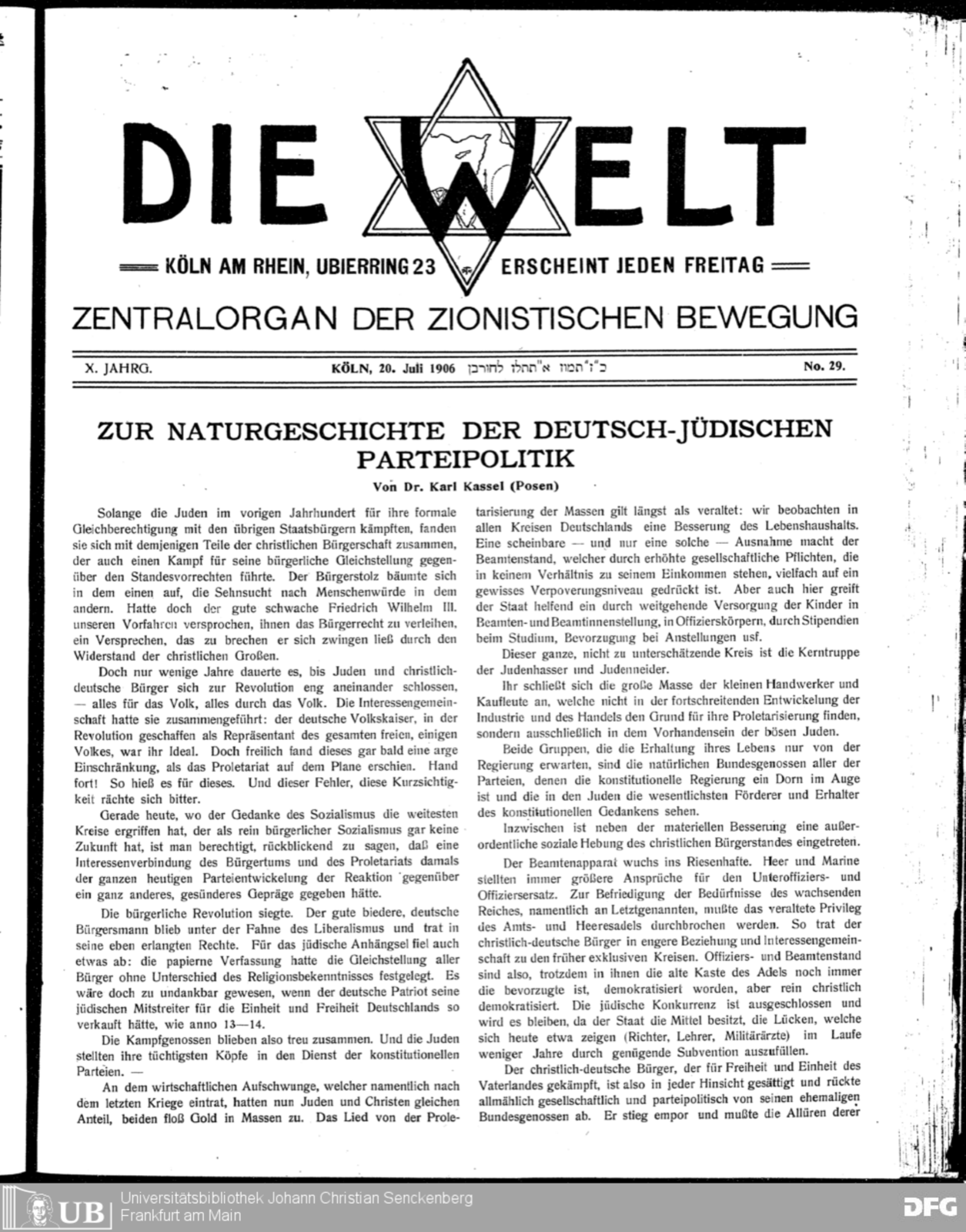
DIE WELT
COLOGNE-ON-RHINE, UBIERRING 23 — PUBLISHED EVERY FRIDAY
CENTRAL ORGAN OF THE ZIONIST MOVEMENT
VOL. X. COLOGNE, 20 July 1906 כ"ז תמוז א"תתלז לחורבן No. 29.
ON THE NATURAL HISTORY OF GERMAN-JEWISH PARTY POLITICS
By Dr. Karl Kassel (Posen)
So long as the Jews of the last century were fighting for their formal equality of rights with the rest of the citizens of the State, they found themselves allied with that part of the Christian citizenry which was likewise waging a struggle for its civic equality against the privileges of rank. In the one it was civic pride that rose up, in the other the longing for human dignity. Had not the good, weak Frederick William III promised our forefathers to grant them the rights of citizenship, a promise which he allowed himself to be compelled to break by the resistance of the Christian magnates?
Yet only a few years passed before Jews and Christian-German burghers joined closely together in the Revolution, — all for the people, all through the people. Community of interest had brought them together: the German People's Emperor, created in the Revolution as the representative of the whole free and united people, was their ideal. But this ideal, to be sure, very soon met with a grievous restriction when the proletariat appeared upon the scene. Hands off! — such was the word for it. And this error, this short-sightedness, avenged itself bitterly.
Precisely to-day, when the idea of Socialism has taken hold of the widest circles, — an idea which, as a purely bourgeois Socialism, has no future at all, — one is entitled to say in retrospect that an alliance of interest between the bourgeoisie and the proletariat would at that time have given the whole of the present party development a quite different and sounder character in its stand against reaction.
The bourgeois revolution triumphed. The good, honest German burgher remained under the banner of Liberalism and entered upon his newly won rights. Something fell to the Jewish appendage as well: the paper constitution had laid down the equality of all citizens without distinction of religious confession. It would, after all, have been too ungrateful had the German patriot sold his Jewish comrades-in-arms in the struggle for the unity and freedom of Germany as he did anno 13—14.
The comrades in the struggle, then, remained faithfully together. And the Jews placed their ablest minds at the service of the constitutional parties. —
In the economic upswing which set in especially after the last war, Jews and Christians now had an equal share; gold flowed in to both in masses. The song of the proletarianization of the masses has long been regarded as out of date: in all circles of Germany we observe an improvement in the household of life. An apparent exception — and only an apparent one — is formed by the official class, which, through heightened social obligations bearing no proportion to its income, is in many cases depressed to a certain level of impoverishment. But here too the State steps in to help, by extensive provision for the children in posts as officials, men and women, in the officers' corps, by scholarships during their studies, preference in appointments, and so forth.
This whole circle, which is not to be underestimated, is the core troop of the Jew-haters and Jew-enviers.
To it attaches itself the great mass of the small artisans and tradesmen, who find the cause of their proletarianization not in the progressive development of industry and commerce, but exclusively in the existence of the wicked Jews.
Both groups, who look to the Government alone for the maintenance of their livelihood, are the natural allies of all those parties to whom constitutional government is a thorn in the flesh and who see in the Jews the chief promoters and upholders of the constitutional idea.
Meanwhile, alongside the material improvement, there has come about an extraordinary social elevation of the Christian middle class.
The machinery of officialdom grew to gigantic proportions. Army and Navy made ever greater demands for the supply of non-commissioned officers and officers. To satisfy the needs of the growing Empire, above all in the last-named, the antiquated privilege of the official and military nobility had to be broken through. Thus the Christian-German burgher entered into closer relations and community of interest with the formerly exclusive circles. The officers' and the officials' estates, then, although the old caste of the nobility is still the favoured one within them, have been democratized, but democratized in a purely Christian sense. Jewish competition is excluded and will remain so, since the State possesses the means of filling, within the space of a few years and by adequate subvention, such gaps as may perhaps appear to-day (judges, teachers, army surgeons).
The Christian-German burgher, who fought for the freedom and unity of the Fatherland, is thus sated in every respect, and has gradually drawn away, socially and in party politics, from his former allies. He rose upward, and perforce the airs of those