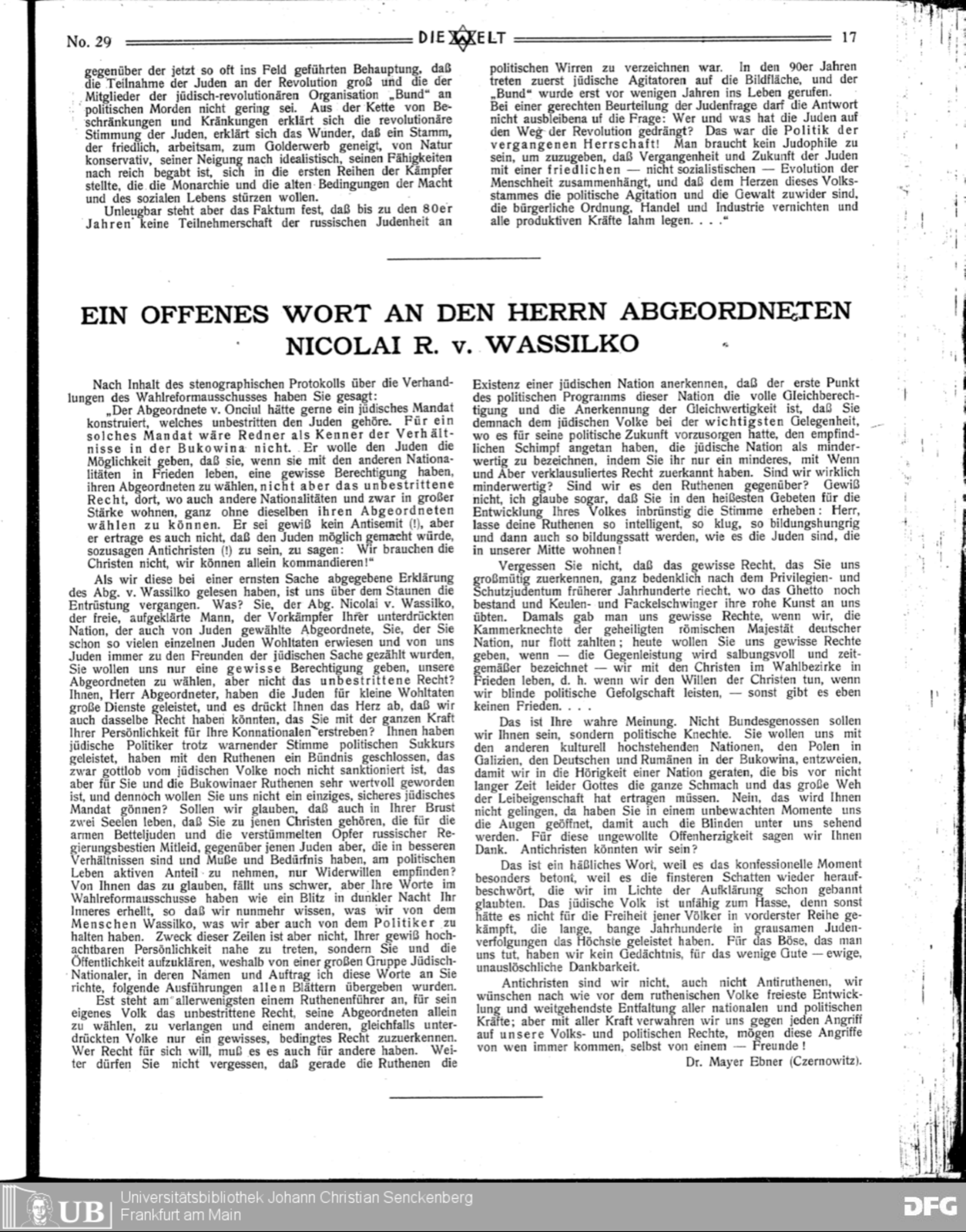
No. 29. — "Die Welt" — Page 17.
(continued from page 16)
…in face of the assertion, now so often brought into the field, that the participation of the Jews in the revolution is great, and that of the members of the Jewish revolutionary organisation, the "Bund," in political murders not small. From the chain of restrictions and humiliations is explained the revolutionary temper of the Jews; from it is explained the marvel that a stock which is peaceable, industrious, inclined to the acquisition of gold, conservative by nature, idealistic in its leanings and richly gifted in its abilities, has placed itself in the front ranks of the fighters who seek to overthrow the monarchy and the old conditions of power and of social life.
Undeniably, however, the fact stands firm that until the 'eighties no participation of Russian Jewry in political disturbances is to be recorded. In the 'nineties Jewish agitators first appear upon the scene, and the "Bund" was called into being only a few years ago. In any just judgment of the Jewish question the answer must not be wanting to the question: Who and what drove the Jews upon the path of revolution? It was the policy of the past régime! One need be no Judophile to admit that the past and the future of the Jews are bound up with a peaceful — not a socialist — evolution of mankind, and that political agitation and violence, which destroy civil order, trade and industry and paralyse all productive forces, are repugnant to the heart of this stock. . . ."
AN OPEN WORD TO THE HONOURABLE DEPUTY NICOLAI R. v. WASSILKO
According to the shorthand record of the proceedings of the Electoral Reform Committee, you said:
"Deputy v. Onciul would have liked to construct a Jewish seat which should belong to the Jews beyond dispute. The speaker, as one acquainted with conditions in Bukovina, was not in favour of such a seat. He wished to give the Jews the possibility, provided they lived in peace with the other nationalities, of having a certain title to elect their deputy, but not the undisputed right, where other nationalities also dwell, and in great strength, to be able to elect their deputy entirely without them. He was certainly no anti-Semite (!), but neither could he bear that the Jews should be enabled to be, so to speak, anti-Christians (!), to say: We do not need the Christians, we can command alone!"
When we read this declaration of Deputy v. Wassilko, made on so serious a matter, our indignation gave way to astonishment. What? You, Deputy Nicolai v. Wassilko, the free, enlightened man, the champion of your oppressed nation, the deputy elected by Jews as well, you, who have already shown kindnesses to so many individual Jews and were always counted by us Jews among the friends of the Jewish cause, you would give us only a certain title to elect our deputies, but not the undisputed right? To you, Honourable Deputy, the Jews have rendered great services for small kindnesses, and it wrings your heart that we too might have the same right that you strive for with the whole force of your personality on behalf of your fellow-nationals? To you Jewish politicians, despite warning voices, have given political succour; they have concluded with the Ruthenians an alliance which, God be thanked, has not yet been sanctioned by the Jewish people, but which has become very valuable to you and to the Bukovinian Ruthenians — and yet you will not grant us a single, secure Jewish seat? Are we to believe that in your breast, too, two souls dwell, that you belong to those Christians who feel pity for the poor beggar-Jews and for the mutilated victims of Russian Government brutes, but only aversion towards those Jews who are in better circumstances and have the leisure and the need to take an active part in political life? It is hard for us to believe this of you; but your words in the Electoral Reform Committee have lit up your inner self like a flash of lightning in the dark night, so that we now know what we are to think of Wassilko the man, and also what of Wassilko the politician. The purpose of these lines, however, is not to give offence to your assuredly most estimable person, but to make clear to you and to the public why the following observations have been handed to all the papers by a large group of Jewish Nationalists, in whose name and by whose commission I address these words to you.
It least of all becomes a leader of the Ruthenians to demand for his own people the undisputed right to elect its deputies alone, and to concede to another people, likewise oppressed, only a certain, conditional right. He who would have right for himself must also have it for others. Further, you must not forget that it is precisely the Ruthenians who recognise the existence of a Jewish nation; that the first point of the political programme of this nation is full equality of rights and the recognition of equal worth; that you have accordingly, on the most important occasion on which it had to provide for its political future, offered the Jewish people the grievous insult of designating the Jewish nation as inferior, in conceding to it only a lesser right, hedged about with ifs and buts. Are we really inferior? Are we so in comparison with the Ruthenians? Assuredly not; I believe, indeed, that in your most fervent prayers for the development of your people you raise your voice ardently: Lord, let Thy Ruthenians become as intelligent, as clever, as hungry for culture, and then as filled with culture, as are the Jews who dwell in our midst!
Do not forget that the certain right which you magnanimously concede to us smells very ominously of the privileged and protected Jewry of earlier centuries, when the ghetto still stood and wielders of cudgels and torches practised their brutal art upon us. In those days certain rights were given us if we, the chamber-serfs of the Holy Roman Majesty of the German Nation, only paid up promptly; to-day you would give us certain rights if — the consideration in return is named unctuously and more in keeping with the times — we live in peace with the Christians in the electoral district, that is, if we do the will of the Christians, if we render blind political allegiance, — otherwise, you see, there is no peace. . . .
That is your true opinion. Not allies are we to be to you, but political vassals. You wish to set us at variance with the other nations of high culture, the Poles in Galicia, the Germans and Roumanians in Bukovina, so that we may fall into bondage to a nation which until not long ago, God knows, had to bear the whole disgrace and the great woe of serfdom. No, in this you will not succeed; in an unguarded moment you have opened our eyes, so that the blind among us, too, may see. For this unintended frankness we thank you. We could be anti-Christians?
That is an ugly word, because it lays particular stress upon the confessional element, because it conjures up again the dark shadows which we believed already banished in the light of enlightenment. The Jewish people is incapable of hatred, for otherwise it would not have fought in the foremost ranks for the freedom of those peoples who through long, anxious centuries achieved the utmost in cruel persecutions of the Jews. For the evil that is done us we have no memory; for the little good — eternal, inextinguishable gratitude.
Anti-Christians we are not, nor anti-Ruthenians; we wish the Ruthenian people, now as before, the freest development and the fullest unfolding of all its national and political forces; but with all our strength we protest against every attack upon our national and political rights, from whomsoever such attacks may come, even from a — friend!
Dr. Mayer Ebner (Czernowitz).