Page 6. — "Die Welt" — No. 28.
LETTERS FROM CZERNOWITZ
A Theodor Herzl Street in Czernowitz
One must have looked more closely at the Buchenland and its provincial capital on the Pruth in order to form a correct judgment of the land and its people. The passing visitor does not always receive the right impression. When a feuilletonist in the "N. Fr. Presse," who began his wanderings through the Bukovina from the gipsy realm of Wallachia, and, admiring the curious juxtaposition of the cathedral, the splendid building of the archiepiscopal residence, and the castle of the wonder-rabbi of Sadagora, in his fancy even saw the Don Cossacks trotting along the frontier from the tower of the town hall, this is
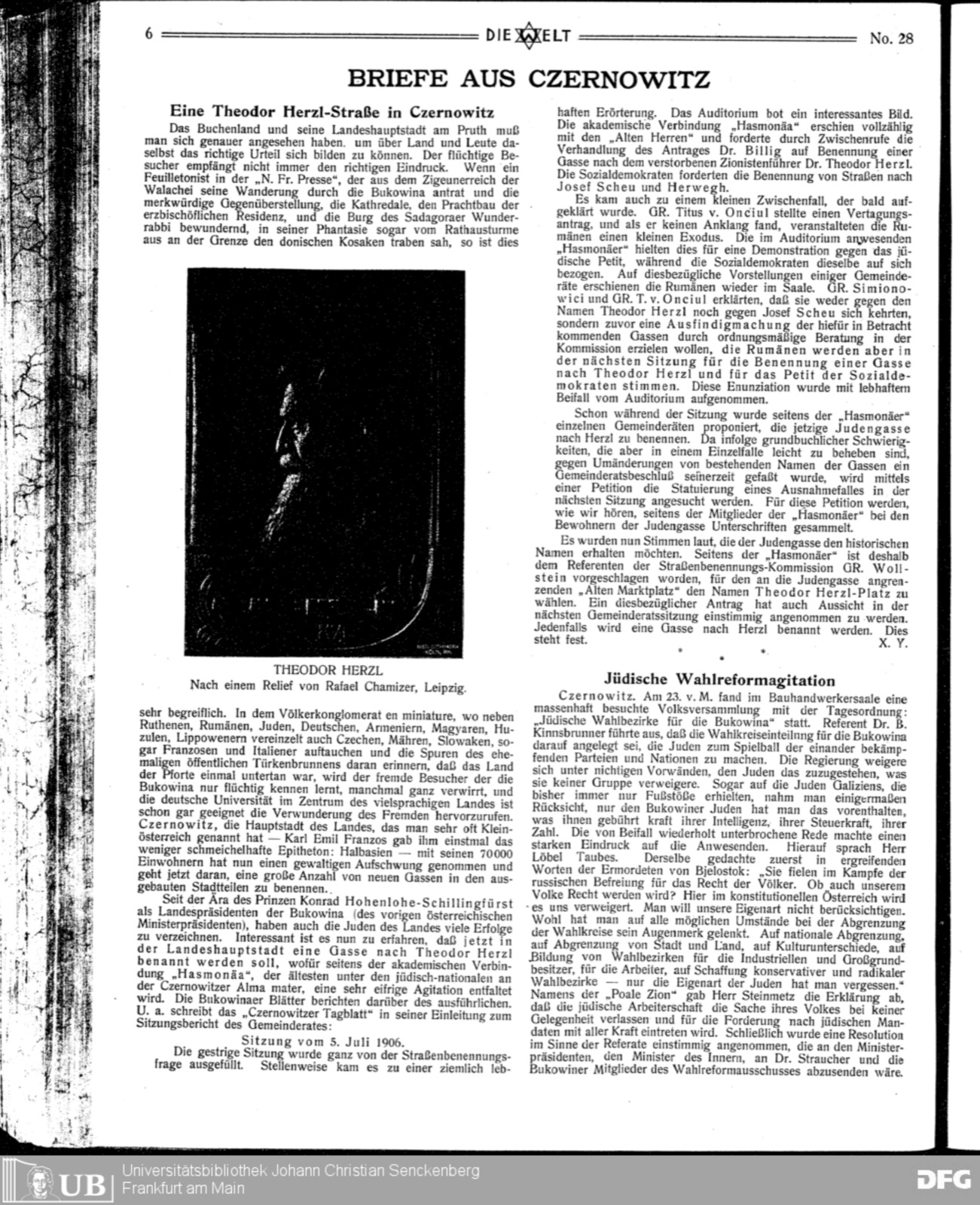
THEODOR HERZL After a relief by Rafael Chamizer, Leipzig.
very comprehensible. In this conglomerate of peoples en miniature, where beside Ruthenians, Roumanians, Jews, Germans, Armenians, Magyars, Huzuls and Lipovans there appear here and there Czechs, Moravians, Slovaks, even Frenchmen and Italians, and where the traces of the former public Turkish fountain recall that the land was once subject to the Porte, the stranger who comes to know the Bukovina only fleetingly is sometimes quite bewildered, and the German university in the centre of this land of many tongues is fit indeed to arouse the stranger's astonishment. Czernowitz, the capital of the land that has very often been called Little Austria — Karl Emil Franzos once gave it the less flattering epithet: Half-Asia — has now, with its 70000 inhabitants, taken a mighty upswing, and is now setting about naming a great number of new streets in the built-up quarters of the town.
Since the era of Prince Konrad Hohenlohe-Schillingfürst as President of the Province of the Bukovina (the previous Austrian Prime Minister), the Jews of the land too have had many successes to record. It is now interesting to learn that a street in the provincial capital is now to be named after Theodor Herzl, for which a very zealous agitation is being carried on by the academic fraternity "Hasmonäa," the oldest of the Jewish-national fraternities at the Czernowitz alma mater. The Bukovina papers report on it at length. Among other things the "Czernowitzer Tagblatt" writes in its introduction to the report of the sitting of the Municipal Council:
Sitting of 5 July 1906. Yesterday's sitting was entirely taken up with the question of naming the streets. At times it came to a rather lively discussion.
The auditorium presented an interesting picture. The academic fraternity "Hasmonäa" appeared in full strength with its "Old Boys," and by interjections demanded the hearing of Dr. Billig's motion to name a street after the late Zionist leader Dr. Theodor Herzl. The Social Democrats demanded that streets be named after Josef Scheu and Herwegh.
There was also a small incident, which was soon cleared up. Councillor Titus v. Onciul moved an adjournment, and when it found no support, the Roumanians staged a little exodus. The "Hasmonaeans" present in the auditorium took this for a demonstration against the Jewish petition, while the Social Democrats referred it to themselves. Upon representations to that effect by some councillors, the Roumanians reappeared in the chamber. Councillor Simionowici and Councillor T. v. Onciul declared that they were opposed neither to the name of Theodor Herzl nor to that of Josef Scheu, but wished first to have the streets coming into consideration for the purpose ascertained by regular deliberation in the commission; the Roumanians, however, will vote at the next sitting for the naming of a street after Theodor Herzl and for the petition of the Social Democrats. This declaration was received by the auditorium with lively applause.
Even during the sitting it was proposed to individual councillors by the "Hasmonaeans" that the present Judengasse be named after Herzl. Since, on account of difficulties with the land register — which, however, are easily removed in a single case — a resolution of the Council was passed some time ago against altering the existing names of streets, the establishment of an exceptional case will be applied for by petition at the next sitting. For this petition, as we hear, signatures are being collected by members of the "Hasmonaeans" among the inhabitants of the Judengasse.
Voices have now been raised that would preserve its historic name for the Judengasse. The "Hasmonaeans" have therefore proposed to Councillor Wollstein, reporter of the Street-Naming Commission, that the name Theodor Herzl-Platz be chosen for the "Old Market Place" adjoining the Judengasse. A motion to this effect has every prospect, too, of being carried unanimously at the next sitting of the Municipal Council. In any case a street will be named after Herzl. That is certain. X. Y.
Jewish Agitation for Electoral Reform
Czernowitz. On the 23rd ult. a popular meeting, attended in great numbers, was held in the Building Tradesmen's Hall with the order of the day: "Jewish Electoral Districts for the Bukovina." The speaker, Dr. B. Kinnsbrunner, set forth that the division of the Bukovina into electoral districts was designed to make the Jews the plaything of the parties and nations fighting one another. The Government refused, on idle pretexts, to concede to the Jews what it refused to no other group. Even the Jews of Galicia, who had hitherto always received nothing but kicks, had been given some consideration; only the Bukovinian Jews had been denied what is their due by virtue of their intelligence, their taxable strength and their numbers. The speech, repeatedly interrupted by applause, made a strong impression upon those present. Herr Löbel Taubes spoke next. He first remembered, in moving words, the murdered of Bjelostok: "They fell in the struggle for Russian liberation, for the rights of the peoples. Will justice be done to our people too? Here in constitutional Austria it is refused us. They will not take our particular character into account. They have, indeed, turned their attention to every possible circumstance in delimiting the electoral districts: to national delimitation, to the delimitation of town and country, to differences of culture, to the formation of electoral districts for the industrialists and the great landowners, for the workers, to the creation of conservative and radical electoral districts — only the particular character of the Jews has been forgotten." In the name of the "Poale Zion," Herr Steinmetz made the declaration that the Jewish working class would on no occasion desert the cause of its people, and would stand up with all its strength for the demand for Jewish mandates. Finally a resolution in the sense of the addresses was carried unanimously, which was to be sent to the Prime Minister, the Minister of the Interior, Dr. Straucher and the Bukovina members of the Electoral Reform Committee.