No. 12 — "Die Welt" — 17
(continued from page 16)
...would conceal stolen goods from the eyes of the youth, him about whom mysteries were whispered.
But he looked into their hearts and pierced into their souls as into the breaches of a besieged city, and found there all their hidden wounds, and quivered with the quiverings of their hearts and suffered sevenfold under their torments.
And at times his eye met a calm and secure heart, — and his eye pierced that heart through and wounded it mortally, and peace fled from it for all time, and the once careless man knew rest by night no more.
And many came and bowed their heads in silence beneath his curse and his blessing, and a very sea of grace welled up in the heart of the youth, and his consolations flowed like morning dew upon aching hearts, and he looked upon them in love with his eyes — the eyes of the morning.
For the youth bore in his heart the rays of the sun also in all their might, and the darkness of the night and its mystery; but his eyes thirsted for the morning alone; the gleam of the lamp of the morning was the seal of his soul, and the shimmer of the dawn the song of a life.
* * *
And when his heart was afraid, when his great dreams and faithful sorrows visited him and streamed over him like the billows of the sea, then the youth went out at the dawn of morning to the city and leaned against a solitary willow on the bank of the slumbering river, and he lifted up his eyes to the hind of the morning and sought her image in the water of the river, and closed his eyes, looked also into the abyss of his soul, and stood long, long, and was silent with all the world in his mighty pain, the pain of the singular one.
And the young angel with the sorrowful eyes and pure pinions, there above upon the star of morning, soundlessly tilted the cup of mute grief, — and from thence there fell one tear after another down into the stillness of the morning.
NOTES
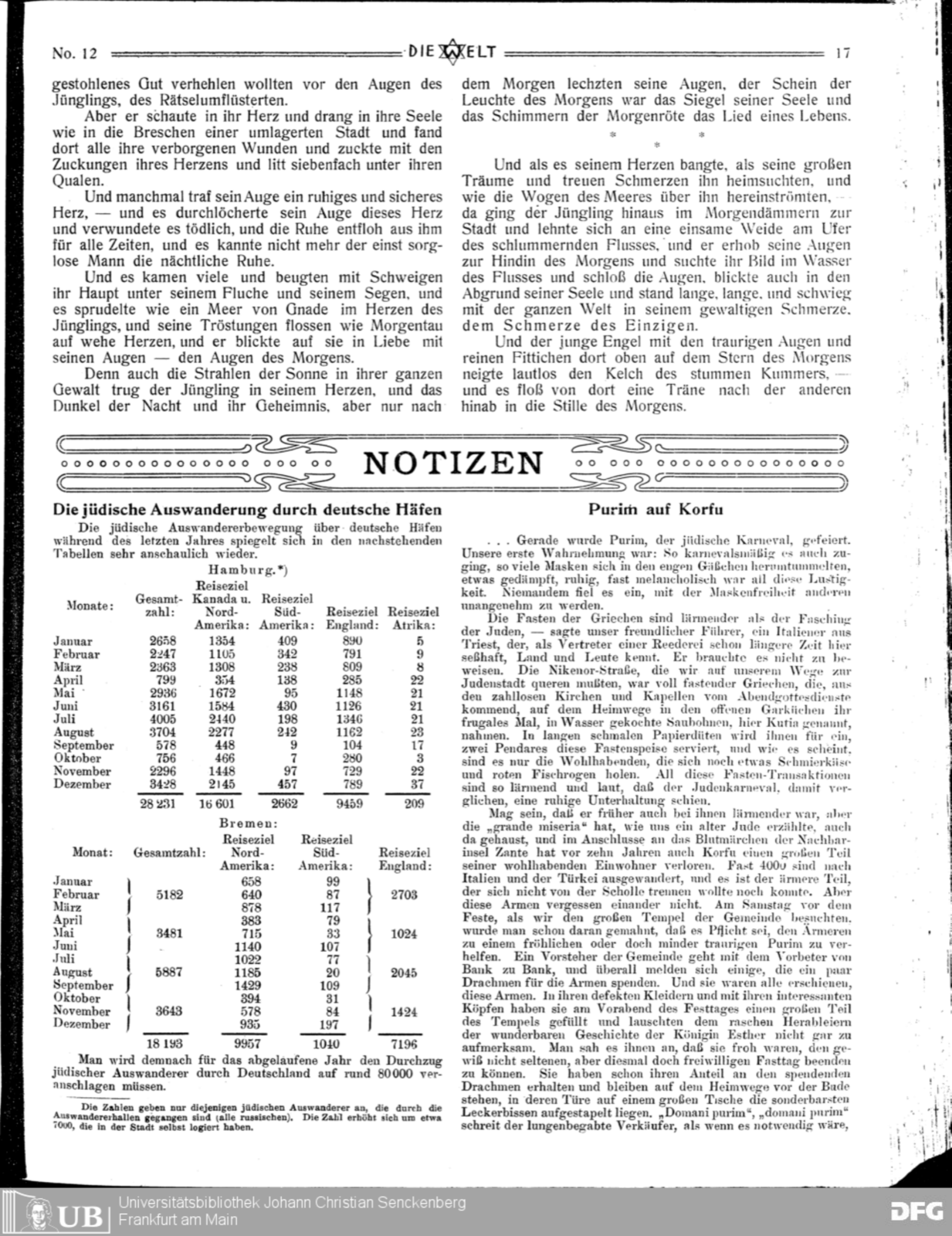
Jewish Emigration through German Ports
The movement of Jewish emigrants through German ports during the past year is very clearly reflected in the following tables.
Hamburg.*)
| Months: | Total: | Destination Canada and North America: | Destination South America: | Destination England: | Destination Africa: |
|---|---|---|---|---|---|
| January | 2658 | 1354 | 409 | 890 | 5 |
| February | 2247 | 1105 | 342 | 791 | 9 |
| March | 2363 | 1308 | 238 | 809 | 8 |
| April | 799 | 354 | 138 | 285 | 22 |
| May | 2936 | 1672 | 95 | 1148 | 21 |
| June | 3161 | 1584 | 430 | 1126 | 21 |
| July | 4005 | 2440 | 198 | 1346 | 21 |
| August | 3704 | 2277 | 242 | 1162 | 23 |
| September | 578 | 448 | 9 | 104 | 17 |
| October | 756 | 466 | 7 | 280 | 3 |
| November | 2296 | 1448 | 97 | 729 | 22 |
| December | 3428 | 2145 | 457 | 789 | 37 |
| 28 231 | 16 601 | 2662 | 9459 | 209 |
Bremen:
| Month: | Total: | Destination North America: | Destination South America: | Destination England: |
|---|---|---|---|---|
| January | 658 | 99 | ||
| February | 5182 | 640 | 87 | 2703 |
| March | 878 | 117 | ||
| April | 383 | 79 | ||
| May | 3481 | 715 | 33 | 1024 |
| June | 1140 | 107 | ||
| July | 1022 | 77 | ||
| August | 5887 | 1185 | 20 | 2045 |
| September | 1429 | 109 | ||
| October | 394 | 31 | ||
| November | 3643 | 578 | 84 | 1424 |
| December | 935 | 197 | ||
| 18 193 | 9957 | 1040 | 7196 |
For the year just ended, therefore, the passage of Jewish emigrants through Germany must be estimated at roughly 80 000.
*) The figures include only those Jewish emigrants who passed through the emigrants' halls (all of them Russian). The number is increased by some 7000 who lodged in the city itself.
Purim in Corfu
. . . Purim, the Jewish carnival, was just being celebrated. Our first impression was this: carnival-like as the doings were, and many as the masks that romped about the narrow lanes, there was something subdued, quiet, almost melancholy about all this merriment. It occurred to no one to make himself disagreeable to others under the licence of the mask.
The Lent of the Greeks is noisier than the carnival of the Jews, — said our friendly guide, an Italian from Trieste, who, having long been settled here as the agent of a shipping company, knows the land and its people. He had no need to prove it. The Nikenor Street, which we had to cross on our way to the Jews' quarter, was full of fasting Greeks who, coming from evening service in the countless churches and chapels, were taking their frugal meal on the way home in the open cook-shops: broad beans boiled in water, here called Kutia. This Lenten fare is served to them in long narrow paper bags for one or two Pendares, and, as it seems, it is only the well-to-do who fetch themselves a little soft cheese and red fish-roe besides. All these Lenten transactions are so noisy and loud that the Jews' carnival, compared with them, seemed a quiet entertainment.
It may be that it was noisier among them too in former days; but the "grande miseria", as an old Jew told us, has wrought its havoc here as well, and in the wake of the blood-libel on the neighbouring island of Zante, Corfu too lost a great part of its well-to-do inhabitants ten years ago. Almost 4000 emigrated to Italy and Turkey, and it is the poorer part that neither would nor could part from the soil. But these poor do not forget one another. On the Saturday before the festival, when we visited the great synagogue of the community, the congregation was already being reminded that it was a duty to help the poorer to a joyful, or at least a less sorrowful, Purim. A warden of the community goes with the reader from bench to bench, and everywhere a few come forward who give a couple of drachmas for the poor. And they had all come, these poor. In their tattered clothes and with their interesting heads they filled a great part of the synagogue on the eve of the festival, and listened not over-attentively to the rapid droning of the wondrous story of Queen Esther. One could see in their faces that they were glad to be able to end the fast-day — certainly no rare thing with them, but this time at least a voluntary one. They have already received their share of the donated drachmas, and on the way home they stop before the booth in whose doorway the strangest dainties lie heaped upon a great table. "Domani purim", "domani purim", shouts the strong-lunged vendor, as though it were necessary,