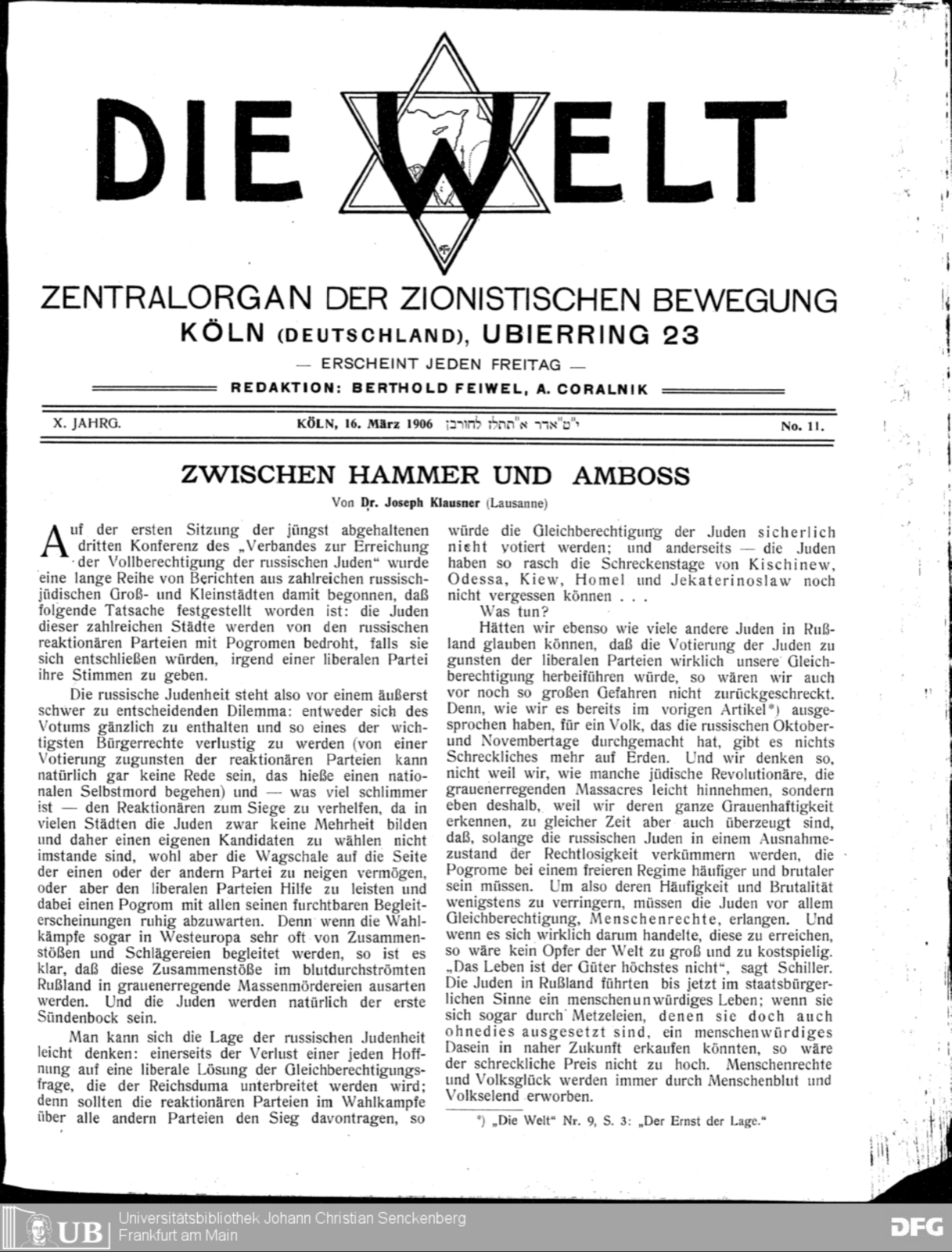
DIE WELT
CENTRAL ORGAN OF THE ZIONIST MOVEMENT
COLOGNE (GERMANY), UBIERRING 23
— PUBLISHED EVERY FRIDAY —
EDITORS: BERTHOLD FEIWEL, A. CORALNIK
Vol. X. | Cologne, 16 March 1906 | י"ט אדר א' התרס"ו לחרבן | No. 11.
BETWEEN HAMMER AND ANVIL
By Dr. Joseph Klausner (Lausanne)
At the first sitting of the recently held third conference of the "League for the Attainment of Full Rights for the Russian Jews", a long series of reports from numerous Russian-Jewish cities and small towns was opened by the establishment of the following fact: the Jews of these numerous towns are threatened by the Russian reactionary parties with pogroms, should they resolve to give their votes to any liberal party whatever.
Russian Jewry thus stands before a dilemma exceedingly hard to decide: either to abstain from voting altogether, and so to forfeit one of the most important rights of citizenship (of a vote in favour of the reactionary parties there can of course be no question at all; that would be to commit national suicide) and — what is far worse — to help the reactionaries to victory, since in many towns the Jews, though they form no majority and are therefore not in a position to elect a candidate of their own, are nevertheless able to tip the scale towards the one party or the other; or else to lend their aid to the liberal parties and meanwhile calmly await a pogrom with all its fearful accompaniments. For if even in Western Europe election contests are very often attended by collisions and brawls, it is clear that in blood-drenched Russia these collisions will degenerate into hideous mass slaughter. And the Jews will naturally be the first scapegoat.
One may readily picture the situation of Russian Jewry: on the one hand, the loss of every hope of a liberal solution of the question of equal rights, which will be laid before the Imperial Duma; for should the reactionary parties carry the day over all other parties in the election contest, the equal rights of the Jews would certainly not be voted; and on the other hand — the Jews have not been able so soon to forget the days of terror of Kishineff, Odessa, Kieff, Homel and Ekaterinoslav . . .
What is to be done?
Could we, like many other Jews in Russia, have believed that the voting of the Jews in favour of the liberal parties would really bring about our equality of rights, we should not have shrunk back even before the very greatest dangers. For, as we have already said in our previous article*), for a people that has lived through the Russian days of October and November there is nothing terrible left on earth. And we think thus, not because, like certain Jewish revolutionaries, we take the hideous massacres lightly, but precisely because we recognise their whole horror, and are at the same time convinced that, so long as the Russian Jews languish in an exceptional state of rightlessness, the pogroms under a freer régime must be more frequent and more brutal. In order, then, at least to diminish their frequency and brutality, the Jews must above all obtain equal rights, the rights of men. And if it were really a question of attaining these, no sacrifice in the world would be too great or too costly. "Life is not the highest of goods," says Schiller. The Jews in Russia have hitherto led, in the civic sense, a life unworthy of human beings; if they could purchase an existence worthy of human beings in the near future even by massacres, to which indeed they are exposed in any case, the terrible price would not be too high. The rights of men and the happiness of peoples are always won with human blood and the misery of peoples.
*) "Die Welt" No. 9, p. 3: "The Gravity of the Situation."