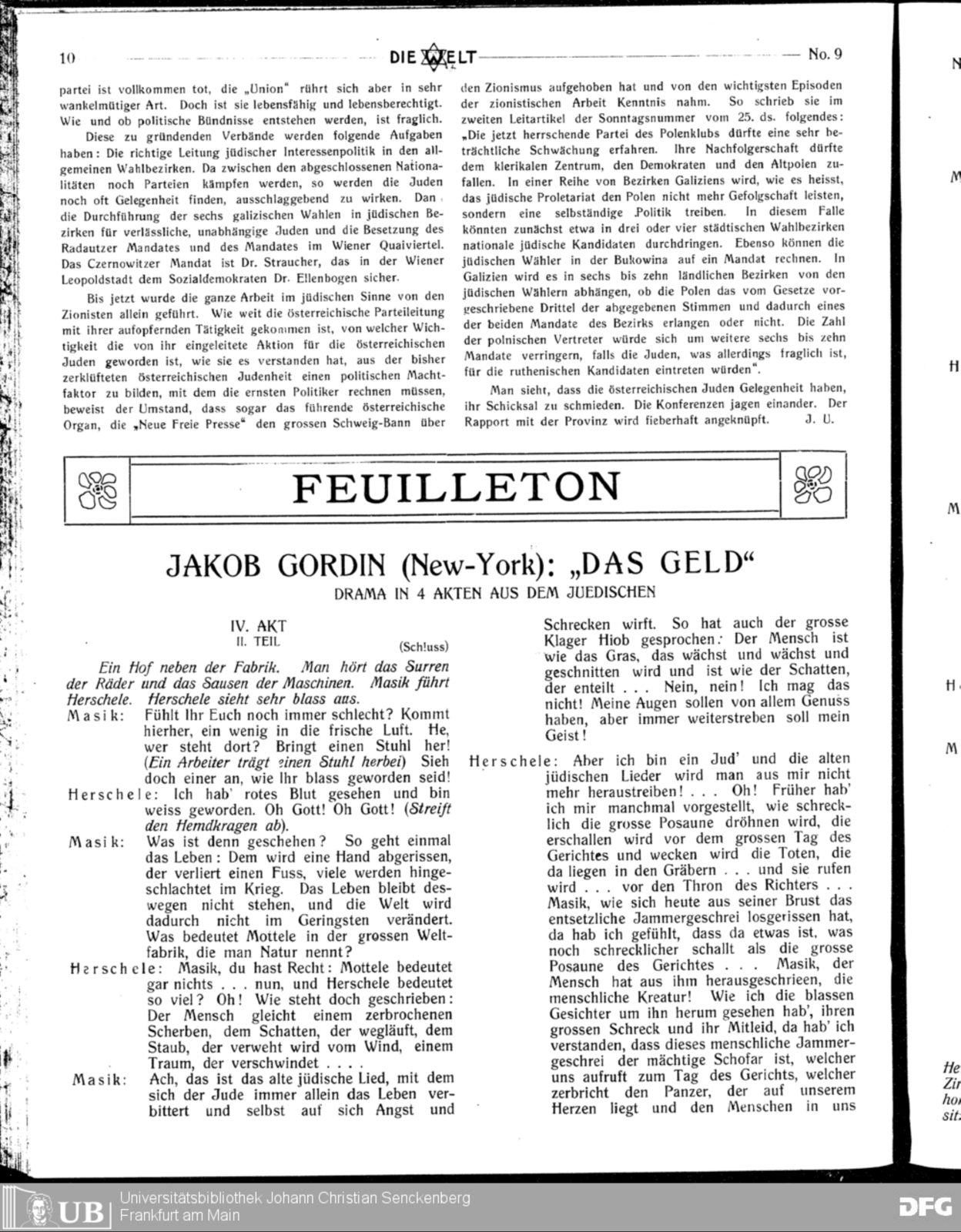
Page 10. — "Die Welt" — No. 9.
(continued from page 9)
…party is completely dead; the "Union," however, bestirs itself in a very vacillating fashion. Yet it is capable of life and entitled to life. How and whether political alliances will come into being is doubtful.
These associations, which are yet to be founded, will have the following tasks: The proper conduct of a policy of Jewish interests in the general constituencies. Since parties will still contend among the self-contained nationalities, the Jews will still often find opportunity to tip the scale. Then the carrying through of the six Galician elections in Jewish districts in favour of trustworthy, independent Jews, and the filling of the Radautz mandate and of the mandate in the Quai district of Vienna. The Czernowitz mandate is secure for Dr. Straucher, that in the Leopoldstadt of Vienna for the Social Democrat Dr. Ellenbogen.
Until now the whole of the work in the Jewish sense has been carried on by the Zionists alone. How far the Austrian party executive has come with its self-sacrificing activity, of what importance the campaign it set on foot has become for the Austrian Jews, how well it has understood how to form out of the hitherto fissured Austrian Jewry a political factor of power with which serious politicians must reckon, is proved by the circumstance that even the leading Austrian organ, the "Neue Freie Presse," has lifted the great ban of silence over Zionism and has taken notice of the most important episodes of Zionist work. Thus it wrote as follows in the second leading article of its Sunday number of the 25th inst.: "The party now dominant in the Polish Club is likely to suffer a very considerable weakening. Its succession is likely to fall to the Clerical Centre, the Democrats and the Old Poles. In a number of districts of Galicia, it is said, the Jewish proletariat will no longer follow the Poles, but will pursue an independent policy. In that case national Jewish candidates might at first succeed in perhaps three or four urban constituencies. Likewise the Jewish voters in the Bukovina can count upon one mandate. In Galicia it will depend upon the Jewish voters in six to ten rural districts whether or not the Poles obtain the third of the votes cast prescribed by law, and thereby one of the two mandates of the district. The number of Polish representatives would be reduced by a further six to ten mandates should the Jews — which is, to be sure, doubtful — come out for the Ruthenian candidates."
One sees that the Austrian Jews have the opportunity to forge their own destiny. Conferences chase one another. Contact with the provinces is being established feverishly. J. U.
FEUILLETON
JAKOB GORDIN (New York): "MONEY"
DRAMA IN 4 ACTS, FROM THE YIDDISH
ACT IV PART II (Conclusion)
A yard beside the factory. One hears the whirring of the wheels and the rushing of the machines. Masik is leading Herschele. Herschele looks very pale.
Masik: Do you still feel unwell? Come over here, into the fresh air a little. Hey, who is standing there? Bring a chair! (A workman carries a chair over) Just look at that, how pale you have turned!
Herschele: I have seen red blood and turned white. O God! O God! (Pulls off his shirt-collar).
Masik: Why, what has happened? That is the way of life: one has a hand torn off, another loses a foot, many are slaughtered in war. Life does not stand still on that account, and the world is not altered in the least by it. What does Mottele signify in the great world-factory that is called Nature?
Herschele: Masik, you are right: Mottele signifies nothing at all … well, and does Herschele signify so much? Oh! How is it written: Man is like a broken potsherd, like the shadow that flees, like the dust that is blown away by the wind, like a dream that vanishes …
Masik: Ah, that is the old Jewish song with which the Jew is for ever embittering his own life and casting fear and terror upon himself. So too spoke the great complainer Job: Man is like the grass that grows and grows and is cut down, and is like the shadow that hastens away … No, no! I will have none of it! My eyes shall have enjoyment of everything, but my spirit shall ever strive onward!
Herschele: But I am a Jew, and the old Jewish songs will not be driven out of me any more! … Oh! Once I used sometimes to imagine how terribly the great trumpet will thunder that shall sound before the great Day of Judgment, and shall wake the dead that lie in their graves … and shall summon them … before the throne of the Judge … Masik, when to-day that dreadful cry of anguish broke loose from his breast, I felt that there is something which sounds yet more terrible than the great trumpet of Judgment … Masik, it was Man that cried out of him, the human creature! When I saw the pale faces around him, their great terror and their pity, I understood that this human cry of anguish is the mighty shofar which summons us to the Day of Judgment, which breaks the armour that lies upon our heart and the man in us