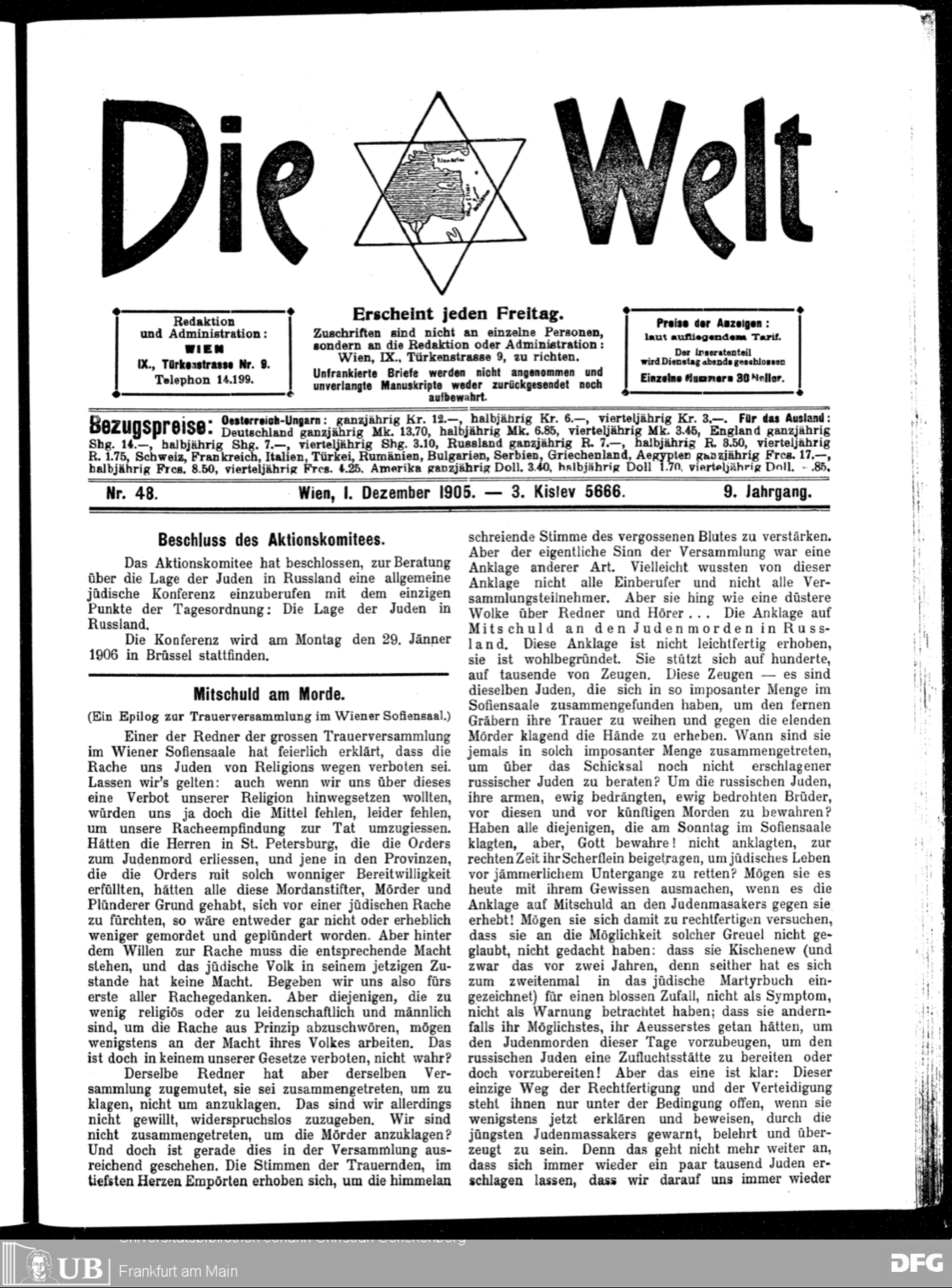
Die Welt
Editorial Office and Administration: VIENNA, IX., Türkenstrasse No. 9. Telephone 14.199.
Appears every Friday. Correspondence is to be addressed not to individual persons but to the Editorial Office or the Administration: Vienna, IX., Türkenstrasse 9. Unstamped letters are not accepted, and unsolicited manuscripts are neither returned nor kept.
Advertisement rates: according to the tariff available on request. The advertising section closes on Tuesday evening. Single numbers 20 Heller.
Subscription rates: Austria-Hungary: yearly Kr. 12.—, half-yearly Kr. 6.—, quarterly Kr. 3.—. Abroad: Germany yearly Mk. 13.70, half-yearly Mk. 6.85, quarterly Mk. 3.45; England yearly Shg. 14.—, half-yearly Shg. 7.—, quarterly Shg. 3.10; Russia yearly R. 7.—, half-yearly R. 3.50, quarterly R. 1.75; Switzerland, France, Italy, Turkey, Roumania, Bulgaria, Servia, Greece, Egypt yearly Frcs. 17.—, half-yearly Frcs. 8.50, quarterly Frcs. 4.25; America yearly Doll. 3.40, half-yearly Doll 1.70, quarterly Doll. —.85.
No. 48. Vienna, I. December 1905. — 3 Kislev 5666. 9th Year.
Resolution of the Actions Committee.
The Actions Committee has resolved to convene a general Jewish conference for deliberation on the situation of the Jews in Russia, with a single item on the agenda: The situation of the Jews in Russia.
The conference will take place on Monday, 29 January 1906, in Brussels.
Complicity in Murder.
(An Epilogue to the Mourning Assembly in the Vienna Sofiensaal.)
One of the speakers at the great mourning assembly in the Vienna Sofiensaal solemnly declared that vengeance is forbidden to us Jews by our religion. Let it pass: even if we wished to set ourselves above this one prohibition of our religion, we should still lack the means — lack them, alas — to cast our feeling of vengeance into deed. Had the gentlemen in St. Petersburg who issued the orders for the murder of Jews, and those in the provinces who carried out the orders with such delighted readiness — had all these instigators of murder, murderers and plunderers had reason to fear a Jewish vengeance, then there would have been either no murdering and plundering at all, or considerably less. But behind the will to vengeance there must stand the corresponding power, and the Jewish people in its present condition has no power. Let us, then, for the present renounce all thoughts of vengeance. But let those who are too little religious, or too passionate and manly, to forswear vengeance on principle at least work for the power of their people. That, surely, is forbidden in none of our laws, is it not?
The same speaker, however, expected the same assembly to accept that it had come together to lament, not to accuse. That, indeed, we are not willing to concede without contradiction. We did not come together to accuse the murderers? And yet that is precisely what was done, and amply, in the assembly. The voices of the mourners, outraged to the depths of their hearts, were raised to swell the voice of the shed blood that cries to heaven. But the real meaning of the assembly was an accusation of another kind. Perhaps not all the conveners and not all who took part in the assembly knew of this accusation. But it hung like a dark cloud over speakers and hearers ... The accusation of complicity in the murders of Jews in Russia. This accusation is not lightly raised; it is well founded. It rests upon hundreds, upon thousands of witnesses. These witnesses — they are the very Jews who gathered in so imposing a multitude in the Sofiensaal to dedicate their mourning to distant graves and to raise their hands in lament against the wretched murderers. When have they ever come together in such an imposing multitude to deliberate upon the fate of Russian Jews not yet slain? To preserve the Russian Jews, their poor, ever-oppressed, ever-threatened brethren, from these and from future murders? Did all those who lamented in the Sofiensaal on Sunday — but, God forbid! did not accuse — contribute their mite in good time to save Jewish lives from a miserable end? Let them settle it today with their conscience, if it raises against them the accusation of complicity in the massacres of the Jews! Let them try to justify themselves by saying that they did not believe in, did not think of, the possibility of such horrors: that they regarded Kischenew (and that is to say the Kischenew of two years ago, for since then it has inscribed itself a second time in the Jewish book of martyrs) as a mere accident, not as a symptom, not as a warning; that otherwise they would have done their utmost, their very uttermost, to forestall the murders of Jews of these days, to prepare a place of refuge for the Russian Jews, or at least to make preparation for one! But one thing is clear: this sole path of justification and defence lies open to them only on condition that they at least now declare and prove that they have been warned, taught and convinced by the latest massacres of the Jews. For it can go on no longer that again and again a few thousand Jews let themselves be slain, that thereupon we again and again