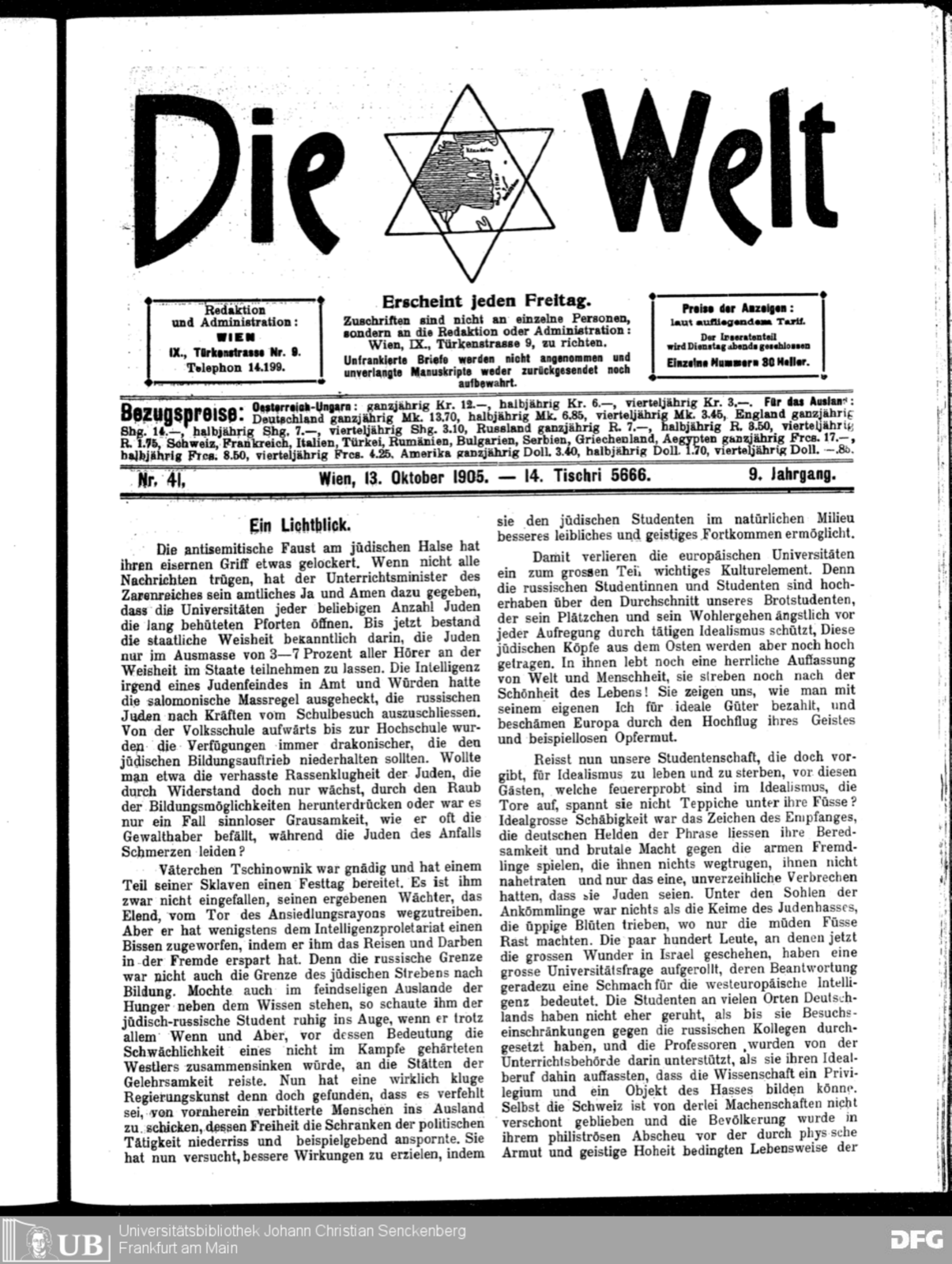
Die Welt
Published every Friday.
Editorial and business offices: VIENNA, IX., Türkenstrasse No. 9. Telephone 14.199.
Correspondence should be addressed not to individuals but to the Editorial Office or the Administration: Vienna, IX., Türkenstrasse 9. Unstamped letters will not be accepted, and unsolicited manuscripts are neither returned nor kept.
Advertising rates: according to the published tariff. The advertisement section closes on Tuesday evening. Single numbers 20 Heller.
Subscription rates: Austria-Hungary: yearly Kr. 12.—, half-yearly Kr. 6.—, quarterly Kr. 3.—. Abroad: Germany yearly Mk. 13.70, half-yearly Mk. 6.85, quarterly Mk. 3.45; England yearly Shg. 14.—, half-yearly Shg. 7.—, quarterly Shg. 3.10; Russia yearly R. 7.—, half-yearly R. 3.50, quarterly R. 1.75; Switzerland, France, Italy, Turkey, Roumania, Bulgaria, Servia, Greece, Egypt yearly Frcs. 17.—, half-yearly Frcs. 8.50, quarterly Frcs. 4.25; America yearly Doll. 3.40, half-yearly Doll. 1.70, quarterly Doll. —.85.
No. 41. Vienna, 13 October 1905. — 14 Tishri 5666. 9th Year.
A Ray of Light.
The antisemitic fist at the Jewish throat has somewhat loosened its iron grip. If all reports do not deceive, the Minister of Education of the Tsar's empire has given his official yea and amen to the universities opening their long-guarded gates to any number of Jews whatever. Until now, as is well known, the wisdom of the State consisted in allowing the Jews to share in the wisdom within the State only to the extent of 3—7 per cent of all students. The intelligence of some Jew-hater in office and dignity had hatched the Solomonic measure of excluding the Russian Jews from schooling as far as possible. From the elementary school up to the university, the decrees meant to hold down the Jewish striving after education grew ever more Draconian. Did they perhaps wish to crush, by robbing it of the means of education, the hated racial cleverness of the Jews, which resistance only makes grow? Or was it merely a case of that senseless cruelty which so often seizes those in power, while the Jews suffer the pangs of the seizure?
Little Father Tchinovnik has been gracious and has prepared a holiday for a part of his slaves. It has not, indeed, occurred to him to drive his devoted sentry, Misery, away from the gate of the Pale of Settlement. But he has at least thrown a morsel to the intellectual proletariat, by sparing it travel and privation in foreign lands. For the Russian frontier was not also the frontier of the Jewish striving after learning. Though in hostile foreign lands hunger might stand beside knowledge, the Russo-Jewish student looked it calmly in the eye when, in spite of every if and but — before whose weight the feebleness of a Westerner not hardened in struggle would collapse — he journeyed to the seats of learning. Now a truly shrewd statecraft has after all found that it was a mistake to send men embittered from the outset into foreign lands, whose freedom tore down the barriers to political activity and spurred them on by its example. It has now tried to achieve better results by enabling the Jewish students to make better bodily and intellectual progress in their natural surroundings.
The European universities thereby lose what was in great part an important element of culture. For the Russian women students and men students stand high above the average of our bread-and-butter student, who anxiously guards his little place and his well-being against every disturbance by active idealism. These Jewish minds from the East, however, still carry their heads high. In them there still lives a glorious conception of the world and of mankind; they still strive after the beauty of life! They show us how one pays for ideal goods with one's own self, and they put Europe to shame by the lofty flight of their spirit and their unexampled spirit of sacrifice.
And does our student body, which professes to live and die for idealism, now throw open its gates before these guests, who are tried by fire in idealism — does it not spread carpets beneath their feet? Ideally great shabbiness was the mark of their reception; the German heroes of the phrase brought their eloquence and brutal power to play against the poor strangers, who took nothing away from them, did them no wrong, and had committed only the one unpardonable crime of being Jews. Beneath the soles of the newcomers there was nothing but the seeds of Jew-hatred, which put forth luxuriant blossoms wherever their weary feet came to rest. The few hundred people upon whom the great wonders in Israel are now being wrought have raised a great university question, the answer to which is nothing less than a disgrace to the intelligence of Western Europe. The students in many places in Germany did not rest until they had carried through restrictions on attendance against their Russian colleagues, and the professors were supported in this by the educational authorities, when they interpreted their ideal calling to mean that science could form a privilege and an object of hatred. Even Switzerland has not been spared such machinations, and the population was, in its philistine abhorrence of the manner of life — conditioned by physical poverty and spiritual loftiness — of the