Page 6. — "Die Welt" — No. 29.
(continued from page 5)
…rubble-stone buildings would seem to be cheap here as well. And I reckon that a farmhouse of rubble stone with a corrugated-iron roof, about 10 x 5 m. in size, can be put up here for about £100 = 2500 francs.
Stone and volcanic rock are, as is well known, present everywhere here in masses; the question of lime mortar, on the other hand, is of importance. Our expert, Herr Kaiser, maintains that no beds of lime are to be found anywhere here; and according to the enumeration of minerals in Sir H. Johnston (The Ug. Prot., pp. 304—311), too, scarcely any lime deposit has been found anywhere in the whole Protectorate; only in the Niyando Valley, south of Kitoto, some 25—30 miles distant from the south-western boundary of our territory, is limestone recorded as present in small quantities. It is, however, still doubtful whether this lime deposit is suitable for working, as regards its quantity as well as its quality. Clay must therefore take the place of lime mortar here. The barracks and other Government houses in Ravine are likewise built of rubble stone laid in clay; a far-projecting roof protects them against being washed away by the rain, the walls are built three feet thick to guard against the penetration of damp, and the foundations and the corners are laid in cement. The rains damage only the lower part somewhat, which is not of much consequence. As roofing material, corrugated iron is most to be recommended, as was also done with the stone buildings in Ravine. Roofing tiles would also be in place here, but it is still very questionable whether suitable clay is to be found here. Then, again, there comes the question of firewood. To find everything together — clay, firewood and water — in one place will be difficult. On the Elgeyo I saw red and yellow clay in two places and took samples, which, however, can hardly be regarded as serviceable tile clay.
Stables, too, are best built in the same manner of rubble stone. Since stables are less exposed to the danger of fire, they may for cheapness' sake be given thatched roofs, which likewise project about 1 metre beyond the walls in order to protect them against the rain. If necessary, temporary stables may also be put up, resembling the negro huts, in this manner: thin wooden posts are driven in every 0.5—0.7 metre, twigs are woven between them, then the whole is plastered inside and out with a layer of clay, and the roof is thatched with straw. Although such stables are not to be recommended, they often come into consideration on account of their cheap and rapid construction.
INDUSTRY AND TRADES.
I now come to my chief subject, concerning which my principal report is to be written — to industry. But where there is nothing, nothing can come to be. Our technical sciences go only so far as to transform existing raw materials into serviceable wares; to create existence out of nothing we leave to Almighty God.
So far as my investigations went, I found no raw materials here that could be turned to account, and am convinced that such are almost absolutely absent here.
Unfortunately I could not penetrate everywhere, but I am certain that in doing so I could only have gathered further proof of the absence of raw materials, or rather of the unfitness of the territory to produce them. Our fellow-member of the expedition, Herr Kaiser, also confirmed that both during his present journey and when he passed through our territory in 1897 he saw no raw materials here that could be turned to account.
Relying upon the opinion he expressed to me on this matter as an expert, as well as upon my own experience, I believe that the territory, taken as a whole, will be unfit to produce raw materials in the future also. It is possible that on the extreme south-western boundary there are small tracts suitable for the cultivation of the soil; but even here, owing on the one hand to the too small area capable of cultivation and on the other to the high cost of transport, no industry of even the most minimal practical value could develop.
Let us assume that mtama (sorghum millet), maize and potatoes thrive very well here; can the wares to be produced from them, starch and spirit, then come into consideration as articles of export, when the cost of transport to Europe amounts to 225 francs per 1000 kg., whereas 1000 kg. of spirit of 96° Tralles costs at Trieste, free on board, duty unpaid, about 370—390 francs?
With the best yield of 60 litre-per-cent per 1 kg. of starch, and a starch content of 65% in mtama, 3.1 kg. of mtama are needed per 1 kg. of 96° spirit; or, with a starch content of 18% in potatoes, 11.1 kg. of potatoes are needed per 1 kg. of 96° spirit. There thus remains a surplus of about 115—135 francs to cover 3100 kg. of mtama, that is, about 40 francs per ton, or 11,000 kg. of potatoes, that is, about 11 francs per ton, exclusive of manufacturing and administrative expenses, packing, etc., etc.
In the manufacture of starch, which has only a small value per unit of weight, being paid for, free on board Trieste, duty unpaid, at about 250 francs per 1000 kg., the price to be obtained for the article barely suffices to cover the cost of transport.
If the settlers build themselves a small distillery for their own use, and if, from a great craving for alcohol, they erect two such here, this can still scarcely be described as a trace of industry.
I should further report here on the trades of the natives. Unfortunately there are almost no natives here at all, scarcely traces of people; and whether the few spears, bows and sandals which these possess can be reckoned as trades, or whether the round kraals thrown together of stones, with straw huts between them, by the old Masai who once lived here, are to be counted as buildings, is very questionable.
AGRICULTURE.
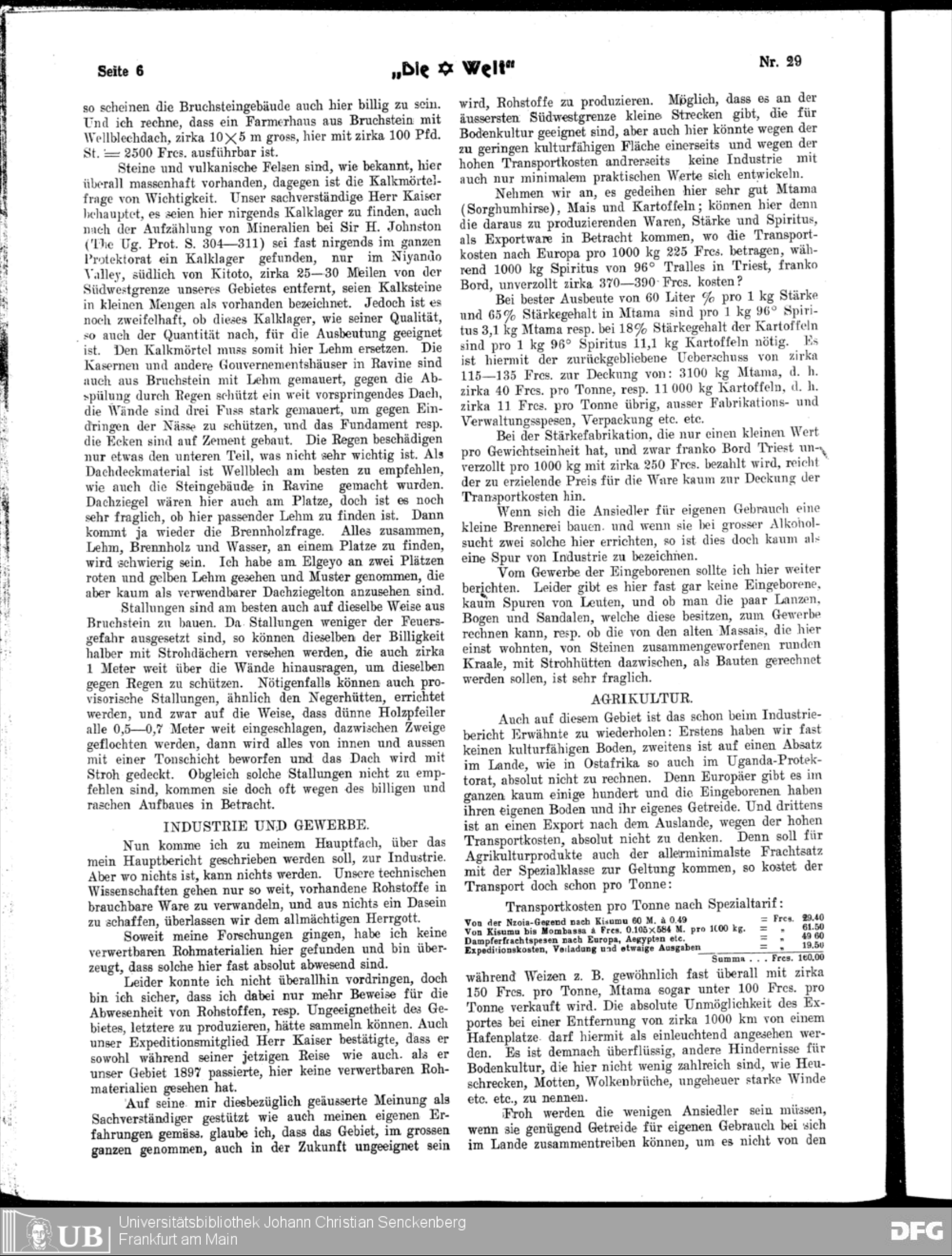
In this field too, what was already mentioned in the report on industry must be repeated: firstly, we have almost no cultivable soil; secondly, a market within the country, in East Africa as in the Uganda Protectorate, is absolutely not to be reckoned upon. For there are scarcely a few hundred Europeans in all, and the natives have their own soil and their own grain. And thirdly, an export abroad is absolutely not to be thought of, on account of the high cost of transport. For even should the very lowest freight rate of the special class apply to agricultural produce, the transport nevertheless already costs per ton:
Cost of transport per ton at the special tariff:
| From the Nzoia district to Kisumu, 60 m. at 0.49 | = Frcs. 29.40 |
| From Kisumu to Mombassa at Frcs. 0.105 x 584 m. per 1000 kg. | = " 61.50 |
| Steamer freight charges to Europe, Egypt, etc. | = " 49.60 |
| Forwarding costs, loading and incidental expenses | = " 19.50 |
| Total . . . | Frcs. 160.00 |
whereas wheat, for example, usually sells almost everywhere at about 150 francs per ton, and mtama even under 100 francs per ton. The absolute impossibility of export at a distance of some 1000 km. from a seaport may hereby be regarded as evident. It is accordingly superfluous to name other obstacles to the cultivation of the soil, which are by no means few here, such as locusts, moths, cloud-bursts, tremendously violent winds, etc., etc.
The few settlers will have to be glad if they can gather together enough grain for their own use within the country, so that it does not, from the