No. 29 — "Die ✡ Welt" — Page 21.
(continued from page 20)
…and which was then later adopted at the Fifth Congress (1901):
As a means to the highest ends of Judaism, which all must be ready to strengthen and to consolidate, Zionists and non-Zionists alike, who wish the future of the Jewish people to be great and fruitful.
The Collections for the National Fund.
The collections for the National Fund rest upon this: that on every occasion which offers itself, a levy or a contribution for the National Fund is given in suitable form, voluntarily or at the prompting of the collectors. The organisation of the National Fund hitherto takes account of the fact that the greater part of its income is recruited from small and very small sums, and it has made special arrangements for the facilitation of precisely these small collections, of which mention will be made in what follows.
The National Fund Stamps.
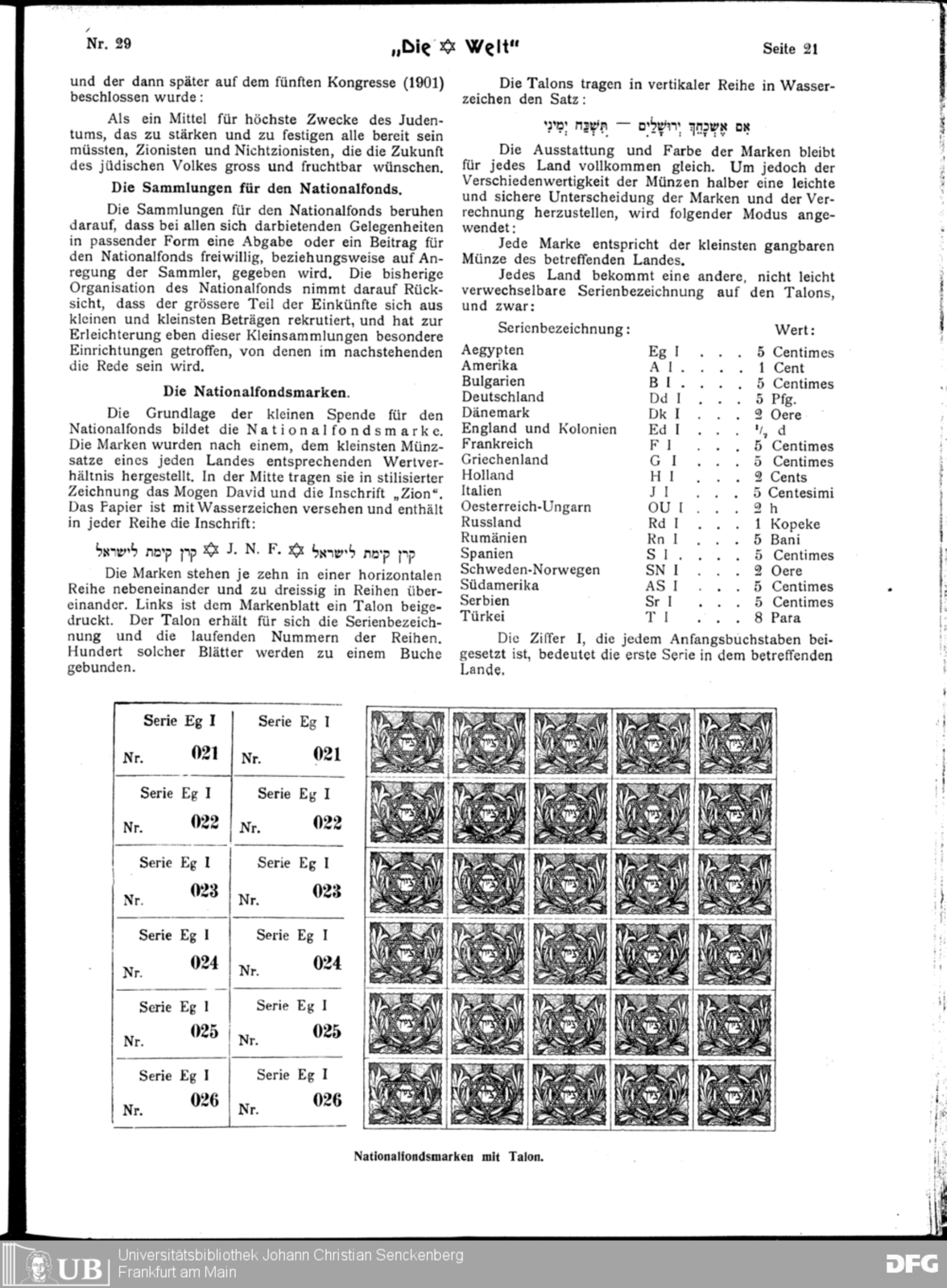
The basis of the small gift to the National Fund is the National Fund stamp. The stamps have been produced in a ratio of value corresponding to the smallest coin of each country. In the centre they bear, in stylised design, the Mogen David and the inscription "Zion." The paper is watermarked and contains in every row the inscription:
קרן קימת לישראל ✡ J. N. F. ✡ קרן קימת לישראל
The stamps stand ten to a horizontal row side by side, and thirty rows one above another. On the left a counterfoil is printed on to the stamp sheet. The counterfoil itself receives the series designation and the running numbers of the rows. One hundred such sheets are bound into a book.
The counterfoils bear, in a vertical row in watermark, the sentence:
אִם אֶשְׁכָּחֵךְ יְרוּשָׁלָיִם — תִּשְׁכַּח יְמִינִי
The design and colour of the stamps remain completely the same for every country. In order, however, on account of the differing values of the coins, to establish an easy and certain distinction of the stamps and of the accounting, the following method is employed:
Each stamp corresponds to the smallest current coin of the country concerned.
Each country receives a different series designation on the counterfoils, not easily confused, namely:
| Series designation: | Value: | ||
|---|---|---|---|
| Egypt | Eg I | . . . | 5 Centimes |
| America | A I | . . . | 1 Cent |
| Bulgaria | B I | . . . | 5 Centimes |
| Germany | Dd I | . . . | 5 Pfg. |
| Denmark | Dk I | . . . | 2 Oere |
| England and Colonies | Ed I | . . . | ¹/₂ d |
| France | F I | . . . | 5 Centimes |
| Greece | G I | . . . | 5 Centimes |
| Holland | H I | . . . | 2 Cents |
| Italy | J I | . . . | 5 Centesimi |
| Austria-Hungary | OU I | . . . | 2 h |
| Russia | Rd I | . . . | 1 Kopeke |
| Roumania | Rn I | . . . | 5 Bani |
| Spain | S I | . . . | 5 Centimes |
| Sweden-Norway | SN I | . . . | 2 Oere |
| South America | AS I | . . . | 5 Centimes |
| Servia | Sr I | . . . | 5 Centimes |
| Turkey | T I | . . . | 8 Para |
The numeral I, which is placed beside each initial letter, signifies the first series in the country concerned.
| Series Eg I No. 021 | Series Eg I No. 021 | ![Stamp] | ![Stamp] | ![Stamp] | ![Stamp] |
|---|---|---|---|---|---|
| Series Eg I No. 022 | Series Eg I No. 022 | ![Stamp] | ![Stamp] | ![Stamp] | ![Stamp] |
| Series Eg I No. 023 | Series Eg I No. 023 | ![Stamp] | ![Stamp] | ![Stamp] | ![Stamp] |
| Series Eg I No. 024 | Series Eg I No. 024 | ![Stamp] | ![Stamp] | ![Stamp] | ![Stamp] |
| Series Eg I No. 025 | Series Eg I No. 025 | ![Stamp] | ![Stamp] | ![Stamp] | ![Stamp] |
| Series Eg I No. 026 | Series Eg I No. 026 | ![Stamp] | ![Stamp] | ![Stamp] | ![Stamp] |
National Fund stamps with counterfoil.