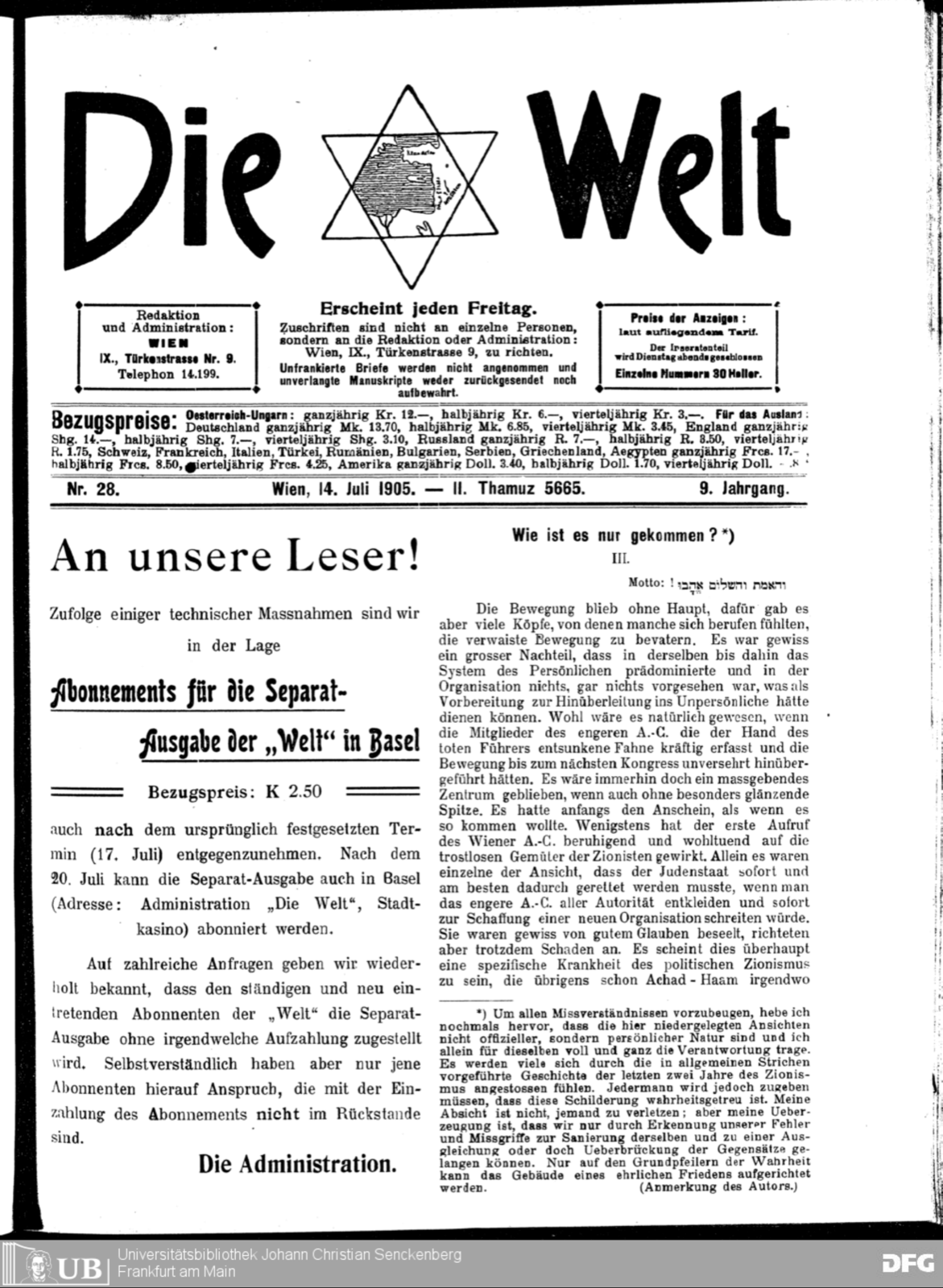
Die Welt
Editorial and business offices: Vienna, IX., Türkenstrasse No. 9; telephone 14.199. Published every Friday. Correspondence is to be addressed not to individuals but to the Editors or the Administration: Vienna, IX., Türkenstrasse 9. Unstamped letters are not accepted, and unsolicited manuscripts are neither returned nor kept. Advertising rates: according to the published tariff. The advertising section closes on Tuesday evenings. Single numbers 30 Heller.
Subscription rates: Austria-Hungary: yearly Kr. 12.—, half-yearly Kr. 6.—, quarterly Kr. 3.—. Abroad: Germany yearly Mk. 13.70, half-yearly Mk. 6.85, quarterly Mk. 3.45; England yearly Shg. 14.—, half-yearly Shg. 7.—, quarterly Shg. 3.10; Russia yearly R. 7.—, half-yearly R. 8.50, quarterly R. 1.75; Switzerland, France, Italy, Turkey, Roumania, Bulgaria, Servia, Greece, Egypt yearly Frcs. 17.—, half-yearly Frcs. 8.50, quarterly Frcs. 4.25; America yearly Doll. 3.40, half-yearly Doll. 1.70, quarterly Doll. —.8
No. 28. | Vienna, 14 July 1905. — II. Thamuz 5665. | 9th Year.
To Our Readers!
Owing to certain technical arrangements we are in a position to accept
Subscriptions to the Separate Edition of "Die Welt" in Basle
=== Subscription price: K 2.50 ===
even after the date originally fixed (17 July). After 20 July the separate edition may also be subscribed for in Basle (address: Administration "Die Welt", Stadtkasino).
In reply to numerous inquiries we repeat that the separate edition will be delivered to the regular and newly joining subscribers of "Die Welt" without any additional payment whatever. It goes without saying, however, that only those subscribers are entitled to it who are not in arrears with the payment of their subscription.
The Administration.
How Did It Come to This? *)
III.
Motto: וראמת והשלום אהבו!
The movement was left without a head, but in its place there were many heads, some of whom felt themselves called to father the orphaned movement. It was assuredly a great disadvantage that up to that time the personal system had predominated in it, and that nothing, absolutely nothing, had been provided in the organisation that might have served as a preparation for the transition to the impersonal. It would of course have been natural had the members of the inner A.-C. firmly grasped the banner that had fallen from the hand of the dead leader and carried the movement through unimpaired to the next Congress. There would at any rate have remained an authoritative centre, even if without an especially brilliant head. At first it seemed as though matters would take that course. At least the first appeal of the Vienna A.-C. had a soothing and beneficent effect upon the disconsolate spirits of the Zionists. But some were of the opinion that the Jewish State must be rescued at once, and best of all by stripping the inner A.-C. of all authority and proceeding forthwith to create a new organisation. They were no doubt animated by good faith, but they did harm nevertheless. This seems, indeed, to be a malady peculiar to political Zionism, which, incidentally, Achad-Haam already somewhere
*) To forestall all misunderstanding, I emphasise once more that the views here set down are not official but personal in character, and that I alone bear full and entire responsibility for them. Many will feel offended by the history of the last two years of Zionism, presented here in broad strokes. Everyone, however, will have to admit that this account is truthful. My intention is not to wound anyone; but it is my conviction that only by recognising our faults and blunders can we arrive at their remedy and at a reconciliation, or at least a bridging, of the antagonisms. Only upon the pillars of truth can the edifice of an honest peace be raised.
(Author's note.)