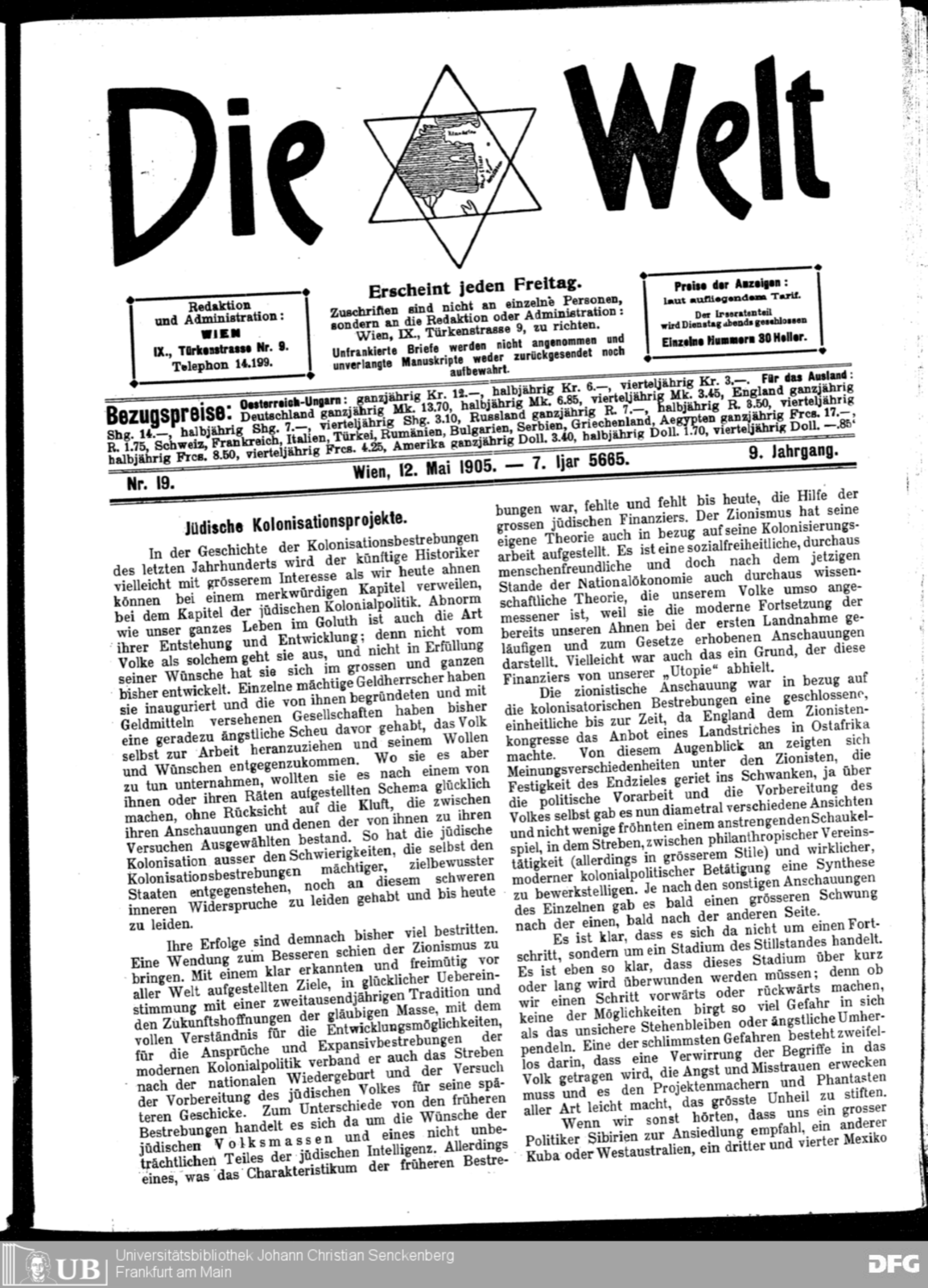
Die Welt
Published every Friday.
Editorial office and administration: Vienna IX., Türkenstrasse No. 9. Telephone 14.199. Correspondence is to be addressed not to individual persons but to the Editorial Office or the Administration: Vienna, IX., Türkenstrasse 9. Unstamped letters are not accepted, and unsolicited manuscripts are neither returned nor kept. Advertisement rates: according to the published tariff. The advertising section closes on Tuesday evenings. Single numbers 30 Heller.
Subscription rates: Austria-Hungary: yearly Kr. 12.—, half-yearly Kr. 6.—, quarterly Kr. 3.—. Abroad: Germany yearly Mk. 13.70, half-yearly Mk. 6.85, quarterly Mk. 3.45; England yearly Shg. 14.—, half-yearly Shg. 7.—, quarterly Shg. 3.10; Russia yearly R. 7.—, half-yearly R. 3.50, quarterly R. 1.75; Switzerland, France, Italy, Turkey, Roumania, Bulgaria, Servia, Greece, Egypt yearly Frcs. 17.—, half-yearly Frcs. 8.50, quarterly Frcs. 4.25; America yearly Doll. 3.40, half-yearly Doll. 1.70, quarterly Doll. —.85
No. 19. | Vienna, 12 May 1905. — 7 Iyar 5665. | 9th Year.
Jewish Colonisation Projects.
In the history of the colonising endeavours of the last century, the future historian will perhaps linger, with greater interest than we can today suspect, over a remarkable chapter: the chapter of Jewish colonial policy. Abnormal, like our whole life in the Goluth, is also the manner of its origin and development; for it does not proceed from the people as such, and on the whole it has not hitherto developed in fulfilment of the people's wishes. Individual mighty lords of money inaugurated it, and the societies founded and furnished with funds by them have hitherto shown a positively anxious reluctance to draw the people itself into the work and to meet its will and wishes. Where, however, they did undertake to do so, they sought to make it happy according to a scheme drawn up by themselves or their counsellors, without regard to the gulf that lay between their views and those of the persons they had selected for their experiments. Thus Jewish colonisation, besides the difficulties that confront even the colonising endeavours of powerful, purposeful states, has had to suffer, and suffers to this day, from this grave inner contradiction.
Its successes have accordingly been much disputed hitherto. Zionism seemed to bring a turn for the better. With a clearly recognised aim, frankly set forth before all the world, in happy accord with a tradition of two thousand years and with the hopes for the future of the believing masses, and with a full understanding of the possibilities of development, of the claims and expansive aspirations of modern colonial policy, it joined to these the striving for national rebirth and the attempt to prepare the Jewish people for its later destinies. In contrast with the earlier endeavours, what was in question here were the wishes of the Jewish masses and of a not inconsiderable part of the Jewish intelligentsia. One thing, to be sure, which had been the characteristic mark of the earlier endeavours, was lacking and is lacking to this day: the help of the great Jewish financiers. Zionism has set up its own theory with regard to its work of colonisation as well. It is a theory of social liberty, thoroughly humane, and yet, by the present state of political economy, thoroughly scientific too; a theory all the more fitting for our people because it represents the modern continuation of views that were already familiar to our ancestors at the first taking of the land and were raised by them to the status of law. Perhaps this, too, was one of the reasons that kept these financiers away from our "Utopia."
The Zionist view with regard to colonising endeavours was a closed and uniform one until the time when England made the Zionist Congress the offer of a tract of land in East Africa. From that moment differences of opinion appeared among the Zionists; the firmness of the final aim began to waver; indeed, there were now diametrically opposed views even on the preparatory political work and the preparation of the people itself, and not a few indulged in a strenuous game of see-saw, in the endeavour to effect a synthesis between philanthropic association work (on a larger scale, it is true) and real, modern colonial-political activity. According to the other views of the individual, the swing was now greater to the one side, now to the other.
It is clear that what we have here is not progress but a stage of standstill. It is equally clear that this stage will sooner or later have to be overcome; for whether we take a step forward or backward, none of the possibilities holds so much danger as uncertain standing still or anxious swinging to and fro. One of the worst dangers undoubtedly lies in the fact that a confusion of ideas is carried among the people, which must awaken fear and mistrust, and makes it easy for projectors and visionaries of every kind to work the greatest mischief.
When we formerly heard that one great politician recommended Siberia to us for settlement, another Cuba or Western Australia, a third and fourth Mexico