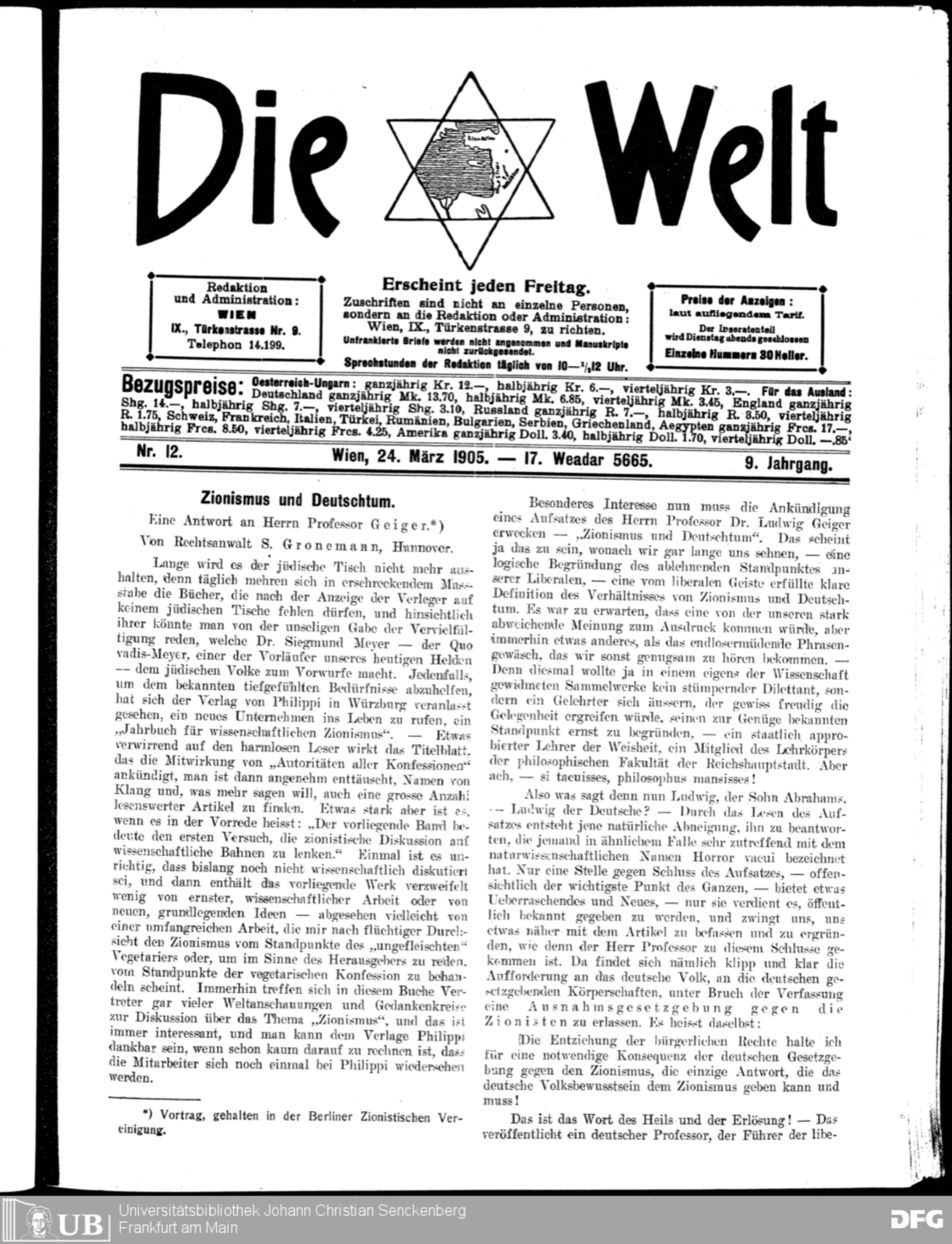
Die Welt
Published every Friday.
Editorial Office and Administration: VIENNA, IX., Türkenstrasse No. 9. Telephone 14.199.
Communications are to be addressed not to individual persons but to the Editorial Office or the Administration: Vienna, IX., Türkenstrasse 9. Unstamped letters are not accepted and manuscripts are not returned. The Editorial Office receives visitors daily from 10 to half past 11 o'clock.
Advertising rates: according to the published tariff. The advertisement section closes on Tuesday evenings. Single numbers 30 Heller.
Subscription rates: Austria-Hungary: yearly Kr. 12.—, half-yearly Kr. 6.—, quarterly Kr. 3.—. Abroad: Germany yearly Mk. 13.70, half-yearly Mk. 6.85, quarterly Mk. 3.45; England yearly Shg. 14.—, half-yearly Shg. 7.—, quarterly Shg. 3.10; Russia yearly R. 7.—, half-yearly R. 3.50, quarterly R. 1.75; Switzerland, France, Italy, Turkey, Roumania, Bulgaria, Servia, Greece, Egypt yearly Frcs. 17.—, half-yearly Frcs. 8.50, quarterly Frcs. 4.25; America yearly Doll. 3.40, half-yearly Doll. 1.70, quarterly Doll. —.85.
No. 12. Vienna, 24 March 1905. — 17 Weadar 5665. 9th Year.
Zionism and Germanism.
A Reply to Professor Geiger.*) By S. Gronemann, Barrister, Hanover.
The Jewish table will not be able to bear the load much longer, for day by day there multiply, at an alarming rate, the books which, according to their publishers' announcements, must be missing from no Jewish table; and with regard to them one might well speak of that unhappy gift of multiplication with which Dr. Siegmund Meyer — the Quo-Vadis Meyer, one of the forerunners of our present hero — reproaches the Jewish people. At all events, in order to meet the well-known and deeply felt want, the publishing house of Philippi in Würzburg has seen fit to launch a new undertaking, a "Year-Book of Scientific Zionism." — The title-page, which announces the collaboration of "authorities of all confessions," has a somewhat bewildering effect upon the unsuspecting reader; one is then agreeably disappointed to find names of standing and, what is more to the point, a large number of articles worth reading. But it is rather strong when the preface declares: "The present volume signifies the first attempt to direct the Zionist discussion into scientific channels." For one thing, it is untrue that there has hitherto been no scientific discussion; and for another, the present work contains desperately little of serious scientific labour or of new and fundamental ideas — save perhaps for one voluminous contribution which, upon a cursory perusal, appears to me to treat Zionism from the standpoint of the "unfleshly" vegetarian, or, to speak in the spirit of the editor, from the standpoint of the vegetarian confession. Nevertheless, representatives of a great many philosophies and circles of thought meet in this book to discuss the theme of "Zionism," and that is always interesting, and one may be grateful to the house of Philippi, even though there is scarcely any reckoning on the contributors meeting again at Philippi.
*) Lecture delivered before the Berlin Zionist Union.
Particular interest, now, must be aroused by the announcement of an essay by Professor Dr. Ludwig Geiger — "Zionism and Germanism." That would seem to be the very thing for which we have long been yearning — a logical justification of the negative attitude of our Liberals — a clear definition, filled with the liberal spirit, of the relation between Zionism and Germanism. It was to be expected that an opinion widely divergent from our own would find expression, but at any rate something other than the endlessly wearisome flow of phrases which we are otherwise made to hear quite enough of. — For this time, in a collection expressly devoted to science, it was to be no bungling dilettante who would speak, but a scholar who would surely seize the opportunity with joy to give serious grounds for his sufficiently well-known position — a State-approved teacher of wisdom, a member of the teaching body of the Faculty of Philosophy of the Imperial capital. But alas — si tacuisses, philosophus mansisses!
Well, then, what does Ludwig, the son of Abraham — Ludwig the German — have to say? — The reading of the essay gives rise to that natural disinclination to answer it which someone, in a similar case, very aptly designated by the scientific name of horror vacui. Only one passage towards the close of the essay — obviously the most important point of the whole — offers anything surprising and new; it alone deserves to be made publicly known, and it compels us to concern ourselves somewhat more closely with the article and to fathom how the Professor arrived at this conclusion. For there, in so many words, is to be found the summons to the German people, to the German legislative bodies, to enact, in breach of the Constitution, exceptional legislation against the Zionists. The passage reads:
"The withdrawal of civil rights I hold to be a necessary consequence of German legislation against Zionism, the only answer which the German national consciousness can and must give to Zionism!
That is the word of salvation and redemption! — This is what a German professor publishes, the leader of the Lib-