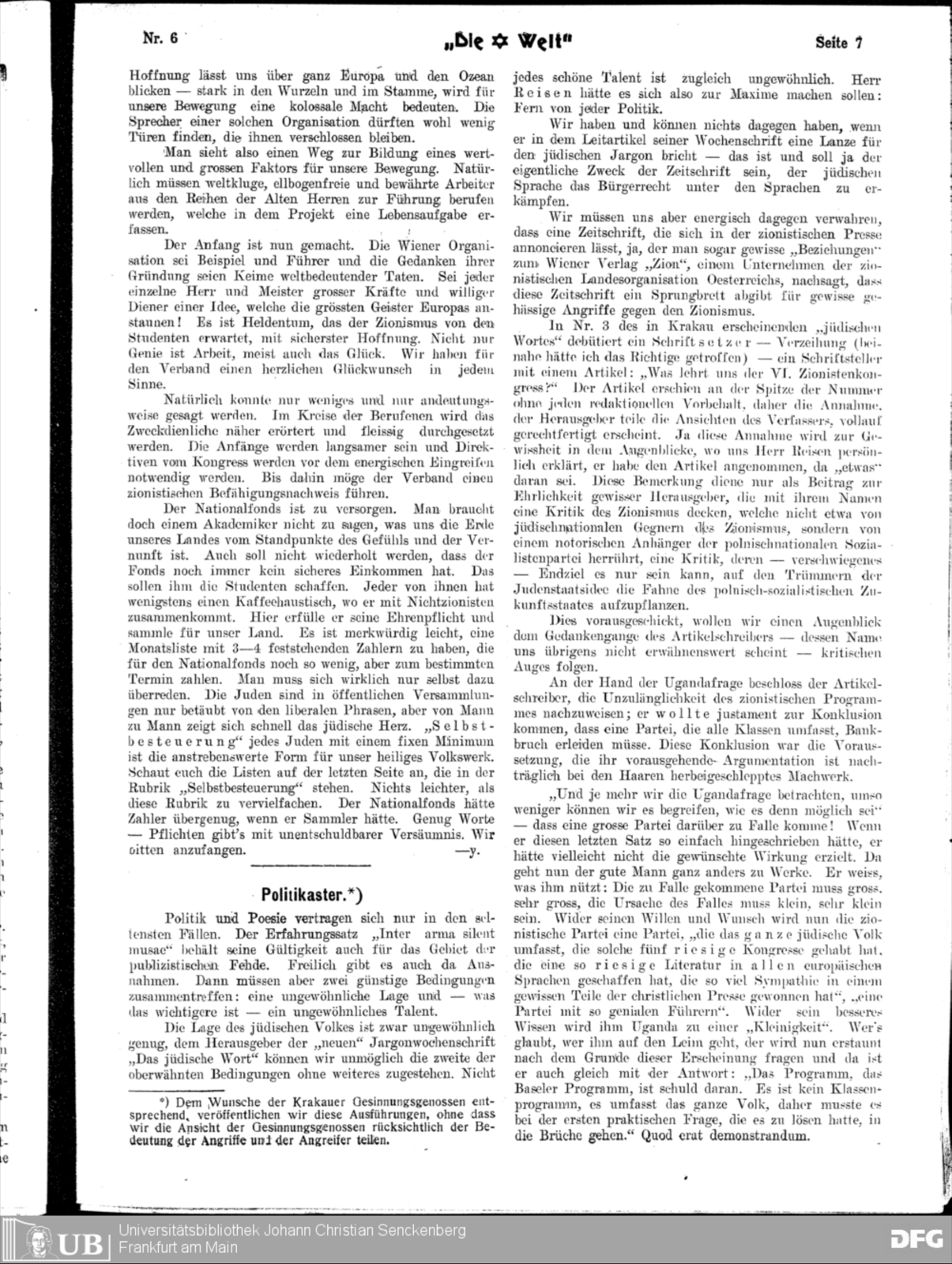
No. 6. — "Die Welt" — Page 7.
(continued from page 6)
…hope lets us look across all Europe and the ocean — strong in its roots and in its trunk, will signify a colossal power for our movement. The spokesmen of such an organisation would surely find few doors that remain closed to them.
One sees, then, a way to the formation of a valuable and great factor for our movement. Naturally, worldly-wise, unhampered and proven workers from the ranks of the Alte Herren, who grasp in the project a task for life, must be called to the leadership.
The beginning has now been made. Let the Vienna organisation be example and leader, and let the thoughts of its founding be the seeds of deeds of world significance. Let each one be lord and master of great forces and willing servant of an idea at which the greatest minds of Europe marvel! It is heroism that Zionism expects of the students, with the surest hope. Not genius only is work; for the most part good fortune is so too. We have for the union a hearty good wish in every sense.
Naturally only a little could be said, and that only by way of hint. In the circle of those who are called, what serves the purpose will be more closely discussed and diligently carried through. The beginnings will be slower, and directions from the Congress will become necessary before the energetic intervention. Until then let the union furnish a Zionist certificate of competence.
The National Fund is to be provided for. Surely one need not tell an academician what the soil of our land is to us from the standpoint of feeling and of reason. Nor shall it be repeated that the Fund still has no assured income. That the students shall create for it. Each of them has at least one coffee-house table where he meets with non-Zionists. Here let him fulfil his duty of honour and collect for our land. It is remarkably easy to have a monthly list with 3—4 fixed payers, who pay for the National Fund ever so little, but at the appointed date. One has really only to persuade oneself to it. The Jews in public meetings are merely stupefied by the liberal phrases, but from man to man the Jewish heart quickly shows itself. "Self-taxation" of every Jew with a fixed minimum is the form to be striven for in our sacred work. Look at the lists on the last page which stand under the rubric "Self-taxation." Nothing easier than to multiply this rubric. The National Fund would have payers more than enough if it had collectors. Enough words — there are duties the neglect of which is inexcusable. We beg that a beginning be made.
—y.
Politicasters.*)
Politics and poetry agree only in the rarest cases. The maxim of experience, "Inter arma silent musae," keeps its validity also for the field of the journalistic feud. To be sure, there are exceptions here too. But then two favourable conditions must coincide: an unusual situation and — what is the more important — an unusual talent.
The situation of the Jewish people is indeed unusual enough; to the editor of the "new" Jargon weekly "Das jüdische Wort" we cannot possibly concede the second of the above-mentioned conditions without more ado. Not every fine talent is at the same time an unusual one. Herr Reisen ought therefore to have made it his maxim: Far from all politics.
We have nothing, and can have nothing, against it if in the leading article of his weekly he breaks a lance for the Jewish Jargon — that is, and indeed should be, the proper purpose of the periodical, to win for the Jewish language the right of citizenship among the languages.
But we must energetically protest against this, that a periodical which has itself advertised in the Zionist press, nay, of which certain "relations" are even reported with the Vienna publishing house "Zion," an undertaking of the Zionist national organisation of Austria — that this periodical should furnish a spring-board for certain spiteful attacks upon Zionism.
In No. 3 of the "jüdisches Wort," which appears in Cracow, a type-setter — pardon (I had almost hit upon the truth) — a writer makes his début with an article: "What does the VIth Zionist Congress teach us?" The article appeared at the head of the number without any editorial reservation, wherefore the assumption that the editor shares the views of the author appears fully justified. Nay, this assumption becomes certainty at the moment when Herr Reisen personally declares to us that he accepted the article because there was "something" in it. Let this remark serve only as a contribution to the honesty of certain editors, who cover with their name a criticism of Zionism which proceeds, not from Jewish-national opponents of Zionism, but from a notorious adherent of the Polish-national Socialist party — a criticism whose — unspoken — final aim can only be to plant upon the ruins of the idea of the Jewish State the banner of the Polish-Socialist state of the future.
This premised, we will for a moment follow with a critical eye the train of thought of the writer of the article — whose name, moreover, does not seem to us worth mentioning.
By means of the Uganda question the writer of the article resolved to demonstrate the inadequacy of the Zionist programme; he was bent at all costs upon coming to the conclusion that a party which embraces all classes must suffer bankruptcy. This conclusion was the premise; the argumentation preceding it is a bungled piece of work dragged in afterwards by the hair.
"And the more we consider the Uganda question, the less can we comprehend how it is possible" — that a great party should come to its fall over it! Had he written down this last sentence thus simply, he would perhaps not have attained the desired effect. So the good man now goes to work quite otherwise. He knows what serves him: the party that has come to its fall must be great, very great; the cause of the fall must be small, very small. Against his will and wish the Zionist party now becomes a party "which embraces the whole Jewish people, which has had five such gigantic Congresses, which has created so gigantic a literature in all European languages, which has won so much sympathy in a certain part of the Christian press," "a party with leaders of such genius." Against his better knowledge Uganda becomes for him a "trifle." He who believes it, he who is caught by his lime, will now ask in astonishment for the reason of this phenomenon, and there he is at once with the answer: "The programme, the Basle Programme, is to blame for it. It is no class programme, it embraces the whole people, and therefore it had to go to pieces at the first practical question which it had to solve." Quod erat demonstrandum.
*) In accordance with the wish of our fellow Zionists of Cracow, we publish these remarks, without sharing the view of our fellow Zionists as regards the importance of the attacks and of the attackers.