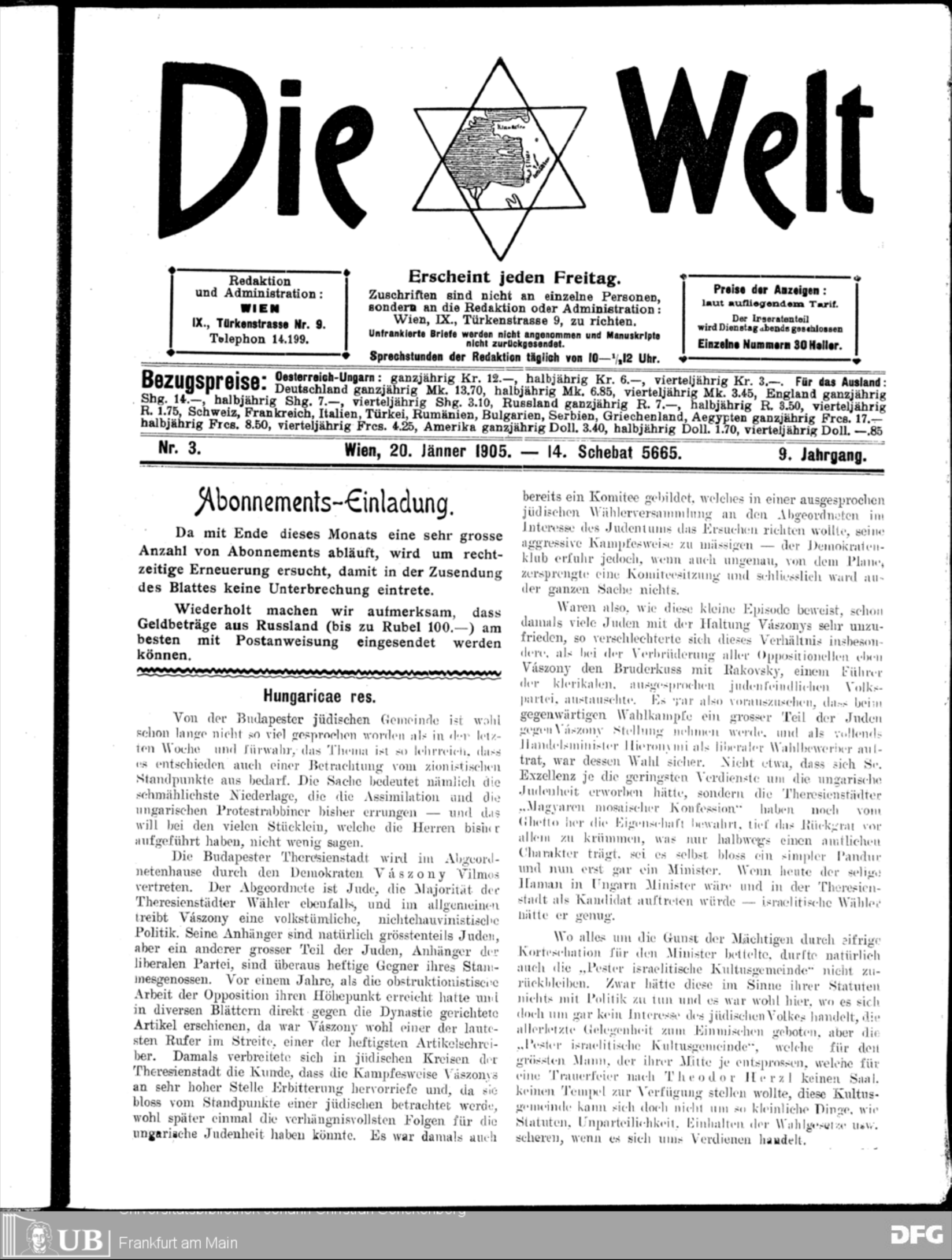
Die Welt
Editorial and Administrative Offices: VIENNA, IX., Türkenstrasse No. 9. Telephone 14.199.
Appears every Friday. Communications are to be addressed not to individual persons, but to the Editorial Office or the Administration: Vienna, IX., Türkenstrasse 9. Unstamped letters are not accepted and manuscripts are not returned. Office hours of the Editorial Office daily from 10—1/212 o'clock.
Advertisement rates: according to the published tariff. The advertisement section closes on Tuesday evening. Single numbers 30 Heller.
Subscription rates: Austria-Hungary: yearly Kr. 12.—, half-yearly Kr. 6.—, quarterly Kr. 3.—. Abroad: Germany yearly Mk. 13.70, half-yearly Mk. 6.85, quarterly Mk. 3.45; England yearly Shg. 14.—, half-yearly Shg. 7.—, quarterly Shg. 3.10; Russia yearly R. 7.—, half-yearly R. 3.50, quarterly R. 1.75; Switzerland, France, Italy, Turkey, Roumania, Bulgaria, Servia, Greece, Egypt yearly Frcs. 17.—, half-yearly Frcs. 8.50, quarterly Frcs. 4.25; America yearly Doll. 3.40, half-yearly Doll. 1.70, quarterly Doll. —.85
No. 3. | Vienna, 20 January 1905. — 14 Shebat 5665. | 9th Year.
Invitation to Subscribe.
As a very large number of subscriptions expire at the end of this month, timely renewal is requested, so that no interruption may occur in the delivery of the paper.
We again call attention to the fact that sums of money from Russia (up to Rubles 100.—) can best be sent by postal money order.
Hungaricae res.
It is surely a long time since the Jewish community of Budapest has been so much talked of as in the past week, and truly the theme is so instructive that it decidedly calls for consideration from the Zionist standpoint as well. For the affair signifies the most ignominious defeat that assimilation and the Hungarian Protest-rabbis have yet achieved — and, considering the many little pieces these gentlemen have hitherto performed, that is saying not a little.
The Theresienstadt of Budapest is represented in the Chamber of Deputies by the Democrat Vászony Vilmos. The deputy is a Jew, the majority of the Theresienstadt electors likewise, and in general Vászony pursues a popular, non-chauvinistic policy. His adherents are naturally for the most part Jews, but another large section of the Jews, adherents of the Liberal party, are exceedingly violent opponents of their kinsman. A year ago, when the obstructionist labours of the Opposition had reached their height and articles aimed directly against the dynasty were appearing in divers papers, Vászony was assuredly one of the loudest criers in the fray, one of the most vehement writers of articles. At that time the report spread in Jewish circles of the Theresienstadt that Vászony's manner of fighting was arousing bitterness in a very high quarter and, since it was regarded solely from the standpoint of a Jewish one, might well some day have the most fateful consequences for Hungarian Jewry. A committee had even been formed at that time which, in an avowedly Jewish meeting of electors, intended to address to the deputy, in the interest of Judaism, the request that he moderate his aggressive manner of fighting — the Democratic Club, however, learned of the plan, albeit inaccurately, broke up a sitting of the committee, and in the end nothing came of the whole affair.
If, then, as this little episode proves, many Jews were even at that time very dissatisfied with Vászony's attitude, this relation grew worse especially when, at the fraternization of all the Oppositionists, it was precisely Vászony who exchanged the kiss of brotherhood with Rakovsky, a leader of the clerical, avowedly anti-Jewish People's Party. It was therefore to be foreseen that in the present electoral contest a large part of the Jews would take their stand against Vászony, and when, to crown all, the Minister of Commerce Hieronymi came forward as the Liberal candidate, his election was certain. Not that His Excellency had ever earned the slightest merit in respect of Hungarian Jewry; but the Theresienstadt "Magyars of the Mosaic confession" have preserved from the Ghetto the quality of bending the backbone low before everything that bears even a halfway official character, be it but a simple pandour, and how much more a Minister. If the late lamented Haman were Minister in Hungary to-day and came forward as candidate in the Theresienstadt — he would have Israelite electors enough.
Where all were begging for the favour of the mighty by zealous canvassing for the Minister, the "Israelite Religious Community of Pest" could naturally not remain behind either. True, according to its statutes it should have nothing to do with politics, and here, where no interest whatever of the Jewish people is at stake, there was surely the very last occasion offered for interference; but the "Israelite Religious Community of Pest," which for the greatest man that ever sprang from its midst, which for a memorial service for Theodor Herzl would place no hall, no temple at disposal — this Community cannot, after all, trouble itself about such petty things as statutes, impartiality, observance of the electoral laws and so forth, when there is something to be earned.