No. 22. — "Die Welt" — Page 7.
(continued from page 6)
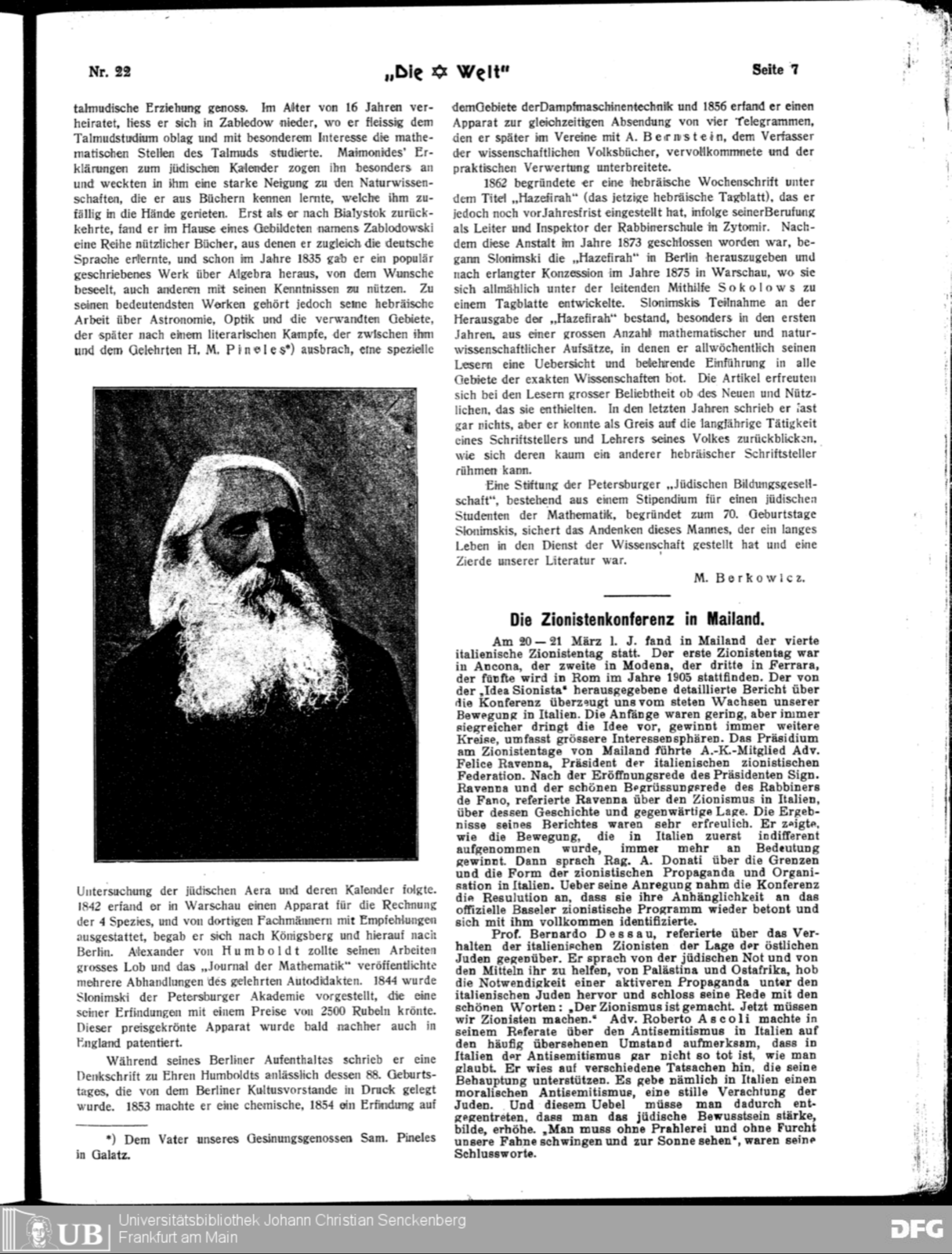
…Talmudic education. Married at the age of 16, he settled in Zabledow, where he diligently applied himself to the study of the Talmud and studied the mathematical passages of the Talmud with particular interest. Maimonides' explanations of the Jewish calendar especially attracted him and awakened in him a strong inclination towards the natural sciences, which he came to know from books that chanced to fall into his hands. Only when he returned to Bialystok did he find, in the house of an educated man named Zablodowski, a number of useful books, from which he at the same time learned the German language; and as early as 1835 he published a popularly written work on algebra, inspired by the wish to be of use to others with his knowledge. Among his most important works, however, is his Hebrew treatise on astronomy, optics and the related fields, to which later, after a literary controversy that broke out between him and the scholar H. M. Pineles*), a special on the field of steam-engine technology, and in 1856 he invented an apparatus for the simultaneous dispatch of four telegrams, which he later perfected in conjunction with A. Bernstein, the author of the popular scientific books, and submitted for practical exploitation.
In 1862 he founded a Hebrew weekly under the title "Hazefirah" (the present Hebrew daily), which, however, he discontinued before the year was out, in consequence of his appointment as director and inspector of the Rabbinical School in Zytomir. After this institution had been closed in the year 1873, Slonimski began to publish the "Hazefirah" in Berlin, and, after obtaining a licence, in 1875 in Warsaw, where, with the leading collaboration of Sokolow, it gradually developed into a daily. Slonimski's share in the publication of the "Hazefirah" consisted, especially in the first years, of a great number of mathematical and scientific essays, in which every week he offered his readers a survey of, and an instructive introduction to, all the fields of the exact sciences. The articles enjoyed great popularity with the readers for the new and useful matter they contained. In recent years he wrote almost nothing at all, but as an old man he could look back upon a long career as a writer and teacher of his people such as hardly any other Hebrew writer can boast.
A foundation of the St. Petersburg "Jewish Society for Education," consisting of a scholarship for a Jewish student of mathematics, established on Slonimski's 70th birthday, secures the memory of this man, who placed a long life in the service of science and was an ornament of our literature.
M. Berkowicz.
The Zionist Conference at Milan.
On 20—21 March of this year the fourth Italian Zionist Congress was held at Milan. The first Zionist Congress was at Ancona, the second at Modena, the third at Ferrara; the fifth will take place at Rome in the year 1905. The detailed report of the Conference published by the "Idea Sionista" convinces us of the steady growth of our movement in Italy. The beginnings were small, but the idea advances ever more victoriously, wins ever wider circles, embraces greater spheres of interest. The chair at the Milan Zionist Congress was taken by Adv. Felice Ravenna, member of the A.C., President of the Italian Zionist Federation. After the opening address of the President, Sign. Ravenna, and the fine address of welcome by Rabbi de Fano, Ravenna reported on Zionism in Italy, its history and its present position. The results of his report were very gratifying. He showed how the movement, which in Italy was at first received with indifference, is steadily gaining in importance. Then Rag. A. Donati spoke on the limits and the form of Zionist propaganda and organization in Italy. On his motion the Conference adopted the resolution that it re-affirms its attachment to the official Basle Zionist programme and identified itself with it completely.
Prof. Bernardo Dessau reported on the attitude of the Italian Zionists towards the situation of the Eastern Jews. He spoke of the Jewish distress and of the means of relieving it, of Palestine and East Africa, emphasized the necessity of a more active propaganda among the Italian Jews, and closed his speech with the fine words: "Zionism is made. Now we must make Zionists." Adv. Roberto Ascoli, in his report on antisemitism in Italy, drew attention to the frequently overlooked circumstance that in Italy antisemitism is by no means so dead as is believed. He pointed to various facts that support his assertion. There exists, namely, in Italy a moral antisemitism, a silent contempt of the Jews. And this evil must be met by strengthening, cultivating and raising Jewish consciousness. "We must wave our banner without boasting and without fear, and look towards the sun," were his closing words.
investigation of the Jewish era and its calendar followed. In 1842 he invented in Warsaw an apparatus for reckoning the four rules of arithmetic, and, furnished with recommendations by the experts there, he went to Koenigsberg and thereafter to Berlin. Alexander von Humboldt paid high praise to his works, and the "Journal der Mathematik" published several treatises by the learned self-taught man. In 1844 Slonimski was presented to the St. Petersburg Academy, which crowned one of his inventions with a prize of 2500 roubles. This prize-winning apparatus was soon afterwards patented in England as well.
During his stay in Berlin he wrote a memorial in honour of Humboldt on the occasion of the latter's 88th birthday, which was printed by the Berlin Congregational Board. In 1853 he made a chemical, in 1854 an invention in
*) The father of our fellow Zionist Sam. Pineles in Galatz.