Page 12 — "Die Welt" — No. 8
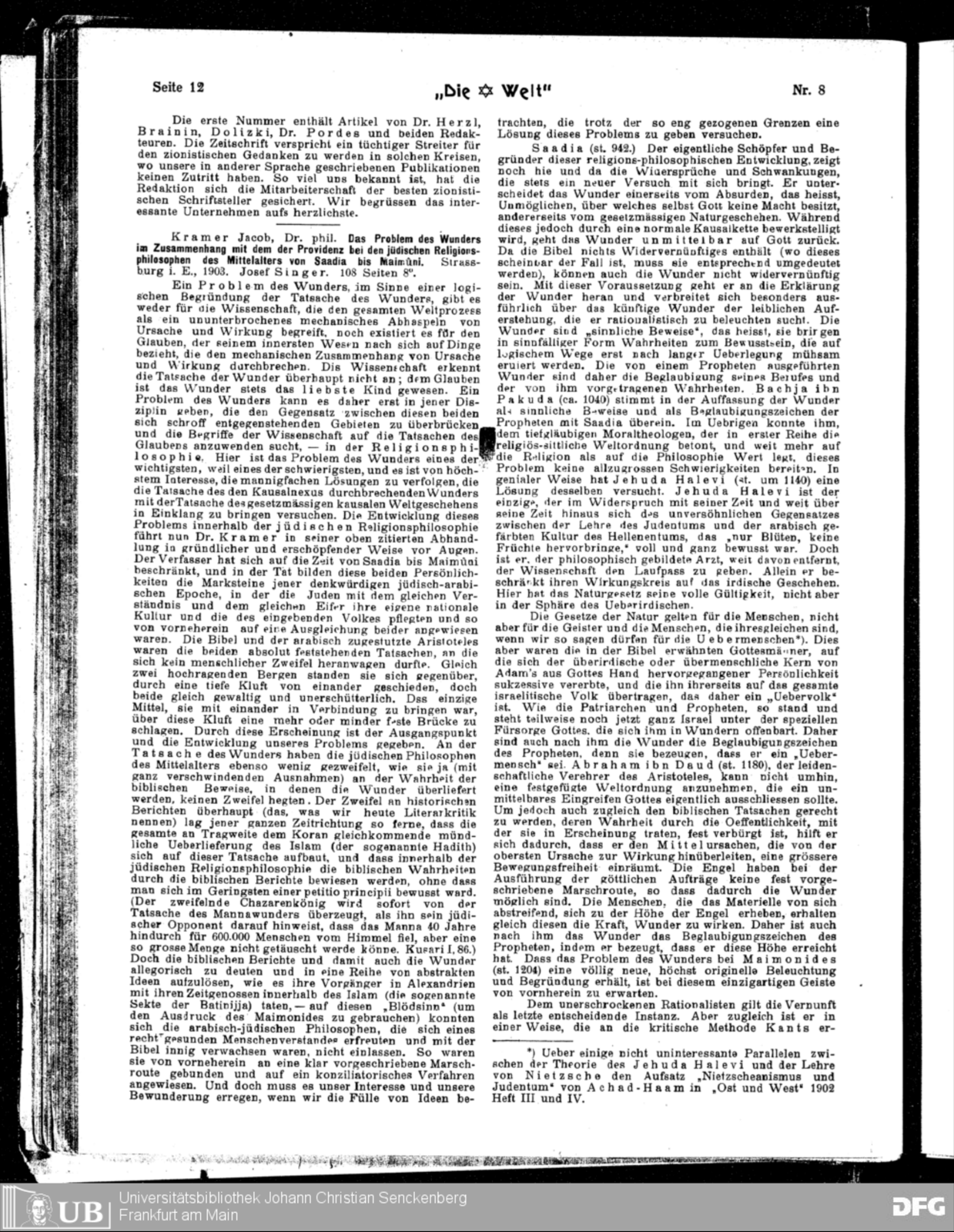
The first number contains articles by Dr. Herzl, Brainin, Dolizki, Dr. Pordes and both editors. The periodical promises to become a doughty champion of the Zionist idea in those circles to which our publications written in other languages have no access. So far as we are aware, the editors have secured the collaboration of the best Zionist writers. We welcome the interesting undertaking most heartily.
Kramer, Jacob, Dr. phil. The Problem of Miracle in Connexion with that of Providence among the Jewish Religious Philosophers of the Middle Ages from Saadia to Maimuni. Strasburg in Alsace, 1903. Josef Singer. 108 pages, 8vo.
A problem of miracle, in the sense of a logical grounding of the fact of miracle, exists neither for science, which conceives the entire world-process as an unbroken mechanical unwinding of cause and effect, nor for faith, which in its innermost nature relates to things that break through the mechanical connexion of cause and effect. Science does not recognise the fact of miracles at all; to faith the miracle has ever been its dearest child. A problem of miracle can therefore arise only in that discipline which seeks to bridge the opposition between these two sharply contrasted domains and to apply the concepts of science to the facts of faith — in the philosophy of religion. Here the problem of miracle is one of the most important, because one of the most difficult, and it is of the highest interest to follow the manifold solutions which attempt to bring the fact of miracle, breaking through the causal nexus, into harmony with the fact of the law-governed causal course of the world. The development of this problem within Jewish religious philosophy is now set before our eyes by Dr. Kramer, in the treatise cited above, in a thorough and exhaustive manner. The author has confined himself to the period from Saadia to Maimuni, and in truth these two personalities form the landmarks of that memorable Judæo-Arabic epoch in which the Jews cultivated with the same understanding and the same zeal their own national culture and that of the people among whom they dwelt, and were thus from the outset driven to a reconciliation of the two. The Bible and the Arabically trimmed Aristotle were the two absolutely established facts which no human doubt might venture to approach. Like two towering mountains they stood face to face, parted from each other by a deep chasm, yet both equally mighty and immovable. The only means of bringing them into connexion with each other was to throw a more or less solid bridge across this chasm. By this circumstance the point of departure and the development of our problem are given. The Jewish philosophers of the Middle Ages doubted the fact of miracle as little as they entertained any doubt (with quite vanishing exceptions) of the truth of the biblical proofs in which the miracles are handed down. Doubt of historical reports in general (what we to-day call literary criticism) lay so remote from the whole tendency of that age that the entire oral tradition of Islam (the so-called Hadith), equal in importance to the Koran, is built upon this fact, and that within Jewish religious philosophy the biblical truths are proved by the biblical reports without anyone's being in the least conscious of a petitio principii. (The doubting King of the Chazars is at once convinced of the fact of the miracle of the manna when his Jewish opponent points out to him that the manna fell from heaven for 600,000 people through 40 years, but that so great a multitude could not be deceived. Kusari I, 86.) But to interpret the biblical reports, and with them the miracles, allegorically, and to dissolve them into a series of abstract ideas, as their predecessors in Alexandria did, together with their contemporaries within Islam (the so-called sect of the Batinijja), — to this "nonsense" (to use the expression of Maimonides) the Arabic-Jewish philosophers, who enjoyed a very sound common sense and were intimately bound up with the Bible, could not lend themselves. Thus they were from the outset bound to a clearly prescribed line of march and driven to a conciliatory procedure. And yet it must arouse our interest and our admiration when we consider the wealth of ideas which, in spite of limits drawn so narrowly, attempt to give a solution of this problem.
Saadia (d. 942), the real creator and founder of this development in the philosophy of religion, still shows here and there the contradictions and waverings which every new attempt brings with it. He distinguishes miracle on the one hand from the absurd, that is, the impossible, over which even God possesses no power, and on the other from the law-governed course of nature. Whereas the latter, however, is brought about by a normal chain of causes, miracle goes back directly to God. Since the Bible contains nothing contrary to reason (where this appears to be the case, it must be reinterpreted accordingly), the miracles, too, cannot be contrary to reason. With this presupposition he approaches the explanation of the miracles, and expatiates at particular length on the future miracle of bodily resurrection, which he seeks to illuminate rationalistically. The miracles are "proofs to the senses," that is, they bring home to consciousness in palpable form truths which by the logical way are laboriously ascertained only after long reflection. The miracles performed by a prophet are therefore the attestation of his calling and of the truths propounded by him. Bachja ibn Pakuda (c. 1040) agrees with Saadia in the conception of miracles as proofs to the senses and as tokens attesting the prophets. For the rest, to him, the deeply believing moral theologian, who lays stress first and foremost on the religious-moral order of the world and sets far more store by religion than by philosophy, this problem could present no very great difficulties. In a manner of genius Jehuda Halevi (d. about 1140) attempted a solution of it. Jehuda Halevi is the only one who, in contradiction to his age and far beyond his age, was fully and wholly conscious of the irreconcilable opposition between the teaching of Judaism and the Arabic-tinged culture of Hellenism, which "brings forth only blossoms, no fruits." Yet he, the philosophically trained physician, is far from giving science its dismissal. He merely restricts its sphere of action to earthly events. Here natural law has its full validity, but not in the sphere of the supra-terrestrial.
The laws of nature hold for men, but not for the spirits and for the men who are their like — if we may so say, for the supermen*). Such, however, were the men of God mentioned in the Bible, to whom the supra-terrestrial or superhuman kernel of the personality of Adam, which had issued from the hand of God, was successively transmitted by inheritance, and who in their turn transferred it to the entire people of Israel, which is therefore a "super-nation." Like the patriarchs and prophets, the whole of Israel stood, and in part still stands to-day, under the special care of God, which reveals itself to it in miracles. Hence with him, too, the miracles are the tokens attesting the prophet, for they bear witness that he is a "superman." Abraham ibn Daud (d. 1180), the passionate admirer of Aristotle, cannot avoid assuming a firmly jointed order of the world, which ought properly to exclude any direct intervention of God. In order, however, at the same time to do justice to the biblical facts, whose truth is firmly vouched for by the publicity with which they came to pass, he helps himself by granting a greater freedom of movement to the intermediate causes which lead over from the supreme cause to the effect. The angels have no fixedly prescribed line of march in carrying out the divine commissions, so that miracles are thereby possible. Men who, stripping off the material, raise themselves to the height of the angels, receive like them the power to work miracles. Hence with him, too, the miracle is the token attesting the prophet, in that it bears witness that he has reached this height. That the problem of miracle should receive with Maimonides (d. 1204) an entirely new and highly original illumination and grounding is to be expected from the outset of this unique mind.
To the fearless rationalist reason counts as the final deciding authority. But at the same time he is, in a manner that, of the critical method of Kant, re-
*) On some not uninteresting parallels between the theory of Jehuda Halevi and the teaching of Nietzsche, the essay "Nietzscheanism and Judaism" by Achad-Haam in "Ost und West," 1902, Nos. III and IV.