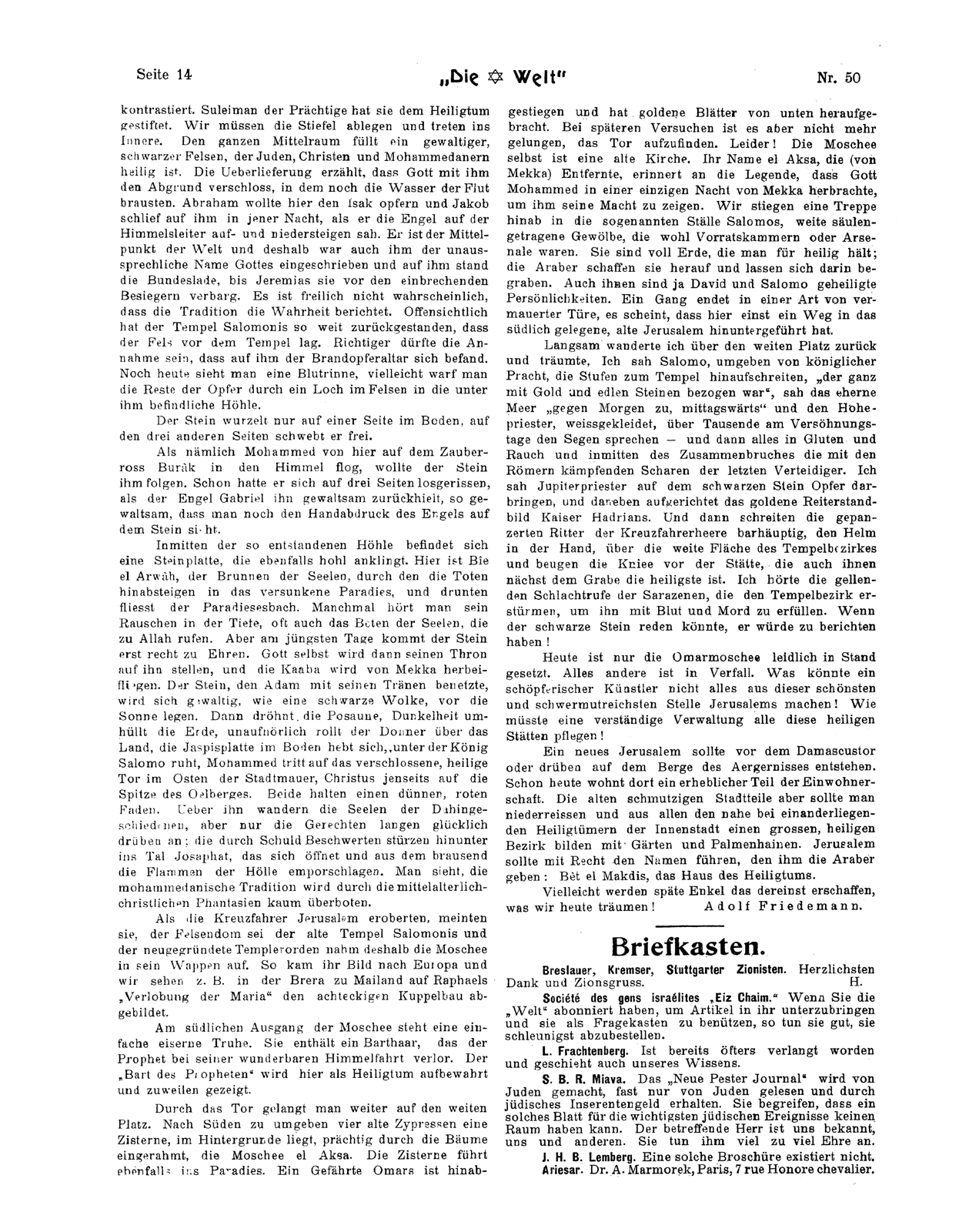
Page 14. — "Die Welt" — No. 50.
(continued from page 13)
…contrasts. Suleiman the Magnificent presented them to the sanctuary. We must take off our boots, and we step into the interior. The whole central space is filled by a mighty black rock, which is holy to Jews, Christians and Mohammedans alike. Tradition relates that with it God closed the abyss in which the waters of the Flood still roared. Here Abraham would have sacrificed Isaac, and upon it Jacob slept on that night when he saw the angels ascending and descending the heavenly ladder. It is the centre of the world, and therefore the ineffable Name of God was also inscribed upon it, and upon it stood the Ark of the Covenant until Jeremiah hid it from the conquerors breaking in. It is, to be sure, not probable that tradition reports the truth. Evidently the Temple of Solomon stood so far back that the rock lay in front of the Temple. The more correct assumption is likely to be that the altar of burnt-offering stood upon it. To this day one may see a channel for the blood; perhaps the remains of the sacrifices were thrown through a hole in the rock into the cave beneath it.
The stone is rooted in the ground on one side only; on the three other sides it hangs free.
For when Mohammed flew up from here to heaven on the magic steed Burâk, the stone wished to follow him. It had already torn itself loose on three sides when the angel Gabriel held it back by force, so forcibly that the print of the angel's hand may still be seen upon the stone.
In the midst of the cave thus formed there is a stone slab which likewise rings hollow. Here is Bîr el Arwâh, the Well of Souls, through which the dead descend into the sunken Paradise, and down below flows the brook of Paradise. At times one hears its rushing in the depths, and often, too, the praying of the souls who call upon Allah. But it is on the Day of Judgment that the stone will come truly into its honour. God Himself will then set His throne upon it, and the Kaaba will come flying hither from Mecca. The stone which Adam moistened with his tears will lay itself mightily, like a black cloud, before the sun. Then the trumpet will peal, darkness will enfold the earth, the thunder will roll unceasingly over the land, the slab of jasper in the ground beneath which King Solomon rests will lift itself, Mohammed will step upon the closed, holy gate in the east of the city wall, and Christ, on the far side, upon the summit of the Mount of Olives. Both will hold a thin red thread. Over it the souls of the departed will pass, but only the righteous will arrive safely on the other side; those weighed down by guilt will plunge into the Valley of Jehoshaphat, which opens, and out of which the flames of Hell leap roaring upward. One sees that the Mohammedan tradition is scarcely surpassed by the fancies of mediaeval Christendom.
When the Crusaders conquered Jerusalem, they supposed the Dome of the Rock to be the old Temple of Solomon, and the newly founded Order of the Templars accordingly took the mosque into its coat of arms. Thus its image came to Europe, and we see, for example, in the Brera at Milan, the octagonal domed building depicted in Raphael's "Betrothal of the Virgin."
At the southern exit of the mosque stands a plain iron chest. It contains a hair of the beard which the Prophet lost during his miraculous ascension into heaven. The "Beard of the Prophet" is preserved here as a relic and is shown from time to time.
Through the gate one passes on to the wide square. Toward the south four old cypresses surround a cistern; in the background, splendidly framed by the trees, lies the Mosque el Aksa. The cistern likewise leads to Paradise. A companion of Omar went down into it and brought up golden leaves from below. In later attempts, however, it has no longer been possible to find the gate. Alas! The mosque itself is an old church. Its name, el Aksa, the Distant One (from Mecca), recalls the legend that God brought Mohammed hither from Mecca in a single night in order to show him His power. We descended a staircase into the so-called Stables of Solomon, wide vaults borne on pillars, which were probably storehouses or arsenals. They are full of earth, which is held to be holy; the Arabs carry it up and have themselves buried in it. For to them, too, David and Solomon are sacred personages. One passage ends in a kind of walled-up door; it appears that a way once led down from here into the old Jerusalem lying to the south.
Slowly I wandered back across the wide square, and dreamed, I saw Solomon, surrounded by royal splendour, ascending the steps to the Temple, "which was overlaid entirely with gold and precious stones," saw the molten sea "toward the east, southward," and the High Priest, clad in white, pronouncing the blessing over thousands on the Day of Atonement — and then all in flames and smoke, and in the midst of the collapse the bands of the last defenders fighting with the Romans. I saw priests of Jupiter offering sacrifice upon the black stone, and beside it, set up, the golden equestrian statue of the Emperor Hadrian. And then the mail-clad knights of the Crusading hosts stride bareheaded, helmet in hand, across the wide expanse of the Temple precinct and bend the knee before the spot which to them, too, is the holiest next to the Sepulchre. I heard the shrill battle-cries of the Saracens storming the Temple precinct to fill it with blood and murder. If the black stone could speak, what it would have to tell!
To-day only the Mosque of Omar is kept in tolerable repair. Everything else is in decay. What might not a creative artist make of this most beautiful and most melancholy spot in Jerusalem! How a sensible administration ought to tend all these holy places!
A new Jerusalem ought to arise before the Damascus Gate, or over yonder on the Mount of Offence. Even now a considerable part of the population lives there. The old, dirty quarters of the city, however, ought to be pulled down, and out of all the sanctuaries of the inner city, lying close to one another, a great holy precinct should be formed, with gardens and groves of palms. Jerusalem should rightly bear the name which the Arabs give it: Bêt el Makdis, the House of the Sanctuary.
Perhaps distant descendants will one day create what we dream to-day!
Adolf Friedemann.
Letter-Box.
Zionists of Breslau, Krems, Stuttgart. Heartiest thanks and Zion's greeting. H.
Société des gens israelites "Eiz Chaim." If you have subscribed to the "Welt" in order to place articles in it and to use it as a query-box, you will do well to cancel your subscription with all speed.
L. Frachtenberg. This has already been demanded more than once, and, so far as we know, is being done.
S. B. R. Miava. The "Neue Pester Journal" is made by Jews, read almost exclusively by Jews, and kept alive by Jewish advertisers' money. You will understand that such a paper can have no room for the most important Jewish events. The gentleman in question is known to us — to us and to others. You do him far too much honour.
J. H. B. Lemberg. No such pamphlet exists.
Ariesar. Dr. A. Marmorek, Paris, 7 rue Honore chevalier.