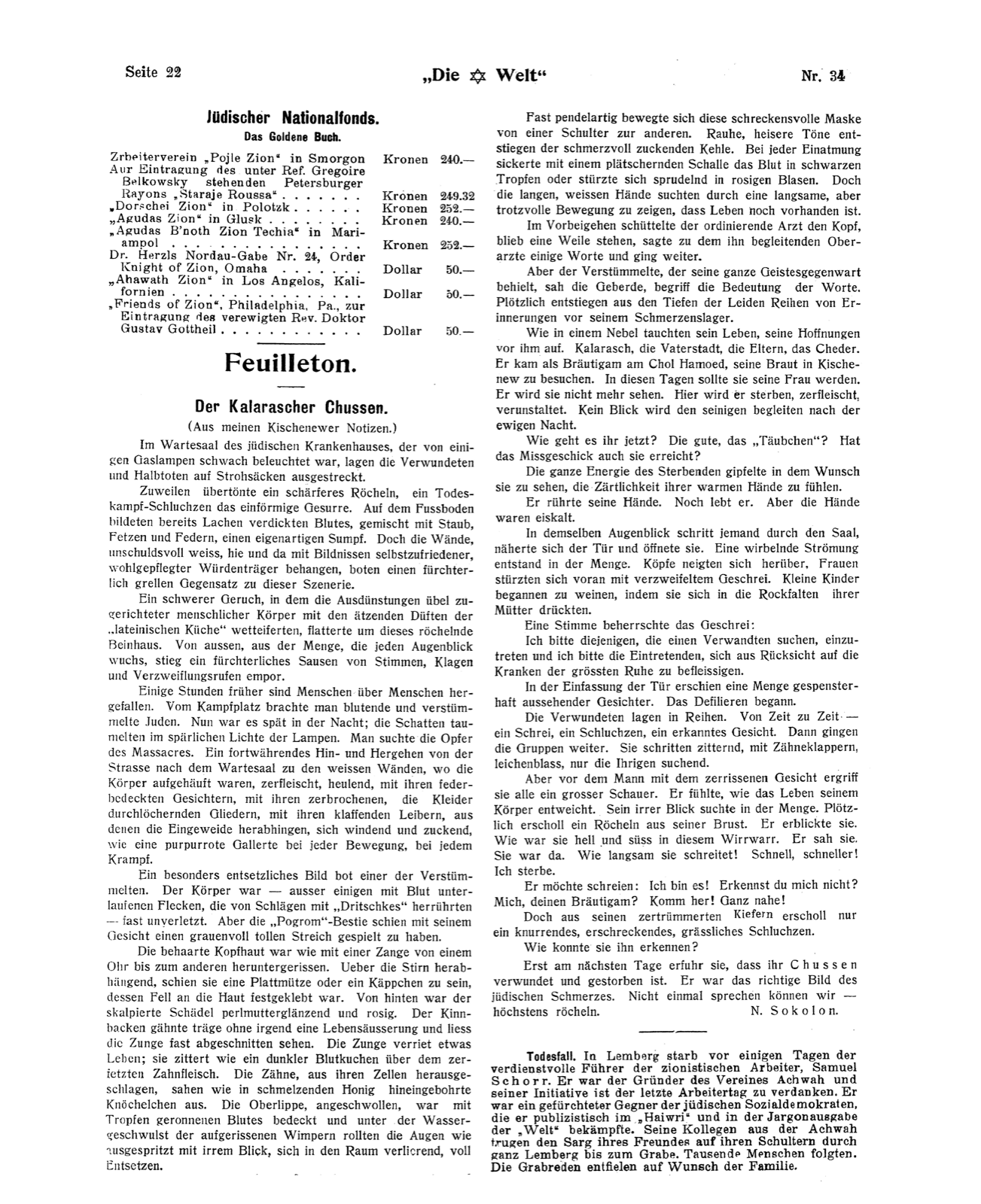
Page 22. — "Die Welt" — No. 34.
Jewish National Fund.
The Golden Book.
Workers' society "Pojle Zion" in Smorgon, Kronen 240.—
For the inscription of the St. Petersburg district "Staraje Roussa", under Ref. Gregoire Belkowsky, Kronen 249.32
"Dorschei Zion" in Polotzk, Kronen 252.—
"Agudas Zion" in Glusk, Kronen 240.—
"Agudas B'noth Zion Techia" in Mariampol, Kronen 252.—
Dr. Herzl's Nordau Gift No. 24, Order Knight of Zion, Omaha, Dollars 50.—
"Ahawath Zion" in Los Angelos, California, Dollars 50.—
"Friends of Zion", Philadelphia, Pa., for the inscription of the late Rev. Doctor Gustav Gottheil, Dollars 50.—
Feuilleton.
The Kalarasch Chussen.
(From my Kischenew Notes.)
In the waiting-room of the Jewish hospital, dimly lit by a few gas-lamps, the wounded and the half-dead lay stretched out upon straw pallets.
Now and again a sharper death-rattle, a sob of the death-struggle, rose above the monotonous hum. On the floor, pools of thickened blood, mixed with dust, rags and feathers, already formed a strange morass. Yet the walls, innocently white, hung here and there with portraits of self-satisfied, well-groomed dignitaries, offered a fearfully glaring contrast to this scene.
A heavy smell, in which the exhalations of cruelly mangled human bodies vied with the pungent odours of the "Latin kitchen", hovered about this rattling charnel-house. From without, from the crowd that grew every moment, rose a fearful roar of voices, lamentations and cries of despair.
Some hours earlier, men had fallen upon men. From the field of battle they brought bleeding and mutilated Jews. Now it was late at night; the shadows reeled in the scanty light of the lamps. People were seeking the victims of the massacre. A ceaseless going to and fro from the street to the waiting-room, to the white walls where the bodies were heaped up, lacerated, howling, with their feather-covered faces, with their broken limbs piercing through their clothes, with their gaping bellies from which the entrails hung down, writhing and twitching like a crimson jelly at every movement, at every spasm.
One of the mutilated presented an especially appalling picture. The body — save for a few bloodshot patches left by blows from "Dritschkes" — was almost unhurt. But the "pogrom" beast seemed to have played a horribly mad prank with his face.
The hairy scalp had been torn down, as though with pincers, from one ear to the other. Hanging down over the forehead, it seemed to be a flat cap or skull-cap whose fur was glued fast to the skin. From behind, the scalped skull shone pearly and rosy. The jaw gaped sluggishly without any sign of life and let the tongue be seen, almost severed. The tongue betrayed some life; it trembles like a dark clot of blood above the torn gums. The teeth, knocked out of their sockets, looked like little bones bored into melting honey. The upper lip, swollen, was covered with drops of clotted blood, and beneath the dropsical swelling of the torn eyelids the eyes rolled as though squirted out, with a crazed gaze losing itself in space, full of horror.
Almost like a pendulum this dreadful mask swung from one shoulder to the other. Rough, hoarse sounds rose from the painfully twitching throat. At every breath the blood trickled with a splashing sound in black drops or gushed forth bubbling in rosy froth. Yet the long white hands sought by a slow but defiant movement to show that life was still present.
In passing, the attending physician shook his head, stood still a while, said a few words to the senior physician accompanying him, and went on.
But the mutilated man, who kept his full presence of mind, saw the gesture and understood the meaning of the words. Suddenly, from the depths of his sufferings, rows of memories rose up before his bed of pain.
As in a mist his life and his hopes rose up before him. Kalarasch, his native town, his parents, the Cheder. He had come as a bridegroom during Chol Hamoed to visit his bride in Kischenew. In these very days she was to have become his wife. He will see her no more. Here he will die, lacerated, disfigured. No glance will accompany his into the eternal night.
How is she faring now? The good one, the "little dove"? Has misfortune overtaken her too?
The whole energy of the dying man culminated in the wish to see her, to feel the tenderness of her warm hands.
He stirred his hands. He still lives. But the hands were ice-cold.
At that same moment someone crossed the hall, approached the door and opened it. A whirling current arose in the crowd. Heads leaned over, women rushed forward with cries of despair. Little children began to weep, pressing themselves into the folds of their mothers' skirts.
One voice rose above the clamour:
I request those who are seeking a relative to enter, and I request those entering to observe the greatest quiet out of consideration for the sick.
In the frame of the door appeared a crowd of ghostly-looking faces. The procession began.
The wounded lay in rows. From time to time — a cry, a sob, a face recognised. Then the groups moved on. They walked trembling, with chattering teeth, deathly pale, seeking only their own.
But before the man with the torn face a great shudder seized them all. He felt life escaping from his body. His crazed gaze searched the crowd. Suddenly a rattle broke from his breast. He caught sight of her. How bright and sweet she was in this confusion. He saw her. She was there. How slowly she walks! Quickly, more quickly! I am dying.
He would cry out: It is I! Do you not know me? Me, your bridegroom? Come here! Quite close!
But from his shattered jaws there came only a snarling, terrifying, hideous sob.
How could she recognise him?
Only on the following day did she learn that her Chussen had been wounded and had died. He was the true image of Jewish suffering. We cannot even speak — at most, rattle in our throats.
N. Sokolon.
Death. In Lemberg there died a few days ago the meritorious leader of the Zionist workers, Samuel Schorr. He was the founder of the society Achwah, and to his initiative the last Workers' Conference is owed. He was a feared opponent of the Jewish Social Democrats, whom he combated as a publicist in the "Haiwri" and in the Jargon edition of "Die Welt". His colleagues of the Achwah carried their friend's coffin on their shoulders through the whole of Lemberg to the grave. Thousands of people followed. At the wish of the family there were no graveside addresses.