No. 16. — "Die Welt" — Page 11.
(continued from page 10)
…small number of eminent Jewish artists were inspired by Jewish subjects; although all the pathos, all the human suffering that are the portion of the wandering people shine forth from the colours of Joseph Israels, the hopes and ideals too, which form a specific trait of the race and are embodied in its literature and its life, could offer many subjects to an artist able to give them fitting artistic form. — A young Galician, Ephraim Lilien, of whom we are speaking here, is perhaps the first to have made this genre of art his own. Brought up in the Jewish teaching, grown up in the midst of a people that groans under the yoke of oppression and mediaeval persecution, thirsting for the freedom that has counted with his forefathers, since the deliverance from Egypt, as the sacred right of mankind; fired by the Zionist propaganda, he has known how to translate into a language which, despite the colouring of the national genius, is common to all, the poetic flame and the immortal hopes of his people." . . . .
The Last Word in Humanity! A Jewish shoemaker, Abraham Bermann, was sentenced by the "Thames" Police Court in London for living in a dwelling dangerous to life, namely in a cellar that housed a family of eight persons. The sanitary inspector had once before drawn the poor shoemaker's attention to the "illegality" of his dwelling, but to no purpose — the shoemaker stayed in the cellar. When the inspector now caught him in flagranti once again, he called him to account. In court the poor Jew pleaded in his defence that he had no means of renting a better dwelling; but this objection was not heeded, and the stern judge gave the ruling that "in so civilised a country as England no one may live in such abominable dwellings; but if he could not earn his living in England, he might betake himself to a country where he could get on better." Thereupon he sentenced him to a fine of 20 shillings and 23 shillings costs, or, should he have no money — to 21 days' imprisonment.
From an Interpellation by Deputy Breiter and Associates to His Excellency the Minister-President as Head of the Ministry of the Interior. Is the Minister of the Interior aware that the District Captain of Stanislau, Julius Prokopczyc, in annulling the elections to the Jewish communal council in the year 1900, appointed 24 government commissioners to administer the Jewish community of Stanislau, and has let these 24 commissioners manage its affairs for three full years?
This proceeding, which makes a mockery of every legal basis, stands alone in the annals of the administrative laws.
The election of 8 August 1900 having been annulled, a new election should at once have been called there, as the statute of organisation prescribes. The appointment of 24 government commissioners is a veritable madness, which could only have sprung from the head of a District Captain suffering from senile decay.
A Jubilee. The Frankfort secondary school (Realschule) of the Jewish religious community celebrates its 50th jubilee this month. For Frankfort Jewry the celebration will become a general festival, since a great many children attend this school first before entering the Gymnasium. A festival committee has been formed, and a commission of ladies and gentlemen appointed to collect the addresses of former pupils, boys and girls. At the festival Burgomaster Adickes, among others, will deliver an address.
Personal News. The betrothal of Miss Klara Silberstein, sister of our fellow Zionist Emil Silberstein, to Mr. Adolf Koller, Mag. pharm., took place recently in Lemberg. — Our fellow Zionist Mr. Sina Alexandrowicz of Cracow has become engaged to Miss Lola Eichenbaum of the same city.
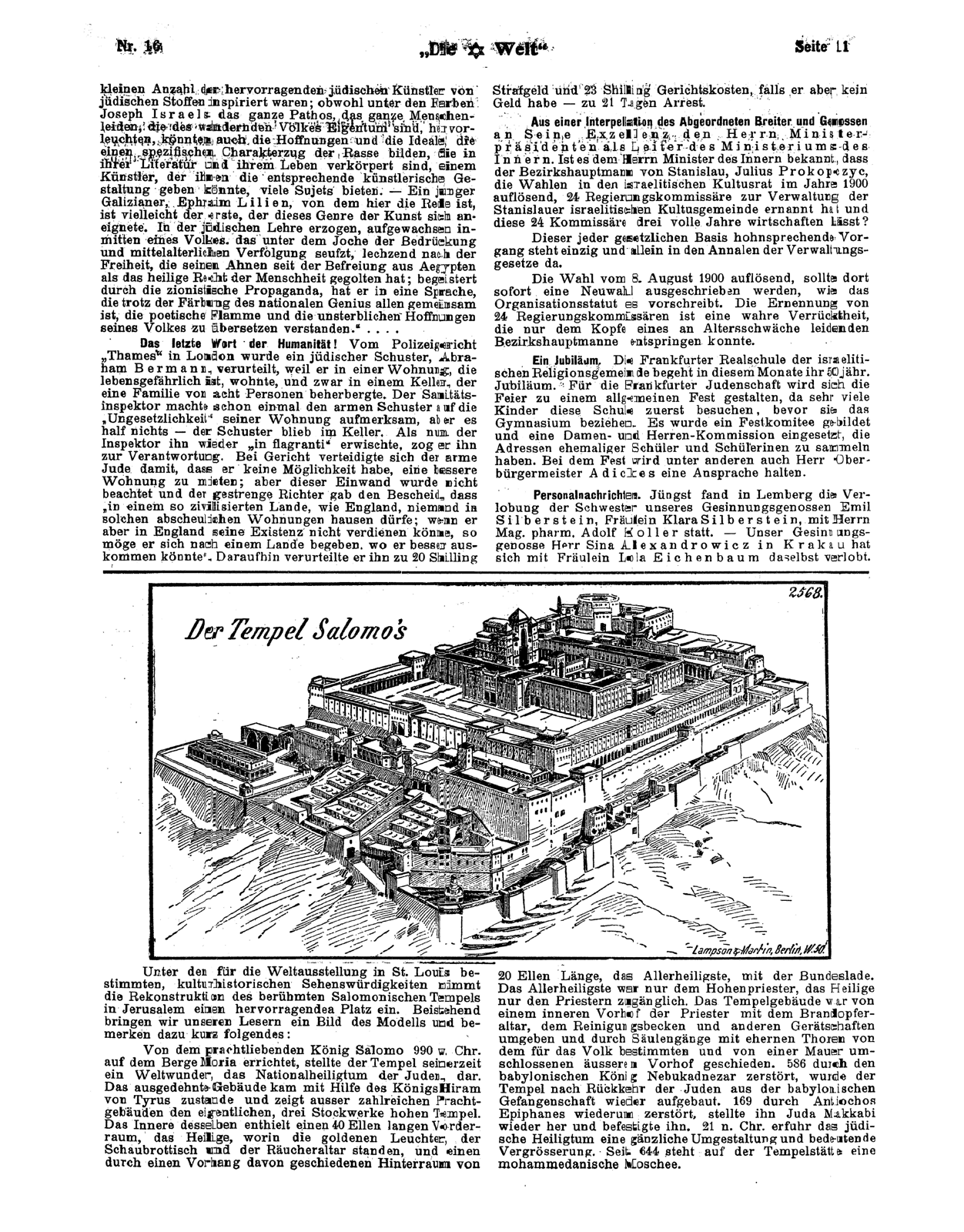
Solomon's Temple
(Illustration of the Temple with the signature: Lampson & Martin, Berlin, W. 50. / 2568.)
Among the objects of cultural and historical interest destined for the World's Fair at St. Louis, the reconstruction of the famous Temple of Solomon in Jerusalem holds a prominent place. We give our readers opposite a picture of the model, with the following brief remarks:
Erected on Mount Moriah by the splendour-loving King Solomon in 990 B.C., the Temple was in its day a wonder of the world, the national sanctuary of the Jews. The extensive structure was built with the help of King Hiram of Tyre and shows, besides numerous magnificent buildings, the Temple proper, three storeys high. Its interior contained a front chamber 40 cubits long, the Holy Place, in which stood the golden candlesticks, the table of shewbread and the altar of incense, and, separated from it by a veil, a rear chamber 20 cubits long, the Holy of Holies, with the Ark of the Covenant. The Holy of Holies was accessible only to the High Priest, the Holy Place only to the priests. The Temple building was surrounded by an inner court of the priests with the altar of burnt offering, the laver and other vessels, and was divided by colonnades with gates of brass from the outer court, which was intended for the people and enclosed by a wall. Destroyed in 586 by the Babylonian king Nebuchadnezzar, the Temple was rebuilt after the return of the Jews from the Babylonian captivity. Destroyed again in 169 by Antiochus Epiphanes, it was restored and fortified by Judah Maccabee. In 21 A.D. the Jewish sanctuary underwent a complete transformation and considerable enlargement. Since 644 a Mohammedan mosque has stood upon the site of the Temple.