Page 9.
(continued from page 8)
…ample of the capital of the world-empire has been followed by the distant colonial capitals as well, Montreal in Canada and Johannesburg in the Transvaal, where Jewish school battalions have likewise come into being.
The boys do not merely wear military uniform and play at soldiers; they are brought up in the military spirit and temper. The strictest discipline and order is the first rule that prevails in the battalion. Hardening and bodily training are the aim and the result of the exercises. They are for the most part pupils of the Jewish Free Schools, and mostly sprung from the poorest classes of the Ghetto population.
In these days, when the memory of our great national heroes, the Maccabees, is being celebrated throughout all Jewry,
med of boys — five bands of the several battalions — they marched into the camp. Shortly afterwards the school battalion from Liverpool arrived under the command of Captain E. K. Jates and was received in the same manner. When the boys had refreshed themselves, they were inspected by their officers, and after the meal they were permitted to rest and amuse themselves at croquet, tennis and football.
The chief command was held by Colonel Goldsmid in person, surrounded by a large staff of officers, to which there naturally belonged a regimental surgeon and a field-chaplain, the Reverend Michael Adler.
The programme of each day had been fixed and was carried out with military precision. At 5.30
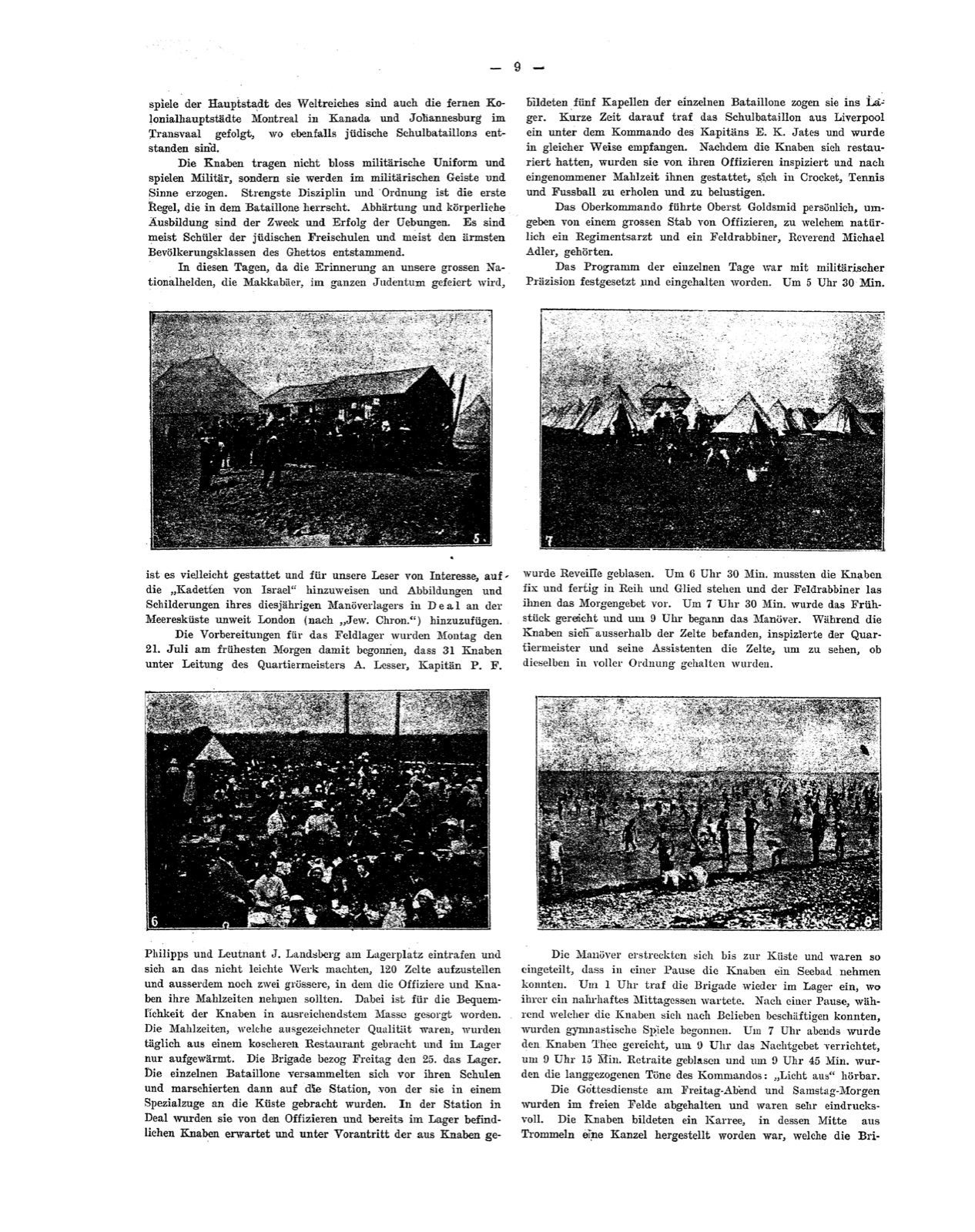
it is perhaps permissible, and of interest to our readers, to call attention to the "Cadets of Israel," and to add illustrations and descriptions of this year's manoeuvre camp at Deal, on the sea-coast not far from London (after the "Jew. Chron.").
The preparations for the field camp were begun on Monday, the 21st of July, in the earliest morning, when 31 boys under the direction of Quartermaster A. Lesser, Captain P. F.
reveille was sounded. At 6.30 the boys had to stand in rank and file, fully ready, and the field-chaplain read the morning prayer to them. At 7.30 breakfast was served, and at 9 o'clock the manoeuvres began. While the boys were outside the tents, the quartermaster and his assistants inspected the tents to see whether they were being kept in perfect order.
Philipps and Lieutenant J. Landsberg arrived at the camping-ground and set themselves to the by no means easy task of pitching 120 tents, and in addition two larger ones, in which the officers and boys were to take their meals. The comfort of the boys was provided for in the most ample measure. The meals, which were of excellent quality, were brought daily from a kosher restaurant and merely warmed up in the camp. The brigade went into camp on Friday the 25th. The several battalions assembled before their schools and then marched to the station, from which they were carried to the coast in a special train. At the station in Deal they were awaited by the officers and by the boys already in camp, and, preceded by the bands for-
The manoeuvres extended as far as the coast and were so arranged that during a pause the boys could take a sea-bath. At 1 o'clock the brigade returned to camp, where a nourishing dinner awaited them. After an interval, during which the boys might occupy themselves as they pleased, gymnastic games were begun. At 7 in the evening tea was served to the boys, at 9 the night prayer was said, at 9.15 the retreat was sounded, and at 9.45 the long-drawn notes of the command "Lights out" were heard.
The services on Friday evening and Saturday morning were held in the open field and were most impressive. The boys formed a square, in the midst of which a pulpit had been built of drums, which the bri-