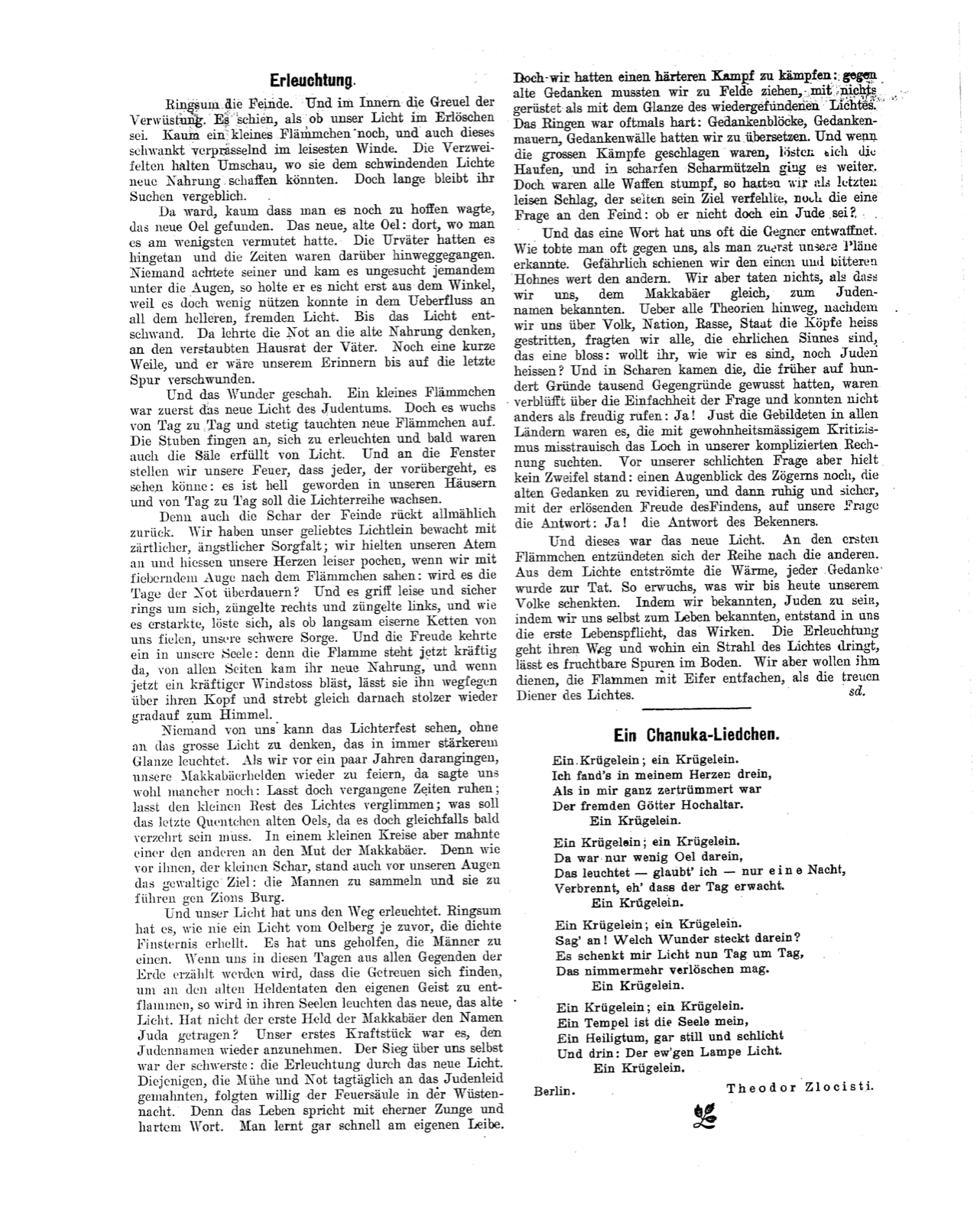
Illumination.
Enemies on every side. And within, the abomination of desolation. It seemed as though our light were going out. Scarcely more than a tiny flame, and even this wavers, sputtering, in the faintest wind. The despairing look about them for some means of giving new nourishment to the dwindling light. But for long their search remains in vain.
Then, when one hardly dared still to hope for it, the new oil was found. The new, old oil: there where it had been least expected. The forefathers had put it by, and the ages had passed over it. No one heeded it, and if it came unsought before anyone's eyes, he did not trouble to fetch it from its corner, since it could be of little use amid the abundance of all that brighter, alien light. Until the light vanished. Then need taught men to think of the old nourishment, of the dusty household goods of the fathers. A little while longer, and it would have vanished from our remembrance to the last trace.
And the miracle came to pass. A tiny flame was at first the new light of Judaism. But it grew from day to day, and steadily new little flames appeared. The rooms began to grow bright, and soon the halls too were filled with light. And we set our fires in the windows, that everyone who passes by may see: it has grown light in our houses, and from day to day the row of lights shall grow.
For the host of our enemies, too, is gradually falling back. We have watched over our beloved little light with tender, anxious care; we held our breath and bade our hearts beat more softly when with feverish eye we looked towards the little flame: will it outlast the days of distress? And it spread quietly and surely all around, flickered to the right and flickered to the left, and as it grew strong our heavy care was loosed, as though iron chains were slowly falling from us. And joy entered into our souls: for the flame now stands firm, new nourishment has come to it from every side, and if a strong gust now blows, it lets it sweep over its head and straightway strives upward again, the prouder, towards heaven.
None of us can see the Feast of Lights without thinking of the great light that shines with ever stronger radiance. When a few years ago we set about celebrating our Maccabean heroes once more, many a one still said to us: Let bygone times rest; let the small remnant of the light burn out; what is the use of the last scrap of old oil, since it too must soon be consumed? But in a small circle one reminded another of the courage of the Maccabees. For as before them, the little band, so before our eyes too there stood the mighty goal: to gather the men and lead them towards the citadel of Zion.
And our light has lit the way for us. All around, as never a light from the Mount of Olives before, it has illumined the thick darkness. It has helped us to unite the men. When in these days we shall be told from every quarter of the earth that the faithful are gathering to kindle their own spirit at the heroic deeds of old, then there will shine in their souls the new, the old light. Did not the first hero of the Maccabees bear the name of Judah? Our first feat of strength was to take up the name of Jew once more. The victory over ourselves was the hardest: the illumination by the new light. Those whom toil and want daily reminded of the Jewish sorrow willingly followed the pillar of fire in the night of the wilderness. For life speaks with a brazen tongue and a hard word. One learns very quickly in one's own flesh.
But we had a harder fight to fight: we had to take the field against old ideas, armed with nothing but the radiance of the light found anew. The struggle was often hard: blocks of ideas, walls of ideas, ramparts of ideas we had to surmount. And when the great battles had been fought, the masses broke up, and it went on in sharp skirmishes. But when all our weapons were blunted, we still had, as a last quiet stroke that seldom missed its mark, the one question to the foe: whether he were not, after all, a Jew?
And that one word has often disarmed our opponents. How men often raged against us when first our plans were recognised. To some we seemed dangerous, and to others worthy of bitter scorn. But we did nothing but profess, like the Maccabee, the name of Jew. Beyond all theories, after we had argued ourselves hot-headed over people, nation, race, and state, we asked all who are of honest mind this one thing only: will you, as we are, still be called Jews? And in crowds they came, those who had formerly known a thousand counter-reasons for a hundred reasons, were astonished at the simplicity of the question, and could not but cry joyfully: Yes! It was precisely the educated in all lands who, with habitual criticism, mistrustfully sought the flaw in our complicated reckoning. But before our simple question no doubt held its ground: one moment more of hesitation, to revise the old ideas, and then, calm and sure, with the redeeming joy of discovery, the answer to our question: Yes! the answer of the confessor.
And this was the new light. From the first little flames the others were kindled one after another. From the light streamed warmth; every thought became a deed. Thus grew what we have given to our people up to this day. In professing ourselves Jews, in professing ourselves for life, there arose in us the first duty of life: work. The illumination goes its way, and wherever a ray of the light penetrates, it leaves fruitful traces in the soil. But we will serve it, and fan the flames with zeal, as the faithful servants of the light. sd.
A Little Chanukah Song.
A little cruse; a little cruse. I found it deep within my heart, When in me lay all shattered quite The high altar of alien gods. A little cruse.
A little cruse; a little cruse. There was but little oil therein, That shines — so thought I — but one night, And burns away ere day awakes. A little cruse.
A little cruse; a little cruse. Say on! What wonder lies therein? It gives me light now day by day, That nevermore will be put out. A little cruse.
A little cruse; a little cruse. A temple is this soul of mine, A sanctuary, still and plain, And therein: the Eternal Lamp's light. A little cruse.
Berlin. Theodor Zlocisti.