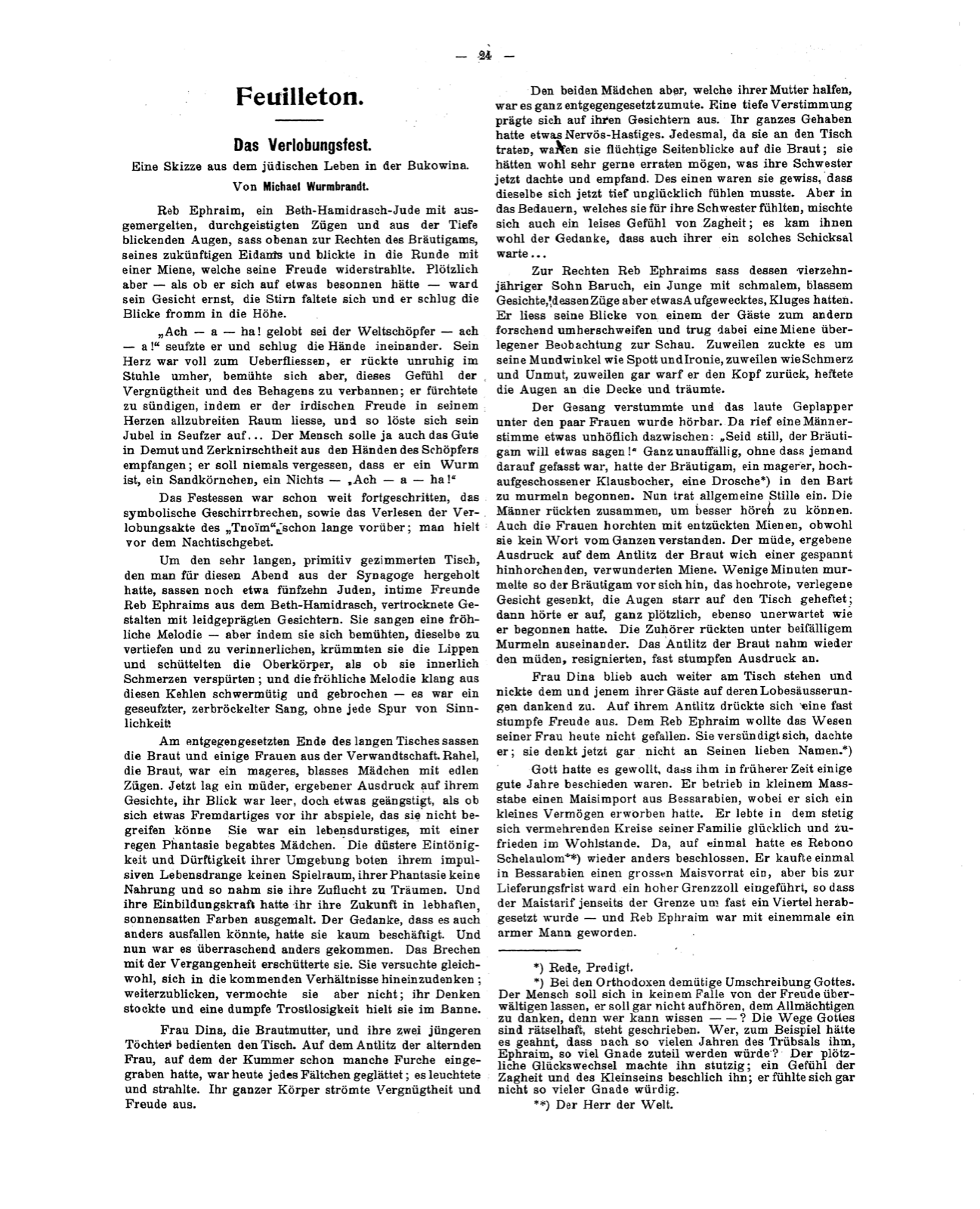
Feuilleton.
The Betrothal Feast.
A Sketch from Jewish Life in the Bukovina. By Michael Wurmbrandt.
Reb Ephraim, a Beth-Hamidrash Jew with emaciated, spiritualised features and eyes that looked out from the depths, sat at the head of the table on the right of the bridegroom, his future son-in-law, and gazed round the company with a countenance that reflected his joy. Suddenly, however — as though he had bethought himself of something — his face grew grave, his brow furrowed, and he piously raised his eyes on high.
"Ah — a — ha! praised be the Creator of the world — ah — a!" he sighed, and clasped his hands together. His heart was full to overflowing; he shifted restlessly about in his chair, yet strove to banish this feeling of contentment and comfort; he feared to sin by allowing earthly joy too broad a place in his heart, and so his exultation dissolved into sighs... For man should receive even the good from the hands of the Creator in humility and contrition; he should never forget that he is a worm, a grain of sand, a nothing — "Ah — a — ha!"
The feast was already far advanced; the symbolic breaking of the crockery, as well as the reading of the betrothal contract, the "Tnoim," was long since over; they had reached the grace after meat.
Round the very long, roughly carpentered table, which had been fetched from the synagogue for this evening, there still sat some fifteen Jews, intimate friends of Reb Ephraim from the Beth-Hamidrash, withered figures with faces stamped by suffering. They were singing a merry melody — but in their endeavour to deepen it and give it inwardness, they twisted their lips and swayed their bodies as though they felt pain within; and the merry melody sounded from these throats melancholy and broken — it was a sighed, crumbling song, without any trace of sensuousness.
At the opposite end of the long table sat the bride and some women of the family. Rachel, the bride, was a thin, pale girl with noble features. Now a weary, resigned expression lay upon her face; her gaze was empty, yet somewhat frightened, as though something strange were being enacted before her which she could not comprehend. She was a girl thirsting for life and gifted with a lively imagination. The gloomy monotony and poverty of her surroundings offered no scope to her impulsive longing for life, no nourishment to her imagination, and so she took refuge in dreams. And her fancy had painted her future for her in vivid, sun-steeped colours. The thought that it might turn out otherwise had scarcely occupied her. And now it had come about surprisingly otherwise. The break with the past shook her. She tried nevertheless to think herself into the circumstances to come; but to look further ahead she was unable; her thoughts came to a standstill, and a dull hopelessness held her spellbound.
Mrs. Dina, the bride's mother, and her two younger daughters waited at table. On the countenance of the ageing woman, in which sorrow had already graven many a furrow, every little wrinkle was smoothed out to-day; it shone and beamed. Her whole body radiated contentment and joy.
The two girls who were helping their mother, however, were in a wholly contrary mood. A deep dejection was stamped upon their faces. Their whole bearing had something nervous and hurried about it. Each time they came up to the table they cast fleeting sidelong glances at the bride; they would dearly have liked to guess what their sister was now thinking and feeling. Of one thing they were certain: that she must now feel deeply unhappy. But with the pity they felt for their sister there mingled also a faint feeling of timidity; the thought doubtless came to them that a like fate awaited them too...
On Reb Ephraim's right sat his fourteen-year-old son Baruch, a lad with a narrow, pale face, whose features, however, had something alert and clever about them. He let his glances roam searchingly from one guest to another, displaying meanwhile an air of superior observation. At times there twitched about the corners of his mouth something like mockery and irony, at times something like pain and vexation; at times he even threw back his head, fixed his eyes on the ceiling, and dreamed.
The singing ceased, and the loud chatter among the few women became audible. Then a man's voice called out, somewhat rudely: "Be quiet, the bridegroom wants to say something!" Quite unobtrusively, without anyone being prepared for it, the bridegroom, a lean, lanky Klaus-bocher, had begun to murmur a Drosche*) into his beard. Now a general silence fell. The men drew closer together in order to hear better. The women, too, listened with enraptured faces, although they understood not a word of the whole. The weary, resigned expression on the bride's face gave way to a look of tense, wondering attention. For a few minutes the bridegroom went on murmuring thus to himself, his crimson, embarrassed face bent down, his eyes fixed rigidly on the table; then he stopped, quite suddenly, just as unexpectedly as he had begun. The listeners drew apart with murmurs of approval. The bride's face again assumed its weary, resigned, almost dull expression.
Mrs. Dina remained standing at the table and nodded her thanks to this guest and that for their words of praise. Her countenance expressed an almost dull joy. Reb Ephraim did not like his wife's demeanour to-day. She is sinning, he thought; she is not thinking at all now of His dear Name.*)
God had willed that in former times some good years should be granted him. He carried on, in a small way, an import of maize from Bessarabia, by which he had acquired a small fortune. He lived happily and contentedly in comfort, in the steadily growing circle of his family. Then, all at once, Rebono Schelaulom**) had once again decreed otherwise. He once bought a large stock of maize in Bessarabia, but before the date of delivery a high frontier duty was introduced, so that the maize tariff beyond the frontier was reduced by almost a quarter — and Reb Ephraim had all at once become a poor man.
*) Discourse, sermon.
*) Among the Orthodox, a humble periphrasis for God. Man should in no case let himself be overpowered by joy; he should never cease to give thanks to the Almighty, for who can know — ? The ways of God are mysterious, it is written. Who, for example, would have foreseen that after so many years of affliction so much grace would fall to him, Ephraim? The sudden change of fortune made him uneasy; a feeling of timidity and smallness crept over him; he felt himself not at all worthy of so much grace.
**) The Lord of the World.