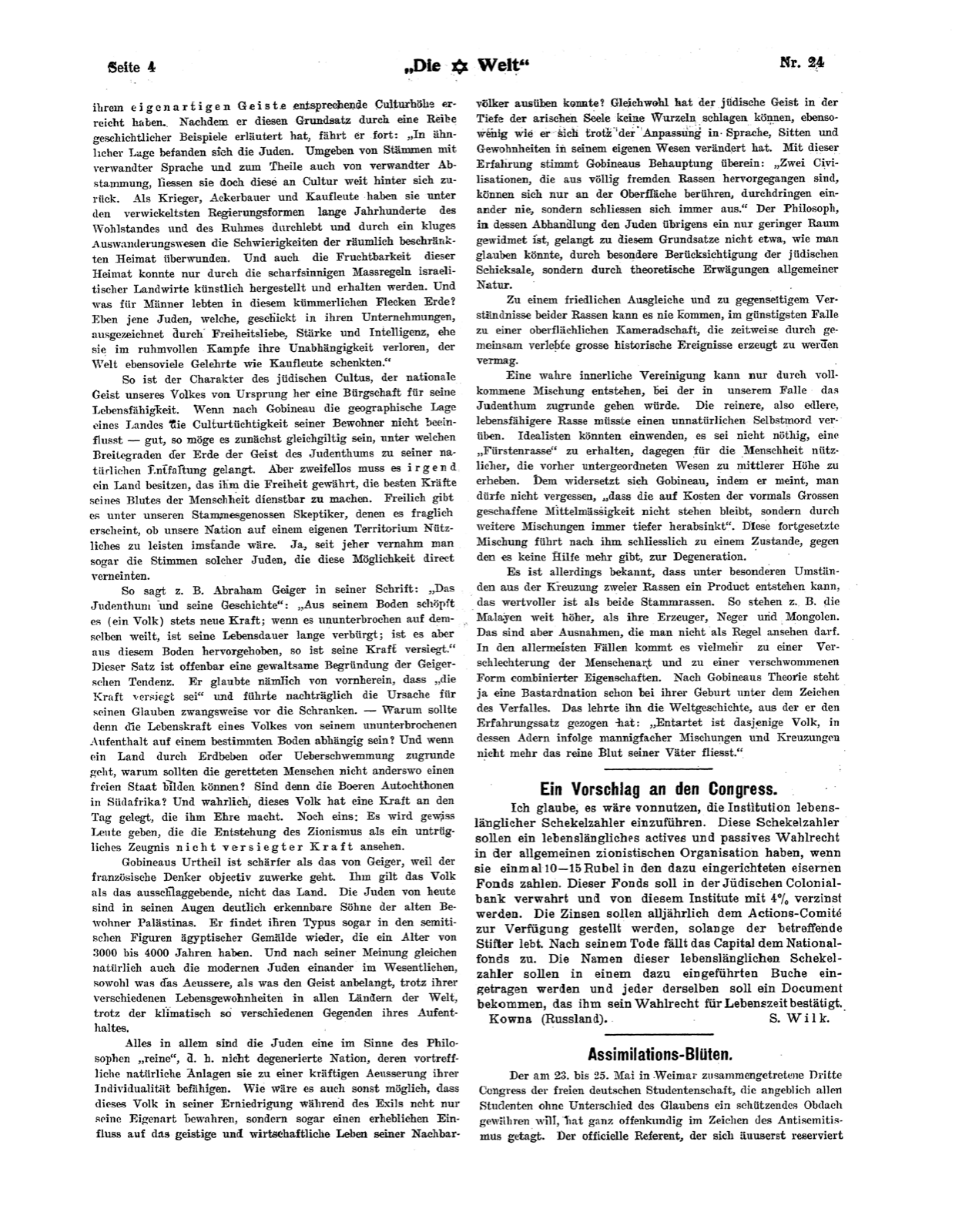
Page 4. — "Die Welt" — No. 24.
(continued from page 3)
...have attained a level of culture corresponding to their peculiar spirit. After illustrating this principle by a series of historical examples, he continues: "The Jews found themselves in a similar position. Surrounded by tribes of kindred speech and in part also of kindred descent, they nevertheless left these far behind them in culture. As warriors, husbandmen and merchants they lived through long centuries of prosperity and glory under the most intricate forms of government, and by a prudent system of emigration overcame the difficulties of a homeland narrowly bounded in space. And even the fertility of this homeland could be artificially created and maintained only by the ingenious measures of Israelite agriculturists. And what manner of men lived upon this meagre patch of earth? Those very Jews who, skilful in their undertakings, distinguished by love of freedom, strength and intelligence, gave the world as many scholars as merchants before they lost their independence in glorious combat."
Thus the character of the Jewish cult, the national spirit of our people, is from its origin a guarantee of its vitality. If, according to Gobineau, the geographical situation of a country does not influence the cultural capacity of its inhabitants — very well, then let it for the present be a matter of indifference under what degrees of latitude the spirit of Judaism attains its natural unfolding. But beyond doubt it must possess some country which grants it the freedom to place the best powers of its blood at the service of mankind. There are, to be sure, sceptics among our kinsmen to whom it seems questionable whether our nation would be capable of accomplishing anything useful upon a territory of its own. Indeed, from of old one has even heard the voices of such Jews as directly denied this possibility.
Thus, for example, Abraham Geiger says in his work "Judaism and its History": "From its soil it (a people) ever draws new strength; if it dwells upon it without interruption, its span of life is long assured; but if it is lifted out of this soil, its strength is dried up." This sentence is evidently a forced justification of Geiger's tendency. He believed, that is to say, from the outset that "the strength was dried up," and afterwards dragged the cause of his belief by compulsion before the bar. — Why, then, should the vital strength of a people depend upon its uninterrupted residence on a particular soil? And if a country perishes through earthquake or flood, why should the survivors not be able to form a free state elsewhere? Are the Boers, then, autochthons in South Africa? And truly, this people has displayed a strength that does it honour. One thing more: there will surely be people who regard the rise of Zionism as an infallible testimony of strength not dried up.
Gobineau's judgment is keener than Geiger's, because the French thinker goes to work objectively. For him the people counts as the decisive thing, not the land. The Jews of to-day are in his eyes clearly recognizable sons of the ancient inhabitants of Palestine. He finds their type again even in the Semitic figures of Egyptian paintings which are from 3000 to 4000 years old. And in his opinion, naturally, the modern Jews also resemble one another in essentials, both in outward appearance and in spirit, in spite of their differing habits of life in all the countries of the world, in spite of the climatically so different regions of their abode.
All in all, the Jews are, in the philosopher's sense, a "pure," that is, a non-degenerate nation, whose excellent natural endowments enable them to give vigorous expression to their individuality. How else, indeed, would it have been possible for this people, in its abasement during the exile, not only to preserve its peculiar character but even to exercise a considerable influence upon the intellectual and economic life of its neighbouring peoples? Nevertheless, the Jewish spirit has been unable to strike root in the depths of the Aryan soul, just as little as it has been altered in its own nature despite adaptation in language, manners and customs. With this experience accords Gobineau's assertion: "Two civilizations which have sprung from wholly alien races can touch each other only on the surface; they never interpenetrate, but always exclude each other." The philosopher, in whose treatise, moreover, only a slight space is devoted to the Jews, arrives at this principle not, as one might suppose, through special consideration of the fortunes of the Jews, but through theoretical reflections of a general nature.
To a peaceful reconciliation and a mutual understanding of the two races it can never come; at best to a superficial comradeship, which may at times be engendered by great historical events lived through in common.
A true inner union can arise only through complete mixture, in which, in our case, Judaism would perish. The purer, and therefore nobler and more vital race would have to commit an unnatural suicide. Idealists might object that it is not necessary to preserve a "princely race," but that it is more useful to mankind to raise the formerly subordinate beings to a middle height. To this Gobineau opposes himself, holding that one must not forget "that the mediocrity created at the expense of those formerly great does not stand still, but sinks ever lower through further mixtures." This continued mixture leads, according to him, at last to a condition against which there is no longer any remedy — to degeneration.
It is known, to be sure, that under special circumstances a product may arise from the crossing of two races which is more valuable than both parent races. Thus, for example, the Malays stand far higher than their progenitors, the Negroes and the Mongols. But these are exceptions which one may not regard as the rule. In by far the most cases there results, rather, a deterioration of the human kind and a blurred form of combined qualities. According to Gobineau's theory, indeed, a bastard nation stands under the sign of decay from its very birth. This world history taught him, from which he drew the empirical principle: "That people is degenerate in whose veins, in consequence of manifold minglings and crossings, the pure blood of its fathers no longer flows."
A Proposal to the Congress.
I believe it would be of use to introduce the institution of life shekel-payers. These shekel-payers should have a life-long active and passive franchise in the general Zionist Organization once they have paid 10–15 roubles into the permanent fund established for the purpose. This fund should be deposited in the Jewish Colonial Bank and bear interest at 4% from that institution. The interest should be placed annually at the disposal of the Actions Committee for as long as the founder concerned lives. After his death the capital falls to the National Fund. The names of these life shekel-payers should be entered in a book instituted for the purpose, and each of them should receive a document confirming his franchise for life.
Kowna (Russia). S. Wilk.
Blossoms of Assimilation.
The Third Congress of the Free German Student Body, which met at Weimar from 23 to 25 May and which professes to offer a sheltering roof to all students without distinction of creed, sat quite openly under the sign of antisemitism. The official reporter, who himself extremely reserved