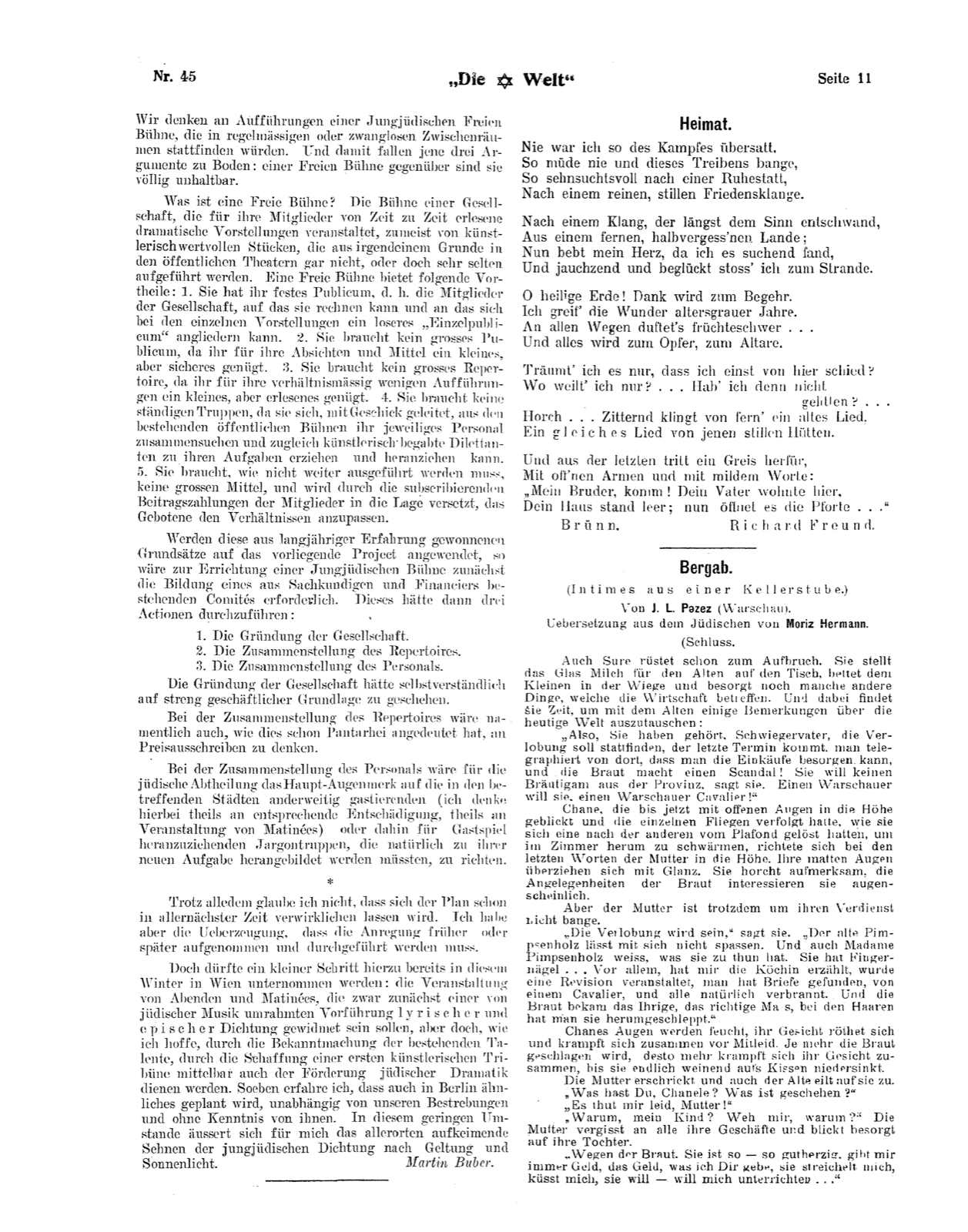
No. 45 — "Die Welt" — Page 11
We are thinking of performances of a Young-Jewish Free Stage, which would take place at regular or at unconstrained intervals. And with that those three arguments fall to the ground: as against a Free Stage they are wholly untenable.
What is a Free Stage? The stage of a society which from time to time arranges for its members choice dramatic performances, for the most part of artistically valuable pieces which for one reason or another are not given at all in the public theatres, or at any rate very seldom. A Free Stage offers the following advantages: 1. It has its settled public, that is to say, the members of the society, upon which it can reckon, and to which at the several performances a looser "individual public" can attach itself. 2. It needs no large public, since for its aims and its means a small but certain one suffices. 3. It needs no large repertoire, since for its comparatively few performances a small but choice one suffices. 4. It needs no permanent companies, since, if skilfully directed, it can gather its personnel for each occasion from the existing public stages, and at the same time train and draw in artistically gifted amateurs for its tasks. 5. It needs, as need not be further set forth, no great means, and is placed by the subscribed contributions of the members in a position to adapt what it offers to circumstances.
If these principles, won from long years of experience, be applied to the project before us, then for the establishment of a Young-Jewish Stage there would first be required the formation of a committee composed of experts and of financiers. This would then have three actions to carry through:
- The founding of the society.
- The composition of the repertoire.
- The composition of the personnel.
The founding of the society would of course have to take place upon a strictly business footing.
In the composition of the repertoire, prize competitions in particular would also have to be thought of, as Pantarhei has already indicated.
In the composition of the personnel the chief attention, for the Jewish section, would have to be directed to the Jargon companies playing in some other capacity in the towns in question (I am thinking here partly of suitable compensation, partly of the arranging of matinées), or to be drawn thither for guest performances — companies which would naturally have to be trained up to their new task.
*
In spite of all this I do not believe that the plan will suffer itself to be realised in the very nearest future. But I have the conviction that the suggestion must sooner or later be taken up and carried through.
Yet a small step towards it may well be undertaken in Vienna this very winter: the arranging of evenings and matinées which, though they are in the first instance to be devoted to a presentation of l y r i c and e p i c poetry framed in Jewish music, will yet, as I hope, by making known the talents that exist, by the creation of a first artistic tribune, serve indirectly the furtherance of Jewish dramatic art as well. I learn at this very moment that something similar is being planned in Berlin also, independently of our endeavours and without knowledge of them. In this slight circumstance there is expressed for me the longing, springing up on every hand, of Young-Jewish poetry after recognition and after sunlight.
Martin Buber.
Home.
Never was I so surfeited with strife, So weary never, nor so fearful of this turmoil, So full of longing for a resting-place, For one pure, quiet sound of peace.
For a sound long vanished from the mind, Out of a far and half-forgotten land; Now trembles my heart, since seeking I have found it, And exulting and made glad I press toward the strand.
O holy earth! Thanksgiving turns to longing. I grasp the wonders of the age-grey years. On every path there breathes a fragrance heavy with fruit . . . And all things turn to sacrifice, to altar.
Did I but dream it, that I once departed hence? Where did I tarry? . . . Have I then not suffered? . . . Hark . . . Tremblingly there sounds from far an ancient song, The s a m e song from those quiet huts.
And from the last there steps an aged man, With open arms and with a gentle word: "My brother, come! Thy father dwelt here, Thy house stood empty; now it opens wide its gate . . ."
B r u e n n. R i c h a r d F r e u n d.
Downhill.
(I n t i m a t e s c e n e s f r o m a c e l l a r - r o o m.)
By J. L. Pazez (Warsaw).
Translated from the Jewish by Moriz Hermann.
(Conclusion.
Sure too is already making ready to be off. She sets the glass of milk for the old man upon the table, beds the little one in the cradle, and attends to sundry other matters that concern the household. And withal she finds time to exchange a few remarks with the old man about the world of to-day:
"Well then, you have heard, father-in-law, the betrothal is to take place, the last term is coming, they telegraph from yonder that the purchases may be seen to, and the bride makes a scandal! She will have no bridegroom from the province, says she. A Warsaw man she will have, a Warsaw cavalier!"
Chane, who until now had gazed upward with open eyes and followed the single flies as one after another they loosed themselves from the ceiling to swarm about the room, raised herself up at the mother's last words. Her dull eyes overspread themselves with a lustre. She listens attentively; the affairs of the bride evidently interest her.
But the mother is nevertheless in no fear for her earnings.
"The betrothal will be," says she. "Old Pimpsenholz is not to be trifled with. And Madame Pimpsenholz too knows what she has to do. She has finger-nails . . . First of all, so the cook told me, a search was made, letters were found, from a cavalier, and all of them burnt, naturally. And the bride got what was coming to her, the right Ma[illegible]s; they dragged her about by the hair."
Chane's eyes grow moist, her face reddens and contracts with pity. The more the bride is beaten, the more her face contracts, until at last she sinks down weeping upon the pillow.
The mother is startled, and the old man too hastens towards her.
"What ails thee, Chanele? What has happened?"
"It grieves me, mother!"
"Why, my child? Woe is me, why?" The mother forgets all her business and looks anxiously upon her daughter.
"Because of the bride. She is so — so kind-hearted, always gives me money, the money that I give thee; she strokes me, kisses me, she wants — wants to teach me . . ."