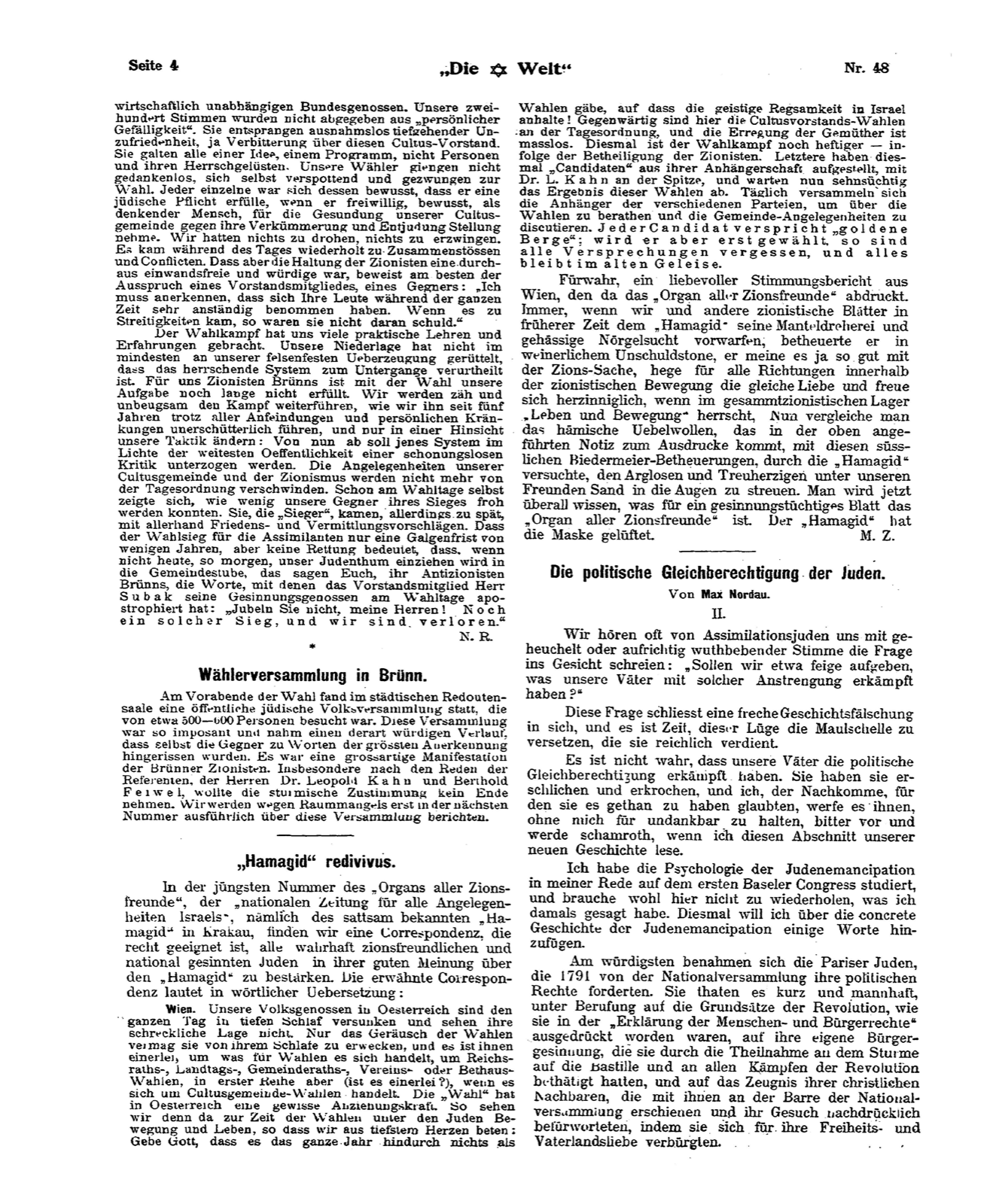
Page 4 — "Die Welt" — No. 48
(continued from page 3)
…economically independent confederates. Our two hundred votes were not cast out of "personal complaisance." Without exception they sprang from a deep-seated dissatisfaction, nay, from exasperation with this Communal Board. They were all of them given to an idea, to a programme, not to persons and their lust of rule. Our electors did not go to the poll thoughtlessly, mocking at themselves and under compulsion. Each single one of them was conscious that he was fulfilling a Jewish duty when, freely, consciously, as a thinking man, he took his stand for the recovery of our Jewish Community against its stunting and its de-Judaisation. We had nothing to threaten with, nothing to extort. In the course of the day it repeatedly came to collisions and conflicts. But that the bearing of the Zionists was throughout unexceptionable and dignified is best proved by the utterance of a member of the Board, an opponent: "I must acknowledge that your people have behaved very decently during the whole time. If it came to quarrels, they were not to blame for them."
The electoral struggle has brought us many practical lessons and experiences. Our defeat has not in the least shaken our rock-firm conviction that the ruling system is doomed to destruction. For us Zionists of Bruenn our task is by no means fulfilled with the election. We shall carry on the struggle tenaciously and unbendingly, as we have carried it on unshakably these five years past in spite of all hostility and personal affronts, and shall alter our tactics in one respect only: from now onward that system shall be subjected, in the light of the widest publicity, to an unsparing criticism. The affairs of our Jewish Community and Zionism will no longer disappear from the order of the day. On the very day of the election it appeared how little our opponents could rejoice in their victory. They, the "victors," came — too late, it is true — with all manner of proposals of peace and mediation. That the electoral victory means for the assimilationists only a respite of a few years, but no deliverance; that, if not to-day then to-morrow, our Judaism will make its entry into the communal chamber — this is told you, ye Anti-Zionists of Bruenn, by the words with which the member of the Board, Herr Subak, apostrophised his fellow-partisans on the day of the election: "Do not rejoice, gentlemen! Another such victory, and we are lost."
N. R.
*
Electors' Meeting in Bruenn.
On the eve of the election a public Jewish popular meeting was held in the municipal Redoutensaal, attended by some 500 to 600 persons. This meeting was so imposing, and took so dignified a course, that even our opponents were carried away into words of the greatest recognition. It was a magnificent manifestation of the Bruenn Zionists. In particular, after the speeches of the speakers, Messrs. Dr. Leopold Kahn and Berthold Feiwel, the stormy assent would not come to an end. For want of space we shall report in detail upon this meeting only in our next number.
"Hamagid" redivivus.
In the latest number of the "organ of all the friends of Zion," the "national newspaper for all the affairs of Israel," namely of the sufficiently well-known "Hamagid" of Cracow, we find a correspondence which is quite fitted to strengthen all truly Zion-loving and nationally minded Jews in their good opinion of the "Hamagid." The correspondence in question runs, in literal translation:
Vienna. Our national brethren in Austria are the whole day long sunk in deep slumber and do not see their dreadful position. Only the noise of elections is able to wake them from their sleep, and it is all one to them what sort of elections are in question, whether elections to the Reichsrath, to the Diet, to the municipal council, to societies or to the prayer-house, but in the first place (is it all one?) when it is a question of elections to the Jewish Community. The "election" has in Austria a certain power of attraction. Thus at election time we see movement and life among the Jews, so that we pray from the bottom of our hearts: God grant that the whole year through there might be nothing but elections, that the spiritual activity in Israel may endure! At present the elections to the Communal Board are here the order of the day, and the excitement of men's minds is measureless. This time the electoral struggle is still fiercer — in consequence of the participation of the Zionists. The latter have this time put forward "candidates" from among their following, with Dr. L. Kahn at their head, and are now awaiting longingly the result of these elections. Daily the adherents of the various parties assemble to take counsel over the elections and to discuss the affairs of the community. Every candidate promises "mountains of gold"; but once he is elected, all promises are forgotten and everything remains in the old rut.
A loving report of the state of feeling in Vienna, forsooth, which the "organ of all the friends of Zion" there prints. Whenever we and other Zionist papers reproached the "Hamagid" in former days with its turning of coats and its spiteful love of fault-finding, it protested in a tearful tone of innocence that it meant so well by the cause of Zion, that it cherished the same love for all tendencies within the Zionist movement, and rejoiced from its very heart when "life and movement" prevailed in the general Zionist camp. Now let one compare the malicious ill-will which finds expression in the notice quoted above with these sugary Biedermeier protestations, by which "Hamagid" sought to throw dust in the eyes of the guileless and trusting among our friends. Everyone will now know what a right-minded sheet the "organ of all the friends of Zion" is. The "Hamagid" has lifted the mask.
M. Z.
The Political Equality of the Jews.
By Max Nordau.
II.
We often hear the question shouted in our faces by assimilationist Jews, in a voice quivering with rage, whether feigned or sincere: "Are we then cravenly to give up what our fathers won with such exertion?"
This question involves within it an impudent falsification of history, and it is time to give this lie the box on the ear it richly deserves.
It is not true that our fathers won political equality by struggle. They obtained it by stealth and by crawling for it, and I, the descendant for whom they believed themselves to have done it, cast it up to them bitterly, without holding myself ungrateful, and turn red with shame when I read this chapter of our modern history.
I studied the psychology of Jewish emancipation in my speech at the first Congress of Basle, and need hardly repeat here what I said upon that occasion. This time I will add a few words upon the concrete history of Jewish emancipation.
Most worthily of all did the Jews of Paris bear themselves, who in 1791 demanded their political rights from the National Assembly. They did it briefly and manfully, appealing to the principles of the Revolution as they had been expressed in the "Declaration of the Rights of Man and of the Citizen," to their own civic spirit, which they had approved by their share in the storming of the Bastille and in all the struggles of the Revolution, and to the testimony of their Christian neighbours, who appeared with them at the bar of the National Assembly and emphatically supported their petition, going surety for their love of freedom and of the fatherland.