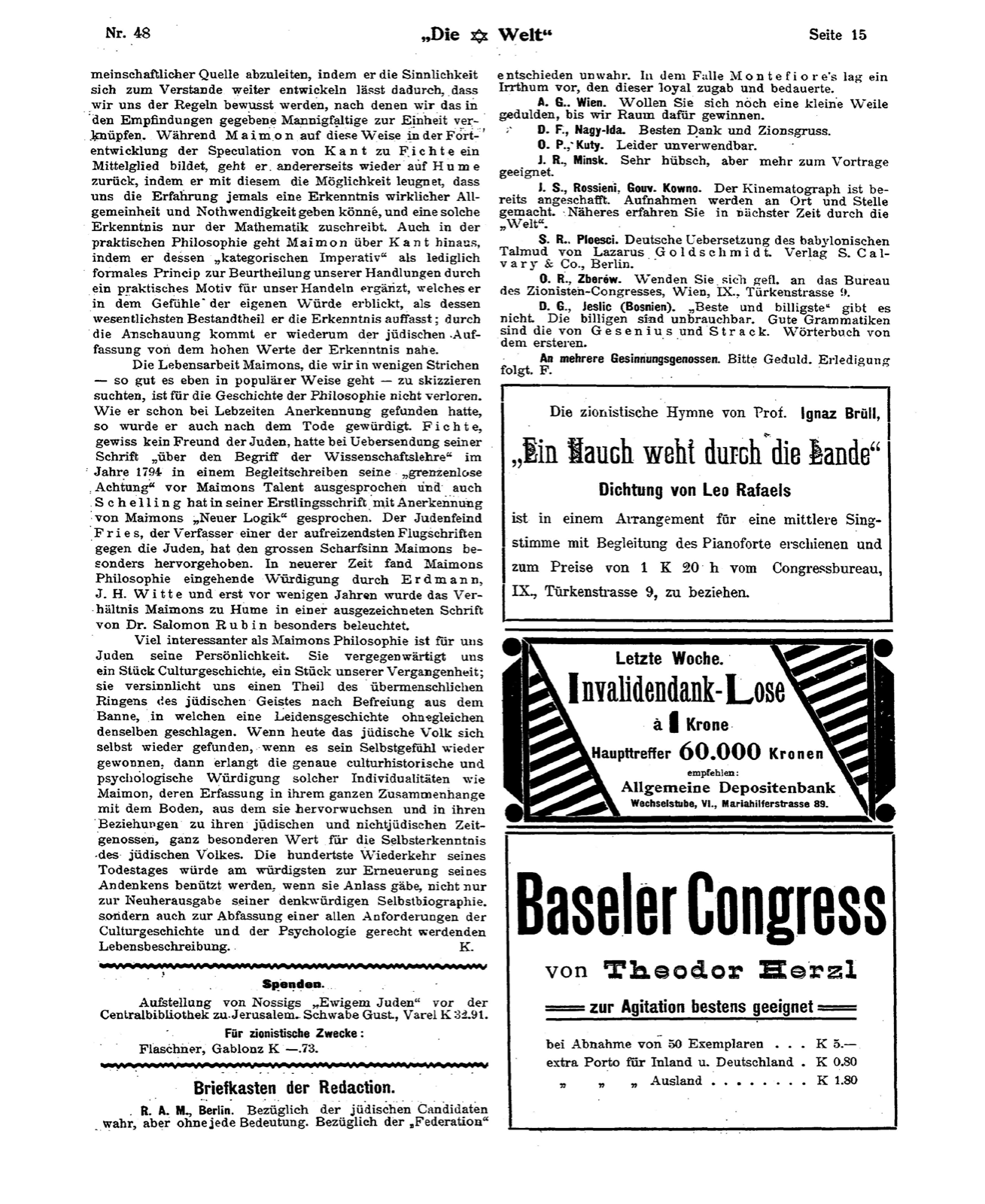
No. 48 — "Die Welt" — Page 15.
(continued from page 14)
…common source, by letting sensibility develop further into the understanding through our becoming conscious of the rules according to which we combine into unity the manifold given in the sensations. While Maimon in this way forms an intermediate link in the further development of speculation from Kant to Fichte, he on the other hand goes back again to Hume, in that he denies with him the possibility that experience can ever give us a knowledge of real universality and necessity, and ascribes such knowledge to mathematics alone. In practical philosophy too Maimon goes beyond Kant, in that he supplements his "categorical imperative", as a merely formal principle for the judging of our actions, by a practical motive for our conduct, which he discerns in the feeling of one's own dignity, of which he conceives knowledge to be the most essential constituent; through this view he again approaches the Jewish conception of the high worth of knowledge.
The life-work of Maimon, which we have sought to sketch in a few strokes — so far as that may be done in a popular manner — is not lost for the history of philosophy. As he had already found recognition in his lifetime, so was he appreciated after his death also. Fichte, assuredly no friend of the Jews, had in the year 1794, upon sending his treatise "Upon the Conception of the Theory of Science", expressed in an accompanying letter his "boundless respect" for Maimon's talent, and Schelling too spoke with recognition of Maimon's "New Logic" in his first published work. The Jew-hater Fries, the author of one of the most inflammatory pamphlets against the Jews, brought Maimon's great acuteness particularly into prominence. In more recent times Maimon's philosophy found a searching appreciation through Erdmann and J. H. Witte, and but a few years ago the relation of Maimon to Hume was specially illuminated in an excellent treatise by Dr. Salomon Rubin.
Far more interesting to us Jews than Maimon's philosophy is his personality. It brings before us a piece of the history of civilisation, a piece of our own past; it makes palpable to us a part of the superhuman wrestling of the Jewish spirit after deliverance from the ban into which a history of suffering without parallel had cast it. If to-day the Jewish people has found itself again, if it has regained its self-consciousness, then the exact appreciation, in the light of the history of civilisation and of psychology, of such individualities as Maimon — the grasping of them in their whole connection with the soil out of which they grew and in their relations to their Jewish and non-Jewish contemporaries — acquires a quite peculiar value for the self-knowledge of the Jewish people. The hundredth return of the day of his death would be most worthily employed for the renewal of his memory if it gave occasion, not only for a fresh edition of his memorable autobiography, but also for the composition of a biography satisfying all the requirements of the history of civilisation and of psychology.
K.
Donations.
For the erection of Nossig's "Eternal Jew" before the Central Library at Jerusalem. Schwabe Gust., Varel K 32.91.
For Zionist purposes: Flaschner, Gablonz K —.73.
The Editor's Letter-Box.
R. A. M., Berlin. As regards the Jewish candidates, true, but without any significance whatever. As regards the "Federation", decidedly untrue. In the case of Montefiore there was an error, which he loyally admitted and regretted.
A. G., Vienna. Will you have patience yet a little while, until we gain room for it.
D. F., Nagy-Ida. Best thanks and Zion's greeting.
O. P., Kuty. Unfortunately not usable.
J. R., Minsk. Very pretty, but better suited for delivery as a lecture.
J. S., Rossieni, Gov. Kowno. The cinematograph has already been procured. The pictures will be taken on the spot. You will learn further particulars shortly through the "Welt".
S. R., Ploesci. German translation of the Babylonian Talmud by Lazarus Goldschmidt. Published by S. Calvary & Co., Berlin.
O. R., Zborów. Be so good as to apply to the Bureau of the Zionist Congress, Vienna, IX., Türkenstrasse 9.
D. G., Jeslic (Bosnia). "Best and cheapest" there is not. The cheap ones are useless. Good grammars are those of Gesenius and Strack. Dictionary by the former.
To several fellow-partisans. Patience, please. A settlement will follow. F.
The Zionist hymn by Prof. Ignaz Brüll,
"Ein Hauch weht durch die Lande"
Poem by Leo Rafaels
has appeared in an arrangement for a medium voice with pianoforte accompaniment, and may be obtained at the price of 1 K 20 h from the Congress Bureau, IX., Türkenstrasse 9.
Last Week.
Invalidendank Lottery Tickets
at 1 Krone
Chief prize 60,000 Kronen
are recommended by:
Allgemeine Depositenbank
Exchange Office, VI., Mariahilferstrasse 89.
The Basle Congress
by Theodor Herzl
excellently suited for agitation
on taking 50 copies . . . K 5.— extra postage for the home country and Germany . K 0.80 " " " abroad . . . . . . K 1.80