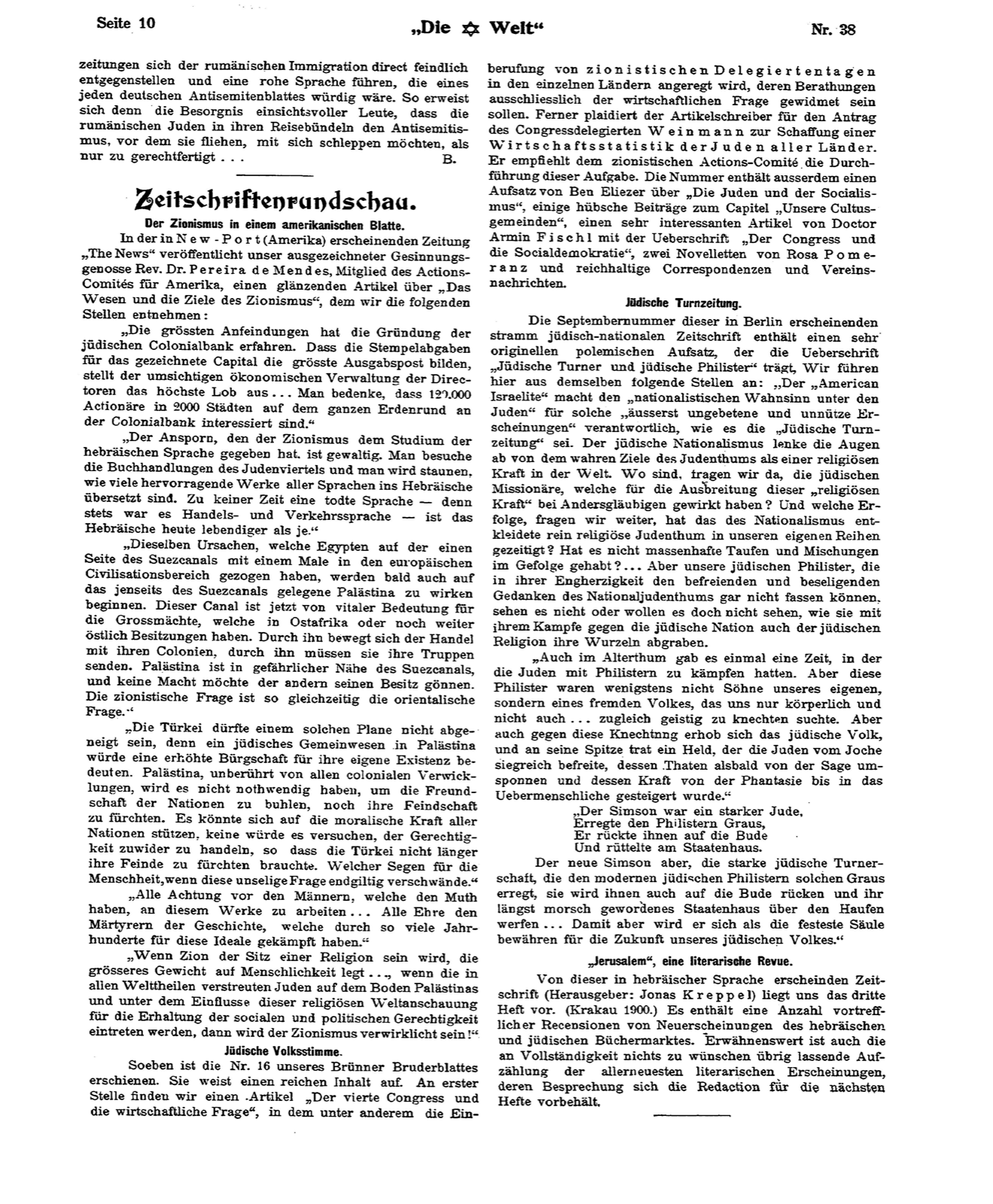
Page 10. — "Die Welt" — No. 38.
(continued from page 9)
…papers set themselves directly in hostility to the Roumanian immigration and use a coarse language that would be worthy of any German anti-Semitic sheet. Thus the apprehension of discerning people, that the Roumanian Jews might drag along with them in their travelling bundles the very anti-Semitism from which they flee, proves but too well justified... B.
Review of the Periodicals.
Zionism in an American Journal.
In the newspaper "The News," which appears in New-Port (America), our excellent fellow-worker the Rev. Dr. Pereira de Mendes, member of the Actions Committee for America, publishes a brilliant article upon "The Nature and the Aims of Zionism," from which we take the following passages:
"The founding of the Jewish Colonial Bank has met with the greatest hostility. That the stamp duties upon the subscribed capital form the largest item of expenditure bears the highest testimony to the prudent economic administration of the directors... Let it be considered that 120,000 shareholders in 2000 towns over the whole round of the earth are interested in the Colonial Bank."
"The impulse which Zionism has given to the study of the Hebrew language is immense. Let a man visit the bookshops of the Jewish quarter and he will be astonished how many eminent works of all languages have been translated into Hebrew. At no time a dead language — for it was always a language of commerce and of intercourse — Hebrew is to-day more living than ever."
"The same causes which at one stroke drew Egypt, upon the one side of the Suez Canal, into the sphere of European civilisation will soon begin to work also upon Palestine, which lies beyond the Suez Canal. This canal is now of vital significance for the Great Powers which have possessions in East Africa or still farther eastward. Through it moves the trade with their colonies, through it they must send their troops. Palestine lies in dangerous proximity to the Suez Canal, and no Power would willingly grant its possession to another. The Zionist question is thus at the same time the Eastern question."
"Turkey would hardly be averse to such a plan, for a Jewish commonwealth in Palestine would signify a heightened guarantee for her own existence. Palestine, untouched by all colonial entanglements, will have no need to court the friendship of the nations, nor to fear their enmity. It could rest upon the moral force of all the nations; none would attempt to act contrary to justice, so that Turkey would no longer need to fear her enemies. What a blessing for mankind, if this unhappy question were finally to disappear."
"All respect to the men who have the courage to labour at this work... All honour to the martyrs of history who through so many centuries have fought for these ideals."
"When Zion shall be the seat of a religion which lays greater weight upon humanity..., when the Jews scattered in all quarters of the world shall, upon the soil of Palestine and under the influence of this religious view of the world, stand forth for the maintenance of social and political justice, then will Zionism be realised!"
Jüdische Volksstimme.
No. 16 of our Bruenn brother-paper has just appeared. It shows a rich content. In the first place we find an article, "The Fourth Congress and the Economic Question," in which, among other things, the convocation of Zionist delegate conferences in the several countries is suggested, whose deliberations are to be devoted exclusively to the economic question. Further, the writer of the article pleads for the motion of the Congress delegate Weinmann for the creation of an economic statistic of the Jews of all countries. He recommends the carrying out of this task to the Zionist Actions Committee. The number contains besides an essay by Ben Eliezer upon "The Jews and Socialism," some pleasing contributions to the chapter "Our Religious Communities," a very interesting article by Dr. Armin Fischl with the heading "The Congress and Social Democracy," two novelettes by Rosa Pomeranz, and copious correspondence and society news.
Jüdische Turnzeitung.
The September number of this staunchly Jewish-national periodical, which appears in Berlin, contains a very original polemical essay bearing the heading "Jewish Gymnasts and Jewish Philistines," We here adduce from it the following passages: "The 'American Israelite' makes the 'nationalistic madness among the Jews' responsible for such 'exceedingly uninvited and useless phenomena' as the 'Jüdische Turnzeitung.' Jewish nationalism, it says, turns the eyes away from the true goal of Judaism as a religious force in the world. Where are, we ask thereupon, the Jewish missionaries who have laboured for the spread of this 'religious force' among those of other faiths? And what successes, we ask further, has the purely religious Judaism, stripped of nationalism, brought forth in our own ranks? Has it not had wholesale baptisms and mixed marriages in its train?... But our Jewish Philistines, who in their narrow-mindedness cannot at all grasp the liberating and blessed thought of national Judaism, do not see it, or will not see it, how with their struggle against the Jewish nation they are digging away the roots of the Jewish religion as well.
"In antiquity too there was once a time in which the Jews had to fight with Philistines. But these Philistines were at least not sons of our own people, but of a foreign one, which sought to enslave us only bodily and not also... spiritually at the same time. But against this enslavement also the Jewish people rose up, and at its head there stepped a hero who victoriously freed the Jews from the yoke, whose deeds were straightway spun about with legend and whose strength was heightened by fancy into the superhuman."
"Samson, he was a stalwart Jew,
He filled the Philistines with dread,
He marched upon their very quarters
And shook their house of state.
The new Samson, however — the strong Jewish gymnastic body, which fills the modern Jewish Philistines with such dread — will likewise march upon their quarters and cast down in a heap their long since decayed house of state... Therewith, however, he will approve himself the firmest pillar for the future of our Jewish people."
"Jerusalem," a literary review.
Of this periodical, which appears in the Hebrew language (editor: Jonas Kreppel), the third number lies before us. (Cracow, 1900.) It contains a number of excellent reviews of new publications of the Hebrew and Jewish book market. Worthy of mention also is the enumeration — leaving nothing to be desired in point of completeness — of the very newest literary publications, the discussion of which the editors reserve for the coming numbers.