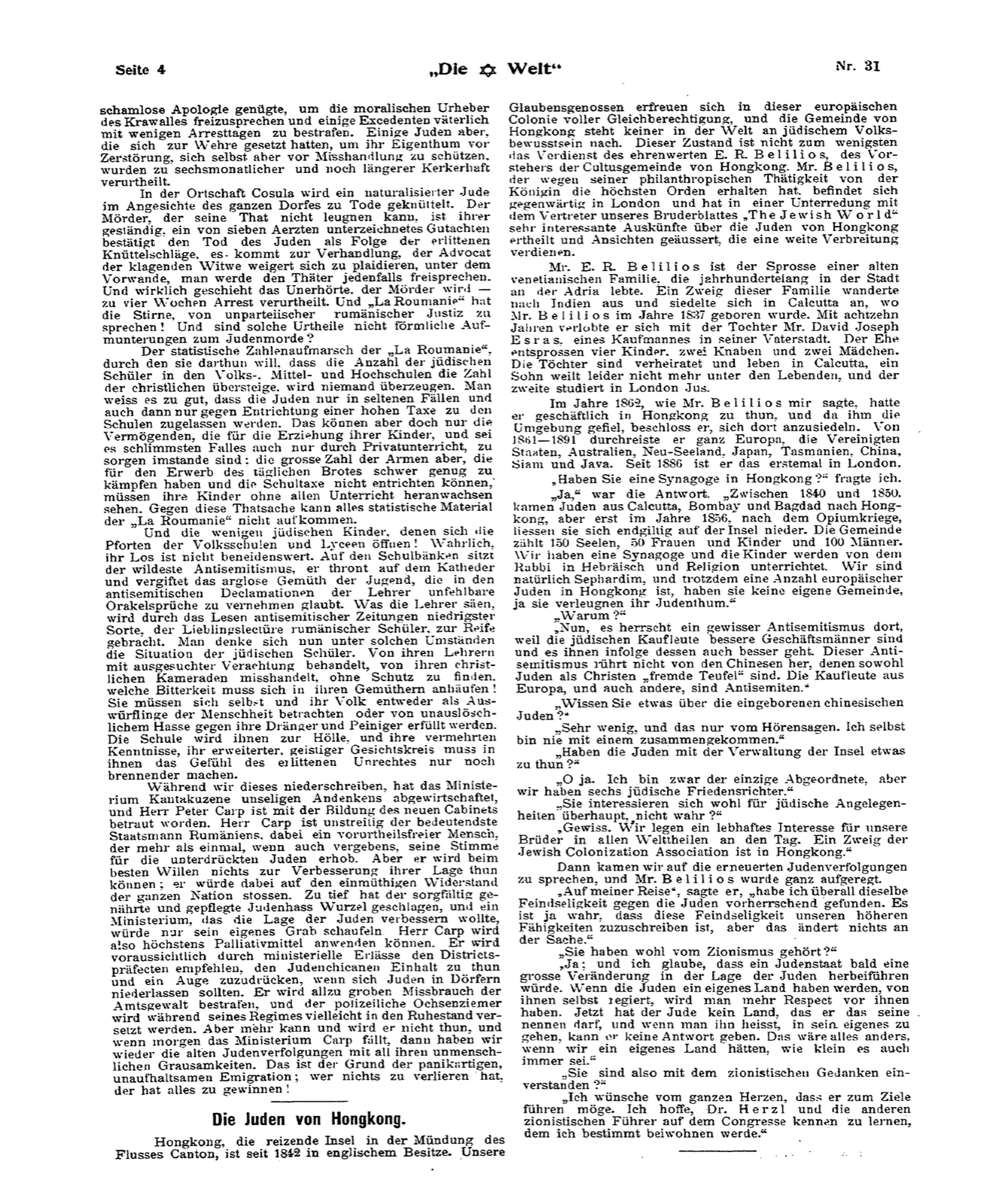
Page 4. — "Die Welt" — No. 31.
(continued from page 3)
…shameless apology sufficed to acquit the moral authors of the riot and to punish a few of the rioters paternally with a few days' arrest. Some Jews, however, who had stood upon their defence in order to protect their property from destruction and themselves from maltreatment, were sentenced to six months' and even longer imprisonment.
In the village of Cosula a naturalised Jew is cudgelled to death in the sight of the whole village. The murderer, who cannot deny his deed, confesses it; a medical opinion signed by seven physicians confirms the Jew's death as the consequence of the blows from the cudgel which he had suffered; the case comes to trial; the advocate of the plaintiff widow refuses to plead, upon the pretext that the perpetrator will in any event be acquitted. And in truth the unheard-of comes to pass: the murderer is sentenced — to four weeks' arrest. And "La Roumanie" has the effrontery to speak of impartial Roumanian justice! And are not such sentences downright encouragements to the murder of Jews?
The statistical parade of figures by "La Roumanie," by which it seeks to show that the number of Jewish pupils in the elementary schools, the secondary schools and the universities exceeds the number of the Christians, will convince nobody. It is too well known that the Jews are admitted to the schools only in rare cases, and then only upon payment of a high fee. But this only the well-to-do can do, who are in a position to provide for the education of their children, if the worst come to the worst even by private instruction alone: the great number of the poor, however, who have hard enough work to fight for the winning of their daily bread and cannot pay the school fee, must see their children grow up without any instruction at all. Against this fact all the statistical material of "La Roumanie" cannot prevail.
And the few Jewish children to whom the gates of the elementary schools and the lyceums do open! Truly, their lot is not to be envied. Upon the school benches sits the wildest anti-Semitism; it is enthroned upon the master's desk and poisons the guileless minds of the young, who believe that they hear infallible oracles in the anti-Semitic declamations of their teachers. What the teachers sow is brought to ripeness by the reading of anti-Semitic newspapers of the lowest sort, the favourite reading of Roumanian schoolboys. Let one now picture to oneself, under such circumstances, the situation of the Jewish pupils. Treated by their teachers with studied contempt, maltreated by their Christian comrades, without finding any protection, what bitterness must gather in their minds! They must either regard themselves and their people as the outcasts of humanity, or be filled with unquenchable hatred against their oppressors and tormentors. The school becomes a hell to them, and their increased knowledge, their widened mental horizon, can only make the feeling of the wrong they have suffered burn the more fiercely.
While we are writing this down, the Ministry of Cantacuzene, of unhappy memory, has run its course, and M. Peter Carp has been entrusted with the formation of the new Cabinet. M. Carp is indisputably the most eminent statesman of Roumania, and withal a man free from prejudice, who more than once, though in vain, has raised his voice for the oppressed Jews. But with the best will in the world he will be able to do nothing for the improvement of their position; he would in so doing encounter the unanimous resistance of the whole nation. Too deeply has the carefully nourished and cultivated hatred of the Jews struck root, and a Ministry that should seek to better the position of the Jews would only be digging its own grave. M. Carp will therefore be able at most to apply palliatives. He will presumably recommend the district prefects by ministerial rescripts to put a stop to the chicaneries against the Jews and to shut an eye if Jews should settle in the villages. He will punish too gross an abuse of official authority, and the ox-hide whip of the police will perhaps be pensioned off during his régime. But more he cannot and will not do; and if to-morrow the Carp Ministry falls, then we shall have again the old persecutions of the Jews with all their inhuman cruelties. That is the ground of the panic-stricken, unstayable emigration; he who has nothing to lose has everything to gain!
The Jews of Hongkong.
Hongkong, the charming island at the mouth of the Canton river, has been in English possession since 1842. Our co-religionists enjoy full equality of rights in this European colony, and the community of Hongkong yields to none in the world in Jewish national consciousness. This state of things is in no small measure the merit of the honourable E. R. Belilios, the president of the congregation of Hongkong. Mr. Belilios, who for his philanthropic activity has received the highest orders from the Queen, is at present in London, and in an interview with the representative of our sister paper "The Jewish World" he has given very interesting information about the Jews of Hongkong and expressed opinions that deserve a wide circulation.
Mr. E. R. Belilios is the scion of an old Venetian family which lived for centuries in the city upon the Adriatic. A branch of this family emigrated to India and settled in Calcutta, where Mr. Belilios was born in the year 1837. At eighteen years of age he became engaged to the daughter of Mr. David Joseph Esra, a merchant in his native city. Of the marriage there sprang four children, two boys and two girls. The daughters are married and live in Calcutta; one son is unhappily no longer among the living, and the second is studying law in London.
In the year 1862, as Mr. Belilios told me, he had business to do in Hongkong, and as the surroundings pleased him he resolved to settle there. From 1861 to 1891 he travelled through the whole of Europe, the United States, Australia, New Zealand, Japan, Tasmania, China, Siam and Java. He is in London now for the first time since 1886.
"Have you a synagogue in Hongkong?" I asked.
"Yes," was the answer. "Between 1840 and 1850 Jews came to Hongkong from Calcutta, Bombay and Bagdad, but only in the year 1856, after the Opium War, did they finally settle upon the island. The community numbers 150 souls, 50 women and children and 100 men. We have a synagogue, and the children are instructed by the Rabbi in Hebrew and in religion. We are of course Sephardim, and although there are a number of European Jews in Hongkong, they have no congregation of their own; nay, they deny their Judaism."
"Why?"
"Well, a certain anti-Semitism prevails there, because the Jewish merchants are the better men of business and consequently fare the better. This anti-Semitism does not proceed from the Chinese, to whom Jews and Christians alike are 'foreign devils.' The merchants from Europe, and others too, are anti-Semites."
"Do you know anything of the native Chinese Jews?"
"Very little, and that only by hearsay. I myself have never met with one."
"Have the Jews anything to do with the administration of the island?"
"Oh yes. I am indeed the only representative, but we have six Jewish justices of the peace."
"You take an interest, no doubt, in Jewish affairs generally, do you not?"
"Certainly. We display a lively interest in our brethren in all quarters of the globe. A branch of the Jewish Colonization Association is in Hongkong."
Then we came to speak of the renewed persecutions of the Jews, and Mr. Belilios grew quite excited.
"Upon my travels," he said, "I have found the same hostility against the Jews prevailing everywhere. It is true indeed that this hostility is to be ascribed to our higher capacities, but that alters nothing in the matter."
"You have heard, I suppose, of Zionism?"
"Yes; and I believe that a Jewish State would soon bring about a great change in the position of the Jews. When the Jews shall have a land of their own, governed by themselves, men will have more respect for them. Now the Jew has no land that he may call his own, and when he is bidden to go to his own, he can give no answer. All that would be otherwise if we had a land of our own, however small it might be."
"You are then in agreement with the Zionist idea?"
"I wish with all my heart that it may lead to its goal. I hope to make the acquaintance of Dr. Herzl and the other Zionist leaders at the Congress, which I shall certainly attend."