Page 14 — "Die Welt" — No. 31
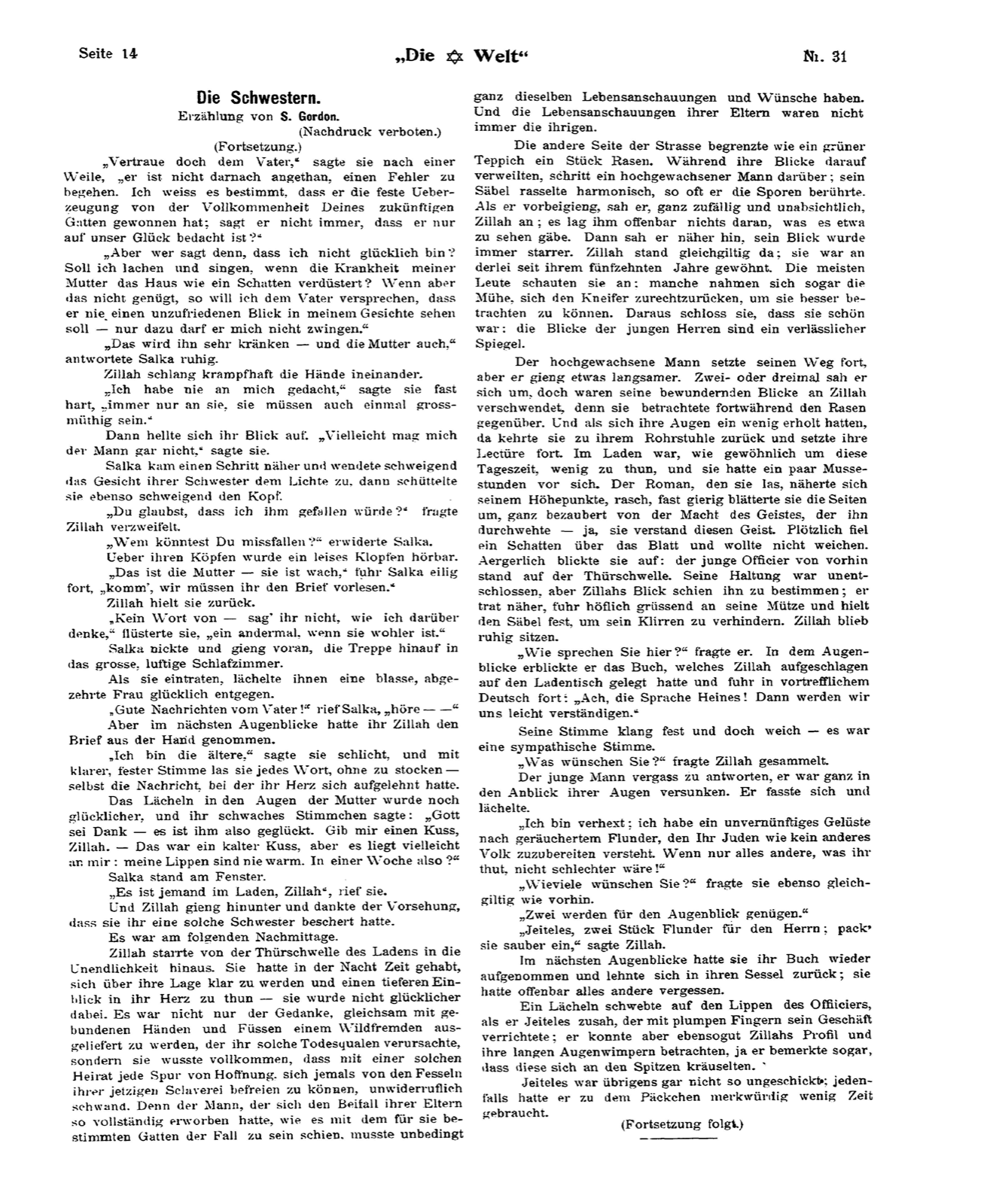
The Sisters.
A tale by S. Gordon. (Reproduction forbidden.) (Continuation.)
"Do but trust father," she said after a while, "he is not the man to commit a mistake. I know for certain that he has gained the firm conviction of the perfection of your future husband; does he not always say that he is mindful only of our happiness?"
"But who says that I am not happy? Am I to laugh and sing when my mother's illness darkens the house like a shadow? But if that is not enough, then I will promise father that he shall never see a discontented look upon my face — only to that he must not force me."
"That will grieve him deeply — and mother too," answered Salka quietly.
Zillah convulsively clasped her hands together.
"I have never thought of myself," she said almost harshly, "always only of them; they too must be magnanimous for once."
Then her look brightened. "Perhaps the man will not care for me at all," she said.
Salka came a step nearer and silently turned her sister's face towards the light, then, just as silently, shook her head.
"You believe that I should please him?" asked Zillah despairingly.
"Whom could you fail to please?" replied Salka.
Above their heads a soft knocking became audible.
"That is mother — she is awake," Salka went on hurriedly; "come, we must read her the letter."
Zillah held her back.
"Not a word of — do not tell her what I think about it," she whispered, "another time, when she is better."
Salka nodded and went before her, up the stairs into the great, airy bedroom.
As they entered, a pale, wasted woman smiled happily towards them.
"Good news from father!" cried Salka; "listen — —"
But in the next moment Zillah had taken the letter out of her hand.
"I am the elder," she said simply, and in a clear, firm voice she read every word without faltering — even the news against which her heart had rebelled.
The smile in the mother's eyes grew still happier, and her weak little voice said: "God be thanked — he has succeeded, then. Give me a kiss, Zillah. — That was a cold kiss, but perhaps it lies with me: my lips are never warm. In a week, then?"
Salka stood at the window.
"There is somebody in the shop, Zillah," she called.
And Zillah went down and thanked Providence for having bestowed such a sister upon her.
It was on the following afternoon.
Zillah stared out from the threshold of the shop into the infinite. In the night she had had time to grow clear about her situation and to take a deeper look into her heart — she did not become happier thereby. It was not only the thought of being delivered over, as it were with bound hands and feet, to an utter stranger that caused her such deathly torments; she knew perfectly well besides that with such a marriage every trace of hope of ever being able to free herself from the fetters of her present slavery vanished irrevocably. For the man who had won her parents' approval so completely as seemed to be the case with the husband destined for her must of necessity hold quite the same views of life and the same wishes. And her parents' views of life were not always hers.
The other side of the street was bordered like a green carpet by a piece of lawn. While her glances rested upon it, a tall man strode across it; his sabre rattled harmoniously as often as it touched his spurs. As he passed by, he looked, quite by chance and without intention, at Zillah; he evidently did not care what there might be to see. Then he looked more closely, and his gaze grew ever more fixed. Zillah stood there indifferent; she had been used to such things since her fifteenth year. Most people looked at her; some even took the trouble to adjust their eye-glasses in order to contemplate her the better. From this she concluded that she was beautiful; the glances of young gentlemen are a trustworthy mirror.
The tall man continued on his way, but he walked somewhat more slowly. Twice or thrice he looked round, yet his admiring glances were wasted upon Zillah, for she was contemplating the lawn opposite all the while. And when her eyes had rested a little, she returned to her cane chair and resumed her reading. In the shop there was, as usual at that hour of the day, little to do, and she had a couple of leisure hours before her. The novel she was reading was approaching its climax; rapidly, almost greedily, she turned the pages, quite enchanted by the power of the spirit that breathed through it — yes, she understood that spirit. Suddenly a shadow fell across the page and would not give way. Vexed, she looked up: the young officer of a while ago was standing upon the threshold. His bearing was irresolute, but Zillah's glance seemed to decide him; he stepped nearer, raised his hand politely to his cap in salute, and held his sabre fast to prevent its clanking. Zillah remained quietly seated.
"What language do you speak here?" he asked. At that moment he caught sight of the book which Zillah had laid open upon the counter, and continued in excellent German: "Ah, the language of Heine! Then we shall easily understand one another."
His voice sounded firm and yet soft — it was a sympathetic voice.
"What do you wish?" asked Zillah, composed.
The young man forgot to answer; he was quite sunk in the sight of her eyes. He collected himself and smiled.
"I am bewitched; I have an unreasonable craving for smoked flounder, which you Jews know how to prepare as no other people does. If only everything else that you do were no worse!"
"How many do you wish?" she asked, as indifferently as before.
"Two will suffice for the moment."
"Jeiteles, two flounders for the gentleman; pack them up neatly," said Zillah.
In the next moment she had taken up her book again and leaned back in her chair; she had evidently forgotten everything else.
A smile hovered upon the officer's lips as he watched Jeiteles, who went about his business with clumsy fingers; but he could just as well contemplate Zillah's profile and her long eyelashes — indeed, he even observed that these curled at the tips.
Jeiteles, moreover, was not so unhandy after all; at any rate he had needed remarkably little time for the little parcel.
(To be continued.)