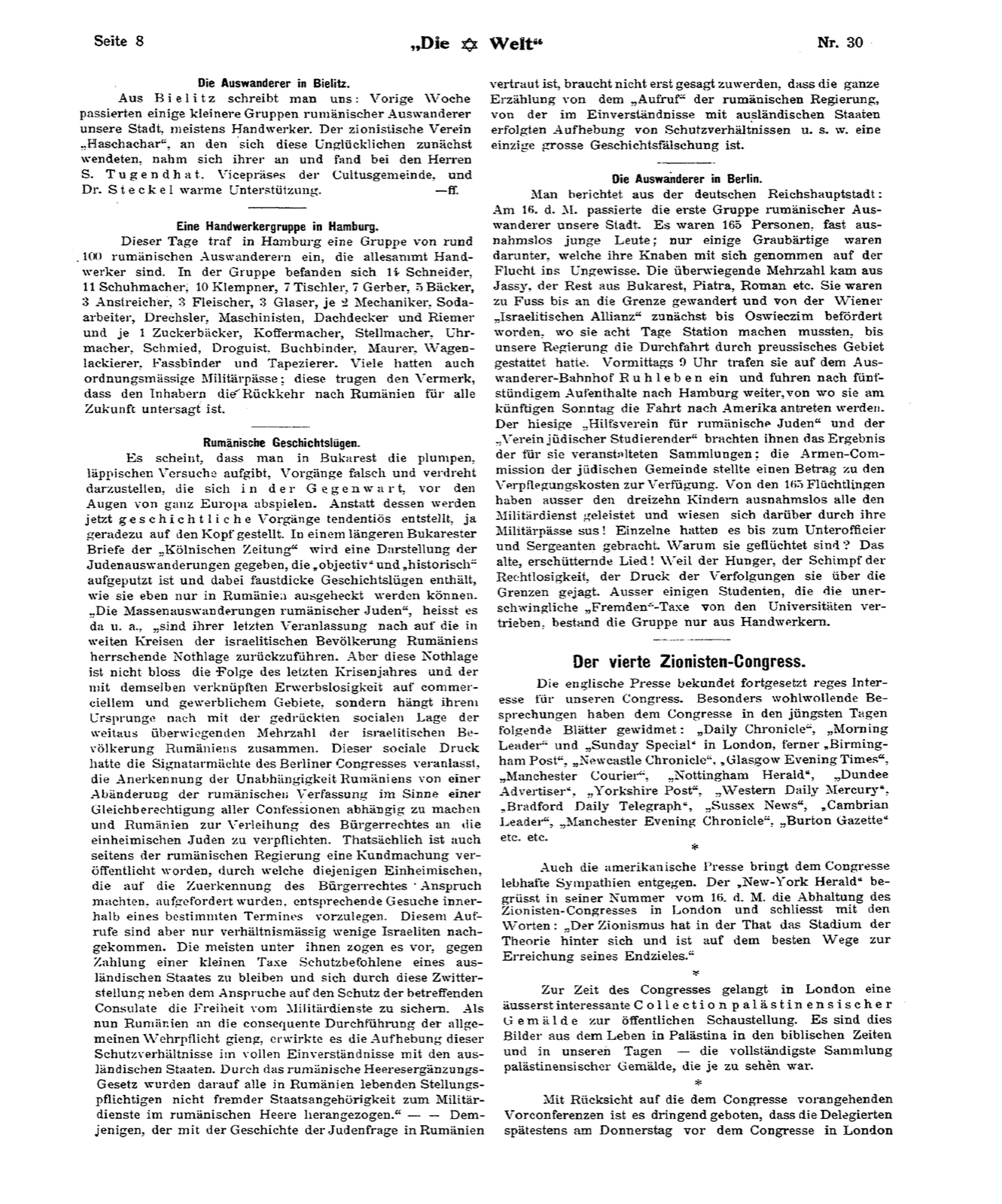
Page 8. — "Die Welt" — No. 30.
The Emigrants in Bielitz. It is written to us from Bielitz: Last week several smaller groups of Roumanian emigrants passed through our town, for the most part artisans. The Zionist union "Haschachar", to which these unfortunates first turned, took up their cause and found warm support in Messrs. S. Tugendhat, vice-president of the religious community, and Dr. Steckel. —ff.
A Group of Artisans in Hamburg. These days there arrived in Hamburg a group of about 100 Roumanian emigrants, who are one and all artisans. In the group there were 14 tailors, 11 shoemakers, 10 tinsmiths, 7 joiners, 7 tanners, 5 bakers, 3 house-painters, 3 butchers, 3 glaziers, 2 each of mechanics, soda-workers, turners, machinists, roofers and strap-makers, and 1 each of confectioner, trunk-maker, cartwright, watchmaker, smith, druggist, bookbinder, mason, carriage-painter, cooper and upholsterer. Many had also regular military passports; these bore the endorsement that the holders are forbidden to return to Roumania for all time to come.
Roumanian Historical Lies. It seems that in Bucharest the clumsy, fatuous attempts are being abandoned to represent falsely and distortedly events which are taking place in the present, before the eyes of all Europe. Instead of this, historical events are now tendentiously perverted, nay, downright turned upon their heads. In a lengthy Bucharest letter of the "Kölnische Zeitung" an account of the Jewish emigrations is given which is tricked out as "objective" and "historical", and withal contains historical lies of the rankest sort, such as can be hatched only in Roumania. "The mass emigrations of Roumanian Jews", it is there said among other things, "are according to their ultimate occasion to be traced back to the distress prevailing in wide circles of the Israelitish population of Roumania. But this distress is not merely the consequence of the last year of crisis and of the want of employment in the commercial and industrial field bound up therewith; in its origin it is connected with the depressed social condition of the far preponderating majority of the Israelitish population of Roumania. This social pressure had moved the signatory Powers of the Berlin Congress to make the recognition of the independence of Roumania dependent upon an alteration of the Roumanian constitution in the sense of an equality of rights of all confessions, and to bind Roumania to the conferring of the citizen's right upon the native Jews. In point of fact a proclamation was also published on the part of the Roumanian Government, by which those natives who laid claim to the award of the citizen's right were called upon to lay their respective petitions before it within a fixed term. But only comparatively few Israelites complied with this summons. Most among them preferred, against payment of a small fee, to remain protected subjects of a foreign State and, through this hybrid position, to secure for themselves, besides the claim to the protection of the consulates concerned, freedom from military service. When Roumania then proceeded to the consistent carrying through of universal military duty, it obtained the abolition of these relations of protection in full agreement with the foreign States. By the Roumanian Army Recruiting Law all persons liable to service living in Roumania who were not of foreign nationality were thereupon drawn to military service in the Roumanian army." — — To him who is familiar with the history of the Jewish question in Roumania it need not first be said that the whole narrative of the "summons" of the Roumanian Government, of the abolition of relations of protection effected in agreement with foreign States, and so forth, is one single great falsification of history.
The Emigrants in Berlin. It is reported from the German imperial capital: On the 16th inst. the first group of Roumanian emigrants passed through our city. There were 165 persons, almost without exception young people; only a few grey-beards were among them, who had taken their boys with them in the flight into the uncertain. The preponderating majority came from Jassy, the rest from Bucharest, Piatra, Roman, etc. They had wandered on foot as far as the frontier and had been conveyed by the Vienna "Israelitish Alliance" in the first instance as far as Oswieczim, where they had to make a halt of eight days until our Government had permitted the passage through Prussian territory. At 9 o'clock in the forenoon they arrived at the emigrants' station Ruhleben and, after a stay of five hours, went on to Hamburg, whence they will set out next Sunday upon the voyage to America. The local "Relief Union for Roumanian Jews" and the "Union of Jewish Students" brought them the proceeds of the collections made on their behalf; the Poor Commission of the Jewish community placed a sum at their disposal towards the cost of maintenance. Of the 165 fugitives, all without exception save the thirteen children have performed military service, and proved it by their military passports! Individual men among them had risen to be non-commissioned officer and sergeant. Why have they fled? The old, harrowing song! Because hunger, the shame of rightlessness, the pressure of persecutions have driven them across the frontiers. Apart from a few students whom the prohibitive "foreigners'" fee had driven from the universities, the group consisted only of artisans.
The Fourth Zionist Congress.
The English press continues to manifest a lively interest in our Congress. Particularly benevolent notices have been devoted to the Congress in the most recent days by the following journals: "Daily Chronicle", "Morning Leader" and "Sunday Special" in London, further "Birmingham Post", "Newcastle Chronicle", "Glasgow Evening Times", "Manchester Courier", "Nottingham Herald", "Dundee Advertiser", "Yorkshire Post", "Western Daily Mercury", "Bradford Daily Telegraph", "Sussex News", "Cambrian Leader", "Manchester Evening Chronicle", "Burton Gazette", etc. etc.
*
The American press also brings lively sympathies to the Congress. The "New-York Herald", in its number of the 16th inst., greets the holding of the Zionist Congress in London and closes with the words: "Zionism has in truth left the stage of theory behind it and is in the fairest way to the attainment of its final aim."
*
At the time of the Congress an exceedingly interesting collection of Palestinian paintings will come to public exhibition in London. These are pictures from the life in Palestine in the Biblical times and in our own days — the most complete collection of Palestinian paintings that has ever been seen.
*
In consideration of the preliminary conferences preceding the Congress, it is urgently required that the delegates be at latest on the Thursday before the Congress in London