Page 8. — "Die ✡ Welt" — No. 28.
(continued from page 7)
…frankly — that those who wander hither from Roumania pass the night in the public streets, as I have read in the newspapers, under the arches of bridges, and positively encamp there. That is a new institution in Vienna. If Christians were to do that, they would be dealt with in quite another fashion."
The Emigrants in Lemberg.
A comrade in the cause at Lemberg reports to us: On the 5th inst. 170 Jewish emigrants from Roumania, provided with ship's passes for Canada, passed through here. At the railway station they were hospitably entertained during the halt of an hour by the local Zionists.
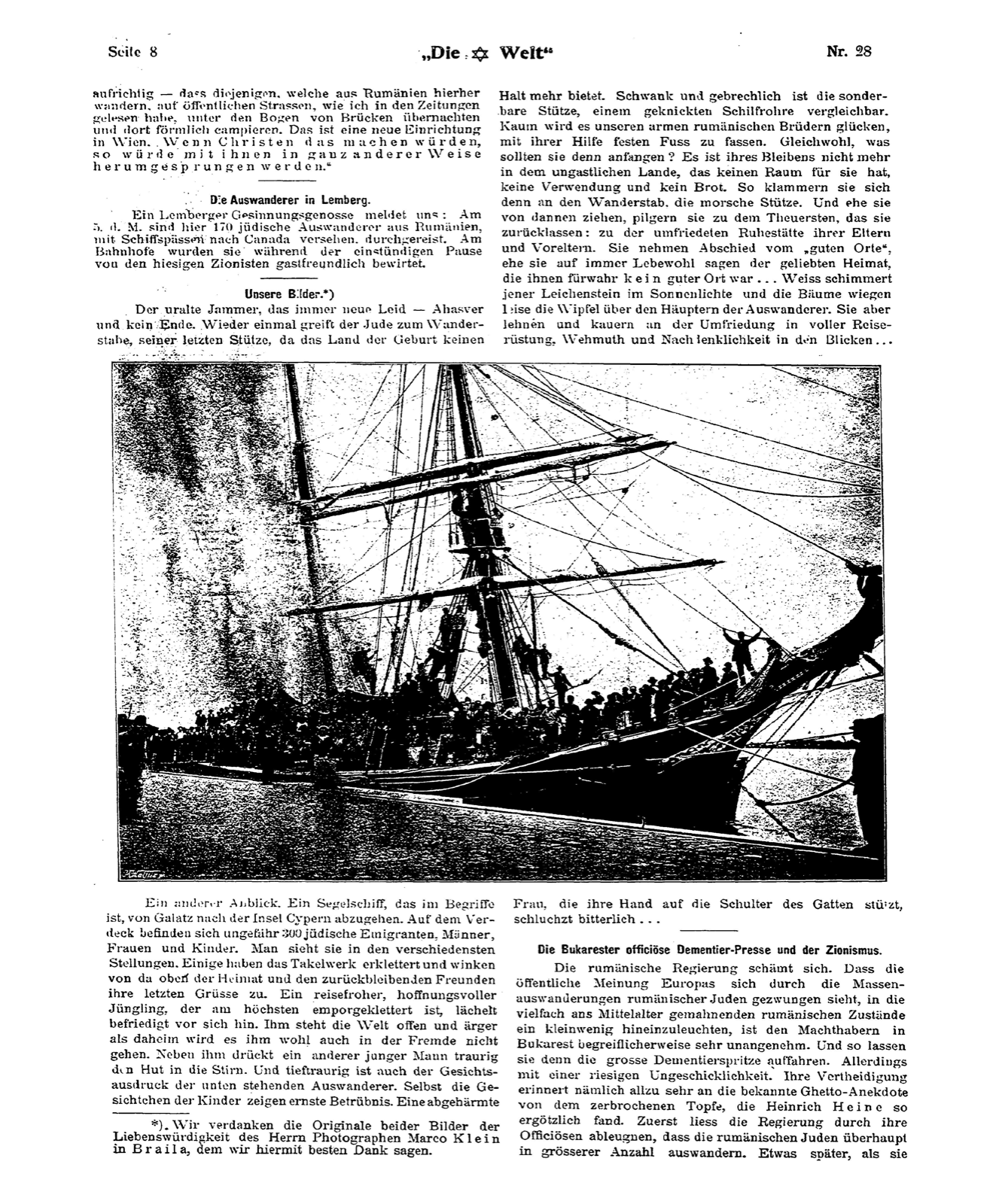
Our Pictures.*)
The immemorial lamentation, the ever-new sorrow — Ahasuerus and no end. Once again the Jew grasps the wanderer's staff, his last support, since the land of his birth offers him a hold no longer. Unsteady and frail is that singular support, comparable to a bruised reed. Hardly will it be granted to our poor Roumanian brethren to gain a firm footing by its help. And yet, what should they do? There is no more abiding for them in the inhospitable land that has no room for them, no employment and no bread. So they cling to the wanderer's staff, the rotten support. And ere they depart thence, they make pilgrimage to the dearest thing that they leave behind: to the walled resting-place of their parents and forefathers. They take leave of the "good place" before they say farewell for ever to the beloved homeland, which was in truth no good place to them . . . White gleams yonder gravestone in the sunlight, and the trees rock their tops softly above the heads of the emigrants. But they lean and crouch against the enclosure in full travelling array, sadness and pensiveness in their looks . . .
Another sight. A sailing vessel that is on the point of departing from Galatz for the island of Cyprus. Upon the deck are some 300 Jewish emigrants, men, women and children. One sees them in the most various attitudes. Some have climbed the rigging and wave from up there their last greetings to the homeland and to the friends they leave behind. A youth, glad of the journey and full of hope, who has climbed highest of all, smiles contentedly to himself. The world stands open to him, and worse than at home it will hardly go with him in a strange land either. Beside him another young man sadly presses his hat down upon his brow. And deeply sad also is the expression on the faces of the emigrants standing below. Even the little faces of the children show a grave affliction. A careworn woman, who rests her hand upon her husband's shoulder, sobs bitterly . . .
The Bucharest Officious Denial-Press and Zionism.
The Roumanian Government is ashamed. That the public opinion of Europe finds itself compelled by the mass emigrations of Roumanian Jews to throw a little light into Roumanian conditions, which in many respects call the Middle Ages to mind, is naturally very disagreeable to the powers that be in Bucharest. And so they bring up the great denial-engine. With an enormous clumsiness, it is true. For their defence recalls all too strongly the well-known ghetto anecdote of the broken pot, which Heinrich Heine found so diverting. First the Government caused its officious organs to deny that the Roumanian Jews are emigrating in any considerable numbers at all. Somewhat later, when they
*) We owe the originals of both pictures to the kindness of Herr Marco Klein, photographer, in Braila, to whom we hereby offer our best thanks.