No. 21. — "Die Welt" — Page 3.
(continued from page 2)
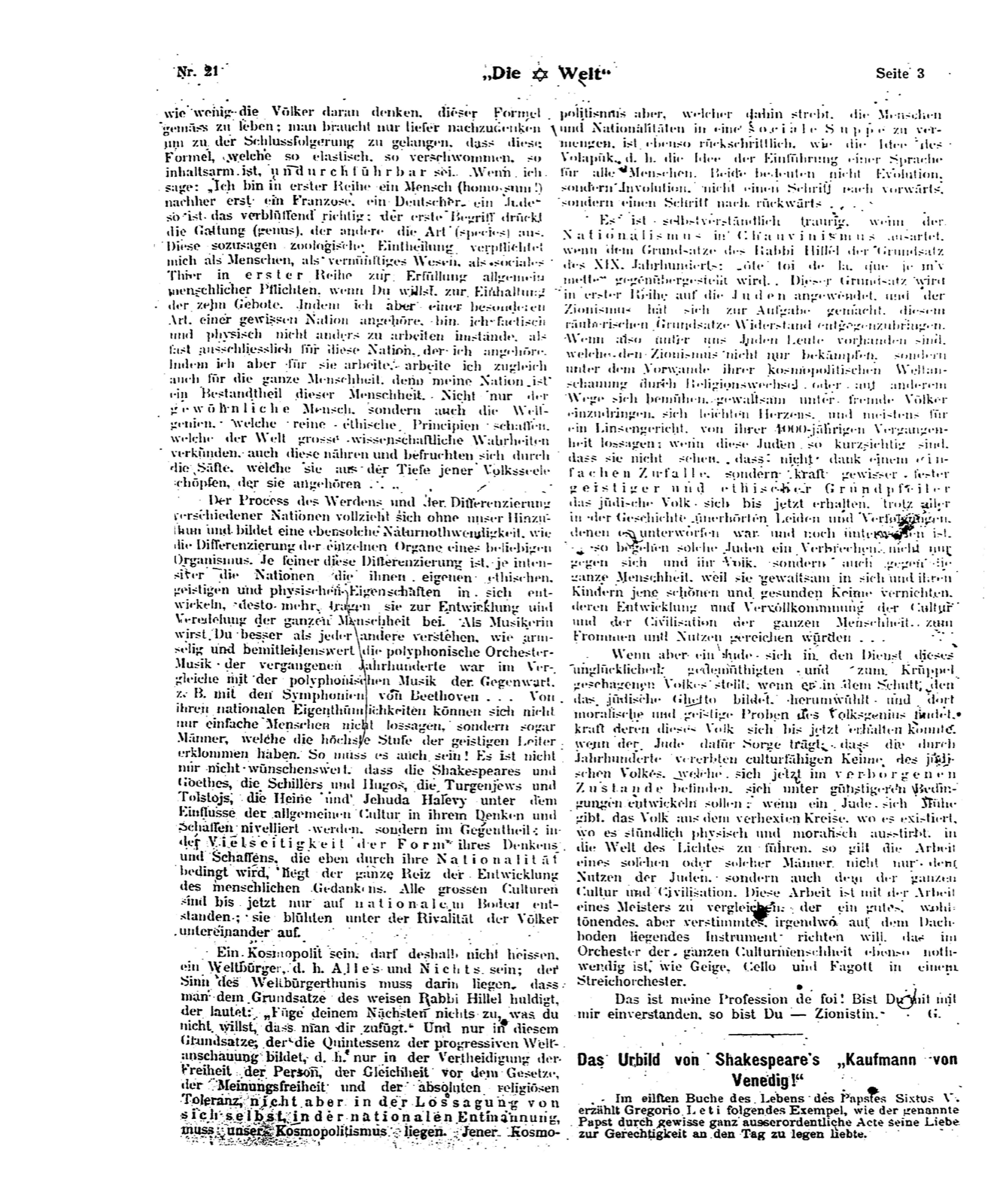
…how little the peoples think of living in accordance with this formula; one need only reflect more deeply in order to arrive at the conclusion that this formula, which is so elastic, so vague, so poor in content, is impracticable. When I say: "I am in the first place a man (homo sum!), and only afterwards a Frenchman, a German, a Jew," that is strikingly correct; the first conception expresses the genus (genus), the other the kind (species). This, so to say, zoological division obliges me as a man, as a rational being, as a social animal, in the first place to the fulfilment of universally human duties — if you will, to the keeping of the Ten Commandments. But inasmuch as I belong to a particular kind, to a certain nation, I am in fact and physically not in a condition to work otherwise than almost exclusively for this nation to which I belong. But inasmuch as I work for it, I work at the same time also for the whole of mankind, for my nation is a component part of this mankind. Not only the ordinary man, but the world-geniuses also, who create pure ethical principles, who proclaim to the world great scientific truths — these too nourish and fructify themselves through the saps which they draw out of the depth of that folk-soul to which they belong . . .
The process of the becoming and of the differentiation of the various nations accomplishes itself without our doing, and forms just such a necessity of nature as the differentiation of the several organs of any organism. The finer this differentiation is, the more intensively the nations develop within themselves the ethical, spiritual and physical properties peculiar to them, the more do they contribute to the development and the ennobling of the whole of mankind. As a musician you will understand better than any other how paltry and pitiable the polyphonic orchestral music of past centuries was in comparison with the polyphonic music of the present, for example with the symphonies of Beethoven . . . From their national peculiarities not only simple men are unable to cut themselves loose, but even men who have climbed the highest rung of the spiritual ladder. And so it must be! It is not only not desirable that the Shakespeares and Goethes, the Schillers and Hugos, the Turgenieffs and Tolstois, the Heines and Jehuda Halevys should, under the influence of the general culture, be levelled in their thinking and their creating — on the contrary; in the many-sidedness of the form of their thinking and their creating, which is conditioned precisely by their nationality, lies the whole charm of the development of human thought. All great cultures have hitherto arisen only upon national soil; they flourished amid the rivalry of the peoples with one another.
To be a cosmopolitan may therefore not mean to be a citizen of the world, that is, to be All and Nothing; the sense of world-citizenship must lie in this, that one does homage to the maxim of the wise Rabbi Hillel, which runs: "Do unto thy neighbour nothing that thou wouldst not have done unto thee." And only in this maxim, which forms the quintessence of the progressive world-view, that is, only in the defence of the freedom of the person, of equality before the law, of freedom of opinion and of absolute religious toleration, and not in the cutting loose from oneself, in national emasculation, must our Cosmopolitanism lie. That Cosmopolitanism, however, which strives to mingle men and nationalities into a social soup, is just as retrograde as the idea of Volapük, that is, the idea of the introduction of one language for all men. Both signify not evolution but involution, not a step forward but a step backward . . .
It is of course sad when nationalism degenerates into chauvinism, when to the maxim of Rabbi Hillel there is opposed the maxim of the XIXth century: "ôte toi de là, que je m'y mette." This maxim is applied in the first place to the Jews, and Zionism has made it its task to offer resistance to this predatory maxim. If, then, there are among us Jews people who not only combat Zionism, but under the pretext of their cosmopolitan world-view endeavour, by change of religion or by another way, forcibly to press in among foreign peoples, who with a light heart, and mostly for a mess of pottage, cut themselves loose from their 4000-year-old past; if these Jews are so short-sighted that they do not see that it is not thanks to a simple accident, but by virtue of certain firm spiritual and ethical foundation-pillars, that the Jewish people has maintained itself until now, in spite of all the sufferings and persecutions unheard of in history to which it was and still is subjected — then such Jews commit a crime, not only against themselves and their people, but also against the whole of mankind, because they forcibly destroy in themselves and in their children those fair and healthy germs whose development and perfecting would redound to the profit and the benefit of the culture and the civilisation of the whole of mankind . . .
But when a Jew places himself in the service of this unhappy, humiliated and cripple-beaten people, when he rummages in the rubbish which the Jewish ghetto forms, and finds there moral and spiritual proofs of the folk-genius by virtue of which this people has been able to maintain itself until now; when the Jew takes care that the culture-capable germs of the Jewish people, inherited through centuries, which now find themselves in a hidden condition, shall develop under more favourable conditions; when a Jew gives himself the trouble to lead the people out of the bewitched circle in which it exists, in which hourly it dies out physically and morally, into the world of light — then the work of such a man or of such men avails not only the benefit of the Jews, but also that of the whole of culture and civilisation. This work is to be compared with the work of a master who will set right a good, well-sounding, but untuned instrument lying somewhere in the garret, which is as necessary in the orchestra of the whole of cultured mankind as violin, cello and bassoon in a string orchestra.
That is my profession de foi! If you are of one mind with me, then you are — a Zionist. — G.
The Original of Shakespeare's "Merchant of Venice"
In the eleventh book of the Life of Pope Sixtus V., Gregorio Leti relates the following example of how the said Pope loved to bring to light his love of justice by certain quite extraordinary acts.