Page 6. — "Die Welt" — No. 17.
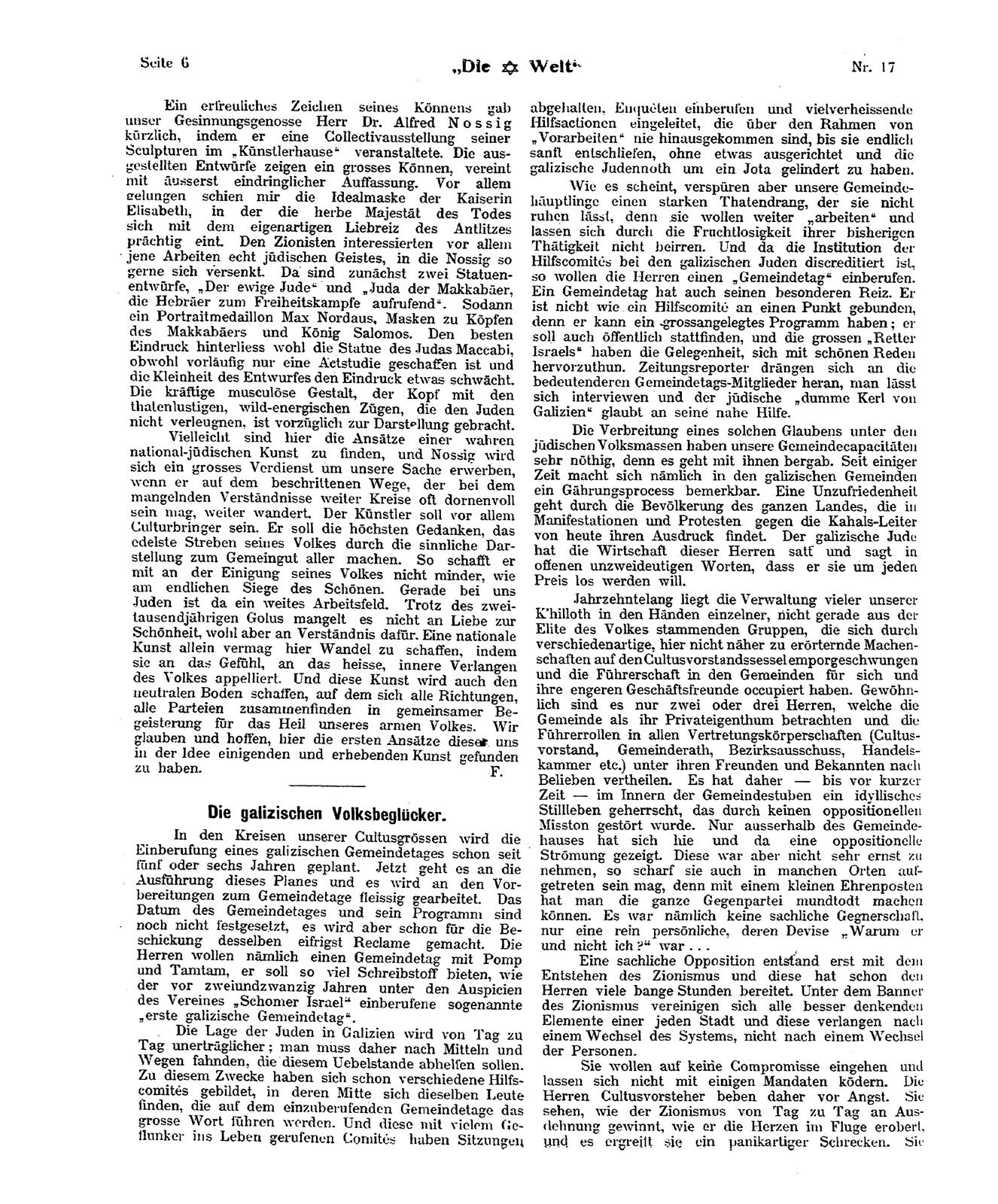
A gratifying token of his powers was lately given by our fellow Zionist Dr. Alfred Nossig, in arranging a collective exhibition of his sculptures in the "Künstlerhaus." The designs exhibited show a great mastery, united with an exceedingly penetrating conception. Above all, the ideal mask of the Empress Elisabeth seemed to me successful, in which the austere majesty of death unites splendidly with the peculiar charm of the countenance. The Zionists were interested above all in those works of a genuinely Jewish spirit in which Nossig so gladly immerses himself. There are, first of all, two designs for statues, "The Eternal Jew" and "Judah the Maccabee, summoning the Hebrews to the struggle for freedom." Then a portrait medallion of Max Nordau, masks for heads of the Maccabee and of King Solomon. The best impression was left, no doubt, by the statue of Judas Maccabi, although as yet only a study from the nude has been executed, and the smallness of the design somewhat weakens the effect. The vigorous muscular figure, the head with its eager, wildly energetic features, which do not belie the Jew, is admirably brought to representation.
Perhaps the beginnings of a true national Jewish art are here to be found, and Nossig will earn a great merit in our cause if he continues to walk in the path he has entered upon, which, given the want of understanding in wide circles, may often enough be thorny. The artist should be above all a bringer of culture. He should, through sensible representation, make the highest thoughts, the noblest strivings of his people the common possession of all. Thus he works at the unification of his people no less than at the final victory of the beautiful. Precisely among us Jews there is here a wide field of labour. In spite of the two-thousand-year Golus there is no lack of love for beauty, but there is a lack of understanding of it. A national art alone is able here to bring about a change, in that it appeals to the feeling, to the ardent inward longing of the people. And this art will also create the neutral ground upon which all tendencies, all parties may come together in a common enthusiasm for the welfare of our poor people. We believe and hope that we have found here the first beginnings of this art, which unites and uplifts us in the idea.
F.
The Galician Benefactors of the People.
In the circles of our Cultus magnates the convocation of a Galician Communal Congress has been planned these five or six years past. Now the execution of this plan is taken in hand, and the preparations for the Communal Congress are being diligently pushed forward. The date of the Communal Congress and its programme are not yet fixed, but advertisement is already being most zealously made for the sending of delegates to it. For the gentlemen want a Communal Congress with pomp and flourish of trumpets; it is to furnish as much matter for the pen as the so-called "first Galician Communal Congress" convoked two-and-twenty years ago under the auspices of the society "Schomer Israel."
The condition of the Jews in Galicia grows from day to day more insupportable; one must therefore hunt after ways and means to remedy this evil state of things. To this end various relief committees have already been formed, in the midst of which are found the very same people who will lead the talk at the Communal Congress that is to be convoked. And these committees, called into being with much fanfaronade, have held sittings, convoked inquiries, and set on foot much-promising relief actions, which never got beyond the compass of "preliminary labours," until at last they gently fell asleep, without having accomplished anything or having alleviated the Galician Jewish distress by a jot.
It would seem, however, that our communal chieftains feel a strong craving for action which leaves them no rest, for they mean to go on "working," and are not to be put out by the fruitlessness of their activity hitherto. And since the institution of relief committees is discredited among the Galician Jews, the gentlemen wish to convoke a "Communal Congress." A Communal Congress has too its particular attraction. It is not, like a relief committee, bound to a single point, for it can have a programme laid out on a grand scale; it is also to take place publicly, and the great "saviours of Israel" have the opportunity of distinguishing themselves with fine speeches. Newspaper reporters press about the more considerable members of the Communal Congress, one allows oneself to be interviewed, and the Jewish "stupid fellow of Galicia" believes that help is at hand.
The spreading of such a belief among the Jewish masses our communal luminaries have very much need of, for things are going downhill with them. For some time past a process of fermentation has been making itself noticeable in the Galician communities. A discontent runs through the population of the whole land, which finds its expression in manifestations and protests against the Kahal leaders of to-day. The Galician Jew has had enough of the management of these gentlemen, and says in open, unambiguous words that he means to be rid of them at any price.
For decades the administration of many of our K'hilloth has lain in the hands of individual groups, not exactly sprung from the elite of the people, who by manœuvres of various kinds, not here to be discussed in detail, have swung themselves up into the chair of the Cultus board and have occupied the leadership in the communities for themselves and their nearer business friends. Commonly it is only two or three gentlemen who regard the community as their private property and distribute the leading parts in all representative bodies (Cultus board, town council, district committee, chamber of commerce, etc.) among their friends and acquaintances at their pleasure. There has therefore — until quite lately — prevailed within the communal chambers an idyllic still life, disturbed by no discordant note of opposition. Only outside the communal house has an oppositional current shown itself here and there. This, however, was not to be taken very seriously, sharply as it may have come forward in many places, for with a small post of honour the whole opposing party could be silenced. For it was no opposition on grounds of principle, but a purely personal one, whose device was, "Why he and not I?"...
An opposition on grounds of principle first arose with the rise of Zionism, and this has already prepared many an anxious hour for the gentlemen. Under the banner of Zionism all the better-thinking elements of every town unite, and these demand a change of the system, not a change of persons.
They will enter into no compromises and are not to be lured with a few mandates. The gentlemen of the Cultus board therefore tremble with fear. They see how Zionism gains from day to day in extension, how it conquers hearts at a rush, and a panic terror seizes them. They