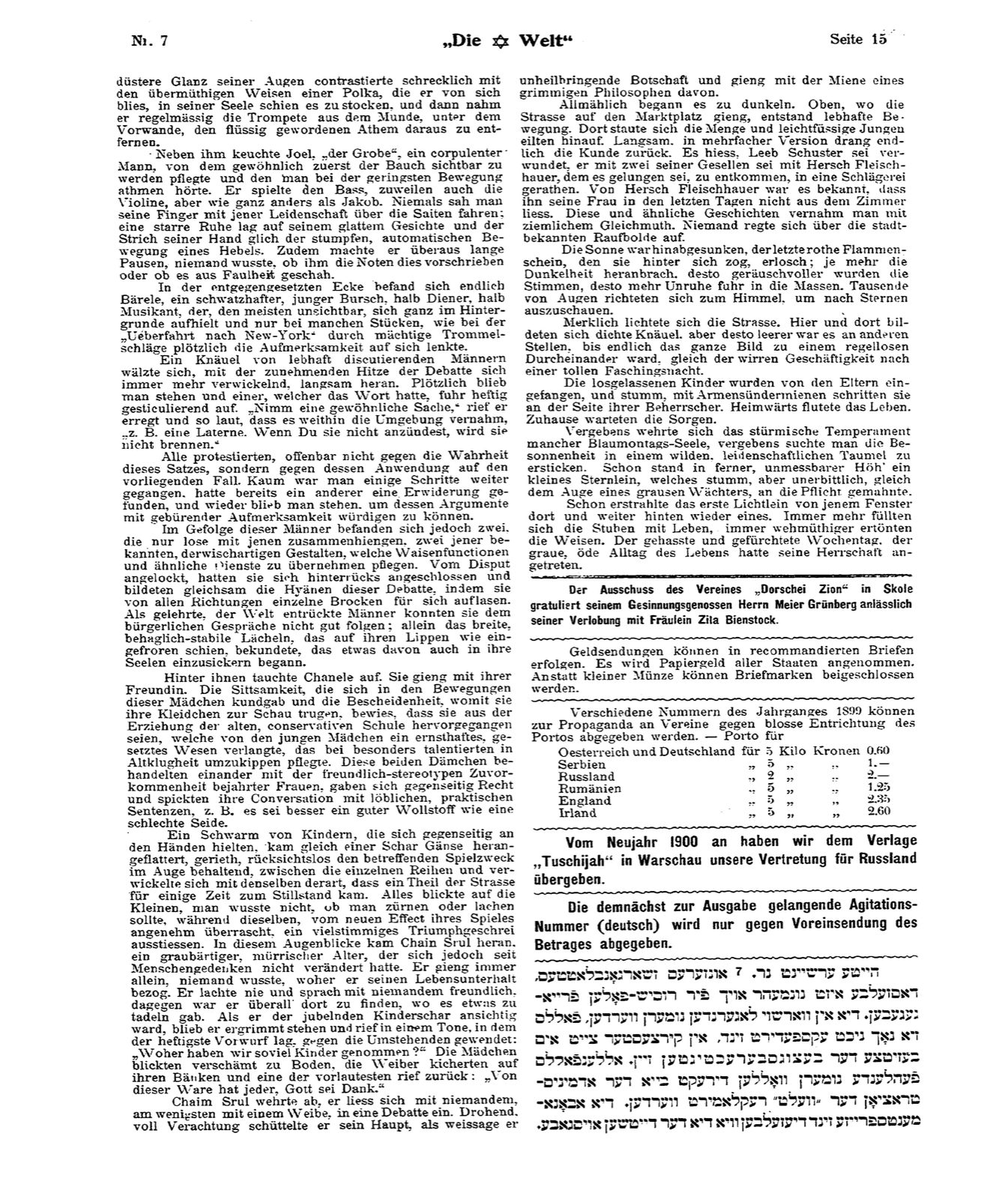
No. 7. — "Die Welt" — Page 15.
(continued from page 14)
…gloomy gleam of his eyes contrasted frightfully with the high-spirited strains of a polka which he blew forth; in his soul it seemed to come to a standstill, and then he regularly took the trumpet from his mouth, under the pretext of removing from it the breath that had turned to liquid.
Beside him panted Joel, "the Coarse", a corpulent man, of whom as a rule the belly was wont to become visible first and whom one heard breathing at the slightest movement. He played the bass, at times the violin also, but how differently from Jakob! Never did one see his fingers travel over the strings with that passion; a rigid calm lay upon his smooth face, and the stroke of his hand resembled the dull, automatic movement of a lever. Moreover he made exceedingly long pauses; nobody knew whether the notes prescribed this to him or whether it happened out of laziness.
In the opposite corner, finally, was Bärele, a talkative young fellow, half servant, half musician, who, invisible to most, kept himself quite in the background and only in certain pieces, as in the "Passage to New York", suddenly drew attention to himself by mighty strokes of the drum.
A knot of men in lively discussion rolled slowly up, entangling itself ever more as the heat of the debate increased. Suddenly they came to a stand, and one of them, who had the word, started up with violent gesticulation. "Take an ordinary thing," he cried, excited and so loud that the neighbourhood heard it far around, "a lantern, for example. If you do not light it, it will not burn."
All protested, evidently not against the truth of this proposition, but against its application to the case in hand. Scarcely had they gone a few steps further when another had already found a rejoinder, and again they came to a stand, in order to be able to weigh his arguments with the attention that was their due.
In the train of these men, however, were two who hung but loosely together with them, two of those well-known, dervish-like figures who are wont to undertake orphans' offices and similar services. Attracted by the dispute, they had attached themselves from behind and formed, as it were, the hyenas of this debate, picking up single scraps for themselves from every direction. As learned men, withdrawn from the world, they could not well follow the citizens' conversation; yet the broad, comfortably settled smile which seemed as though frozen upon their lips testified that something of it was beginning to soak into their souls as well.
Behind them Chanele appeared. She was walking with her friend. The modesty which showed itself in the movements of these girls and the unassumingness with which they carried their little frocks proved that they had come out of the training of the old, conservative school, which demanded of young girls a serious, sedate demeanour, which in the particularly gifted was wont to topple over into precocity. These two little ladies treated one another with the friendly, stereotyped courtesy of elderly women, allowed one another to be in the right, and larded their conversation with laudable, practical maxims, as, for example, that a good woollen stuff was better than a bad silk.
A swarm of children, holding one another by the hands, came fluttering up like a flock of geese, got, keeping the purpose of their game ruthlessly in view, in among the several rows and became so entangled with them that a part of the street came for a time to a standstill. Everybody looked at the little ones; one knew not whether to be angry or to laugh, while they, pleasantly surprised at the new effect of their game, sent up a many-voiced shout of triumph. At this moment Chain Srul came up, a grey-bearded, morose old man who, however, had not changed within the memory of man. He always walked alone; nobody knew whence he drew his livelihood. He never laughed and spoke to nobody in a friendly way; on the other hand he was to be found everywhere where there was anything to find fault with. When he caught sight of the exulting troop of children, he stopped in wrath and cried, turning to the bystanders in a tone in which lay the most vehement reproach: "Whence have we taken so many children?" The girls looked ashamed at the ground, the women tittered upon their benches, and one of the pertest called back: "Of that ware everyone has some, God be thanked."
Chaim Srul waved it aside; he entered into a debate with nobody, and least of all with a woman. Threateningly, full of contempt, he shook his head, as though he were prophesying a message of calamity, and went off with the mien of a grim philosopher.
Gradually it began to grow dark. Above, where the street opened upon the market-place, a lively movement arose. There the crowd was banking up, and light-footed lads hurried thither. Slowly, in several versions, the news at last penetrated back. It was said that Leeb Schuster had been wounded, that he with two of his fellows had got into a brawl with Hersch Fleischhauer, who had succeeded in escaping. Of Hersch Fleischhauer it was known that his wife had not let him out of the room these last days. These and similar stories were heard with tolerable equanimity. Nobody grew excited over the brawlers known to the whole town.
The sun had sunk; the last red gleam of flame which it drew after it was extinguished; the more the darkness came on, the noisier the voices grew, the more unrest entered into the masses. Thousands of eyes turned to the heavens to look out for stars.
The street thinned perceptibly. Here and there dense knots formed, but so much the emptier was it in other places, until at last the whole picture became a lawless confusion, like the tangled bustle after a mad carnival night.
The children who had been let loose were caught in again by their parents, and mute, with the mien of poor sinners, they walked at the side of their rulers. Homewards life flooded. At home the cares were waiting.
In vain did the stormy temperament of many a blue-Monday soul resist; in vain did they seek to smother sober reflection in a wild, passionate frenzy. Already there stood at a far, immeasurable height a little star, which mutely but inexorably, like the eye of a grim watchman, admonished them of duty.
Already the first little light shone out from yonder window, and further back another. Ever more the rooms filled with life, ever more mournfully sounded the strains. The hated and dreaded weekday, the grey, dreary everyday of life, had entered upon its dominion.
The committee of the society "Dorschei Zion" in Skole congratulates its fellow-adherent Mr. Meier Grünberg on the occasion of his betrothal to Miss Zila Bienstock.
Remittances of money may be made in registered letters. Paper money of all States is accepted. In place of small coin, postage stamps may be enclosed.
Various numbers of the volume for 1899 can be supplied to societies for propaganda purposes against mere payment of the postage. — Postage for
| Austria and Germany | for | 5 | kilos | Kronen 0.60 |
| Servia | „ | 5 | „ | „ 1.— |
| Russia | „ | 2 | „ | „ 2.— |
| Roumania | „ | 5 | „ | „ 1.25 |
| England | „ | 5 | „ | „ 2.35 |
| Ireland | „ | 5 | „ | „ 2.60 |
From the New Year 1900 onward we have made over our representation for Russia to the publishing house "Tuschijah" in Warsaw.
The agitation number (in German) shortly to be issued will be supplied only against prepayment of the amount.