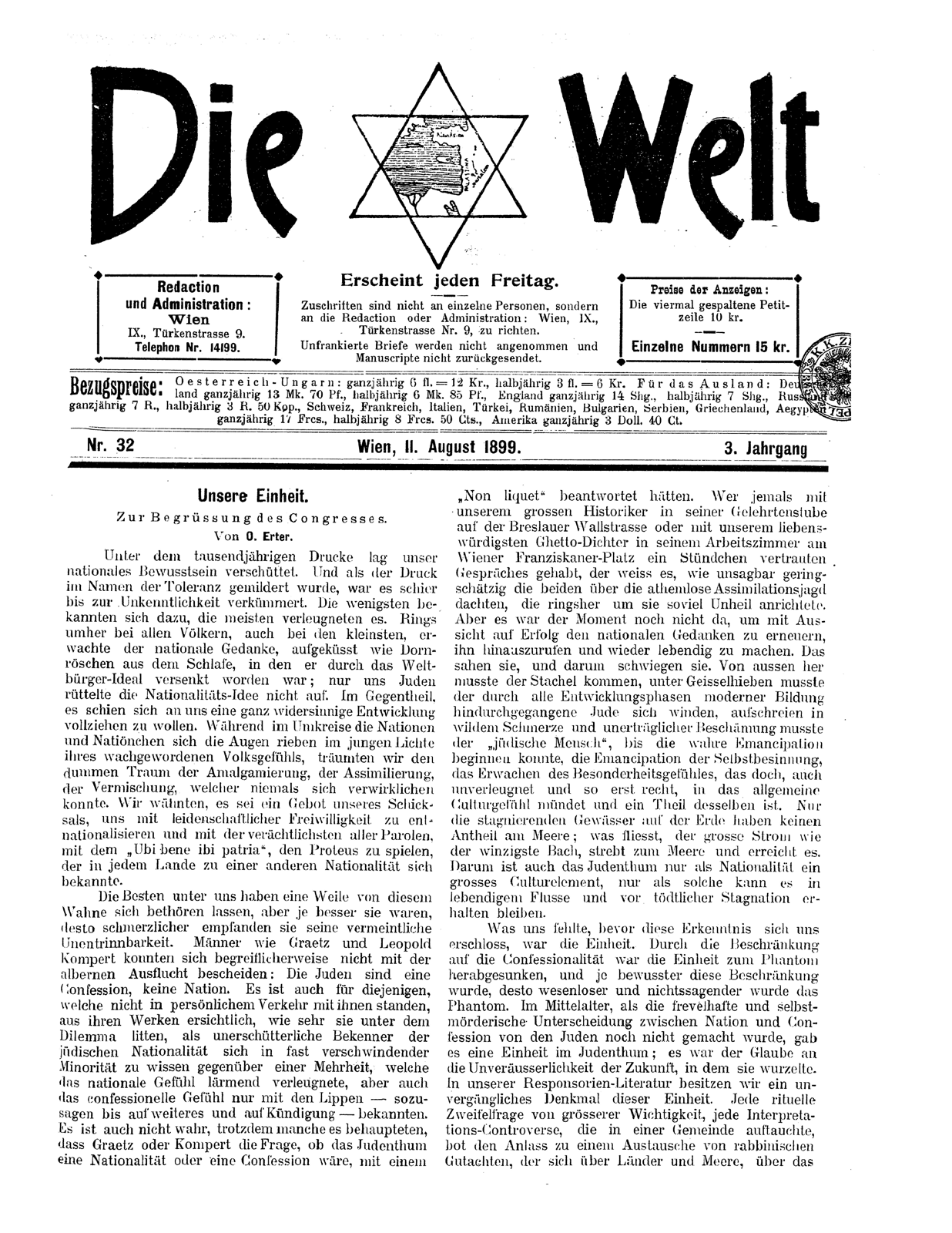
Die Welt
Editorial Office and Administration: Vienna, IX., Türkenstrasse 9. Telephone No. 14199.
Appears every Friday.
Communications are to be addressed not to individual persons, but to the Editorial Office or the Administration: Vienna, IX., Türkenstrasse No. 9.
Unstamped letters are not accepted, and manuscripts are not returned.
Rates of advertisements: the four-column petit line, 10 kr.
Single numbers 15 kr.
Subscription rates: Austria-Hungary: yearly 6 fl. = 12 Kr., half-yearly 3 fl. = 6 Kr. For abroad: Germany yearly 13 Mk. 70 Pf., half-yearly 6 Mk. 85 Pf.; England yearly 14 Shg., half-yearly 7 Shg.; Russia yearly 7 R., half-yearly 3 R. 50 Kop.; Switzerland, France, Italy, Turkey, Roumania, Bulgaria, Servia, Greece, Egypt yearly 17 frcs., half-yearly 8 frcs. 50 cts.; America yearly 3 doll. 40 ct.
No. 32 | Vienna, 11 August 1899. | Third Year
Our Unity.
In Greeting to the Congress.
By O. Erter.
Beneath the pressure of a thousand years our national consciousness lay buried. And when that pressure was softened in the name of toleration, it had dwindled almost past recognition. The fewest avowed it, the most denied it. Round about, among all peoples, even the smallest, the national idea awoke, kissed out of the slumber into which the cosmopolitan ideal had sunk it, like the Sleeping Beauty; only we Jews were not roused by the idea of nationality. On the contrary, a wholly preposterous development seemed about to work itself out upon us. While in the circle around us the nations and the little nationlets were rubbing their eyes in the young light of their awakened sense of peoplehood, we dreamed the foolish dream of amalgamation, of assimilation, of intermixture, which never could be realised. We fancied it a commandment of our destiny to denationalise ourselves with passionate willingness, and, under the most contemptible of all watchwords, under the "Ubi bene ibi patria," to play the Proteus who in every land professed a different nationality.
The best among us allowed themselves for a while to be beguiled by this delusion; but the better they were, the more painfully they felt its supposed inescapability. Men like Graetz and Leopold Kompert could not, as may readily be understood, content themselves with the silly evasion: the Jews are a confession, not a nation. Even for those who stood in no personal intercourse with them it is plain from their works how greatly they suffered under the dilemma of knowing themselves, as unshakable confessors of Jewish nationality, in an almost vanishing minority over against a majority which noisily denied the national feeling, but professed even the confessional feeling only with the lips — so to say until further notice and subject to withdrawal. Nor is it true, though some have asserted it, that Graetz or Kompert answered the question whether Judaism were a nationality or a confession with a "Non liquet." Whoever ever had an hour of confidential talk with our great historian in his scholar's chamber in the Wallstrasse at Breslau, or with our most amiable poet of the Ghetto in his workroom on the Franziskaner-Platz at Vienna, knows how unspeakably contemptuous the two of them were of the breathless chase after assimilation which was working so much mischief all about them. But the moment was not yet come to renew the national idea with any prospect of success, to proclaim it abroad and make it live again. This they saw, and therefore they kept silence. The goad had to come from without; under the strokes of the lash the Jew who had passed through every phase of modern culture had to writhe; the "Jewish man" had to cry out in wild pain and intolerable shame, before the true emancipation could begin — the emancipation of self-recollection, the awakening of the sense of distinctiveness, which, even unrenounced and then indeed all the more, flows into the general feeling of civilisation and is a part of it. Only the stagnant waters upon the earth have no share in the sea; whatever flows, the great river as well as the tiniest brook, strives toward the sea and reaches it. Therefore Judaism too is a great element of civilisation only as a nationality; only as such can it be kept in living flow and preserved from deadly stagnation.
What we lacked, before this knowledge opened itself to us, was unity. Through the restriction to confessionality unity had sunk to a phantom, and the more conscious this restriction became, the more insubstantial and meaningless grew the phantom. In the Middle Ages, when the wicked and suicidal distinction between nation and confession was not yet made by the Jews, there was a unity in Judaism; it was rooted in the faith in the inalienability of the future. In our Responsa literature we possess an imperishable monument of this unity. Every ritual question of doubt of greater importance, every controversy of interpretation that arose in a community, gave occasion for an exchange of rabbinical opinions which extended over lands and seas, over the