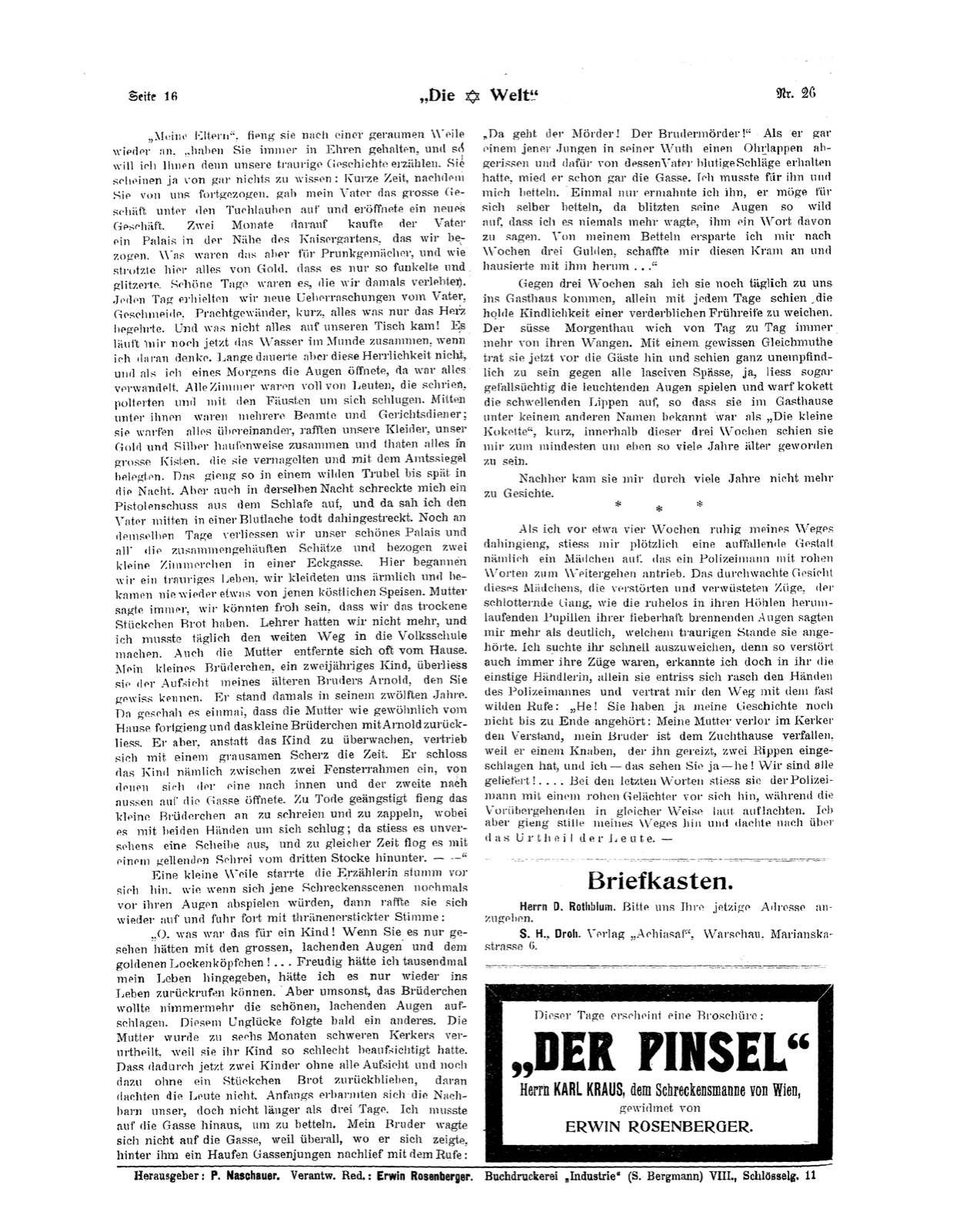
Page 16. — "Die Welt" — No. 26.
"My parents," she began again after a considerable while, "always held you in honour, and so I will tell you our sad story. You seem indeed to know nothing at all of it: a short time after you removed from us, my father gave up the great business under the Tuchlauben and opened a new business. Two months thereafter father bought a palace in the neighbourhood of the Kaisergarten, into which we moved. But what state-chambers those were, and how everything here fairly teemed with gold, so that it sparkled and glittered again. Fine days were those that we then lived through. Every day we received fresh surprises from father, jewellery, splendid raiment, in short everything that the heart could desire. And the things that came upon our table! My mouth waters even now when I think of it. But this magnificence did not last long, and when one morning I opened my eyes, everything was changed. All the rooms were full of people who shouted, made an uproar and struck about them with their fists. In the midst of them were several officials and court-bailiffs; they threw everything one upon another, swept our clothes, our gold and silver together in heaps and put everything into great chests, which they nailed up and covered with the official seal. So it went on in a wild tumult until late into the night. But in that same night a pistol shot startled me out of my sleep, and there I saw my father stretched out dead in the midst of a pool of blood. That very same day we left our beautiful palace and all the heaped-up treasures and moved into two little rooms in a corner lane. Here we began a sad life; we clothed ourselves poorly and never again got anything of those dainty dishes. Mother always said we might be glad that we had our dry morsel of bread. Teachers we had no longer, and I had daily to make the long way to the public school. Mother, too, was often away from the house. My little brother, a child of two years, she left to the care of my elder brother Arnold, whom you surely know. He was then in his twelfth year. Now it happened once that mother went out of the house as usual and left the little brother behind with Arnold. He, however, instead of watching over the child, whiled away the time with a cruel jest. He shut the child, namely, in between two window frames, of which the one opened inwards and the second outwards upon the lane. Frightened to death, the little brother began to scream and to struggle, striking about him with both hands; whereupon he unawares knocked out a pane, and at the same moment flew down with a shrill cry from the third storey. ——"
For a little while the narrator stared mutely before her, as though those scenes of horror were being enacted once more before her eyes; then she pulled herself together again and continued in a voice choked with tears:
"Oh, what a child that was! If you had but seen him with his great laughing eyes and his little golden curly head! ... Gladly would I have given my life a thousand times over, could I but have called him back again into life. But in vain; the little brother would nevermore open his beautiful laughing eyes. Upon this misfortune another soon followed. Mother was sentenced to six months' hard imprisonment, because she had watched over her child so ill. That thereby two children were now left behind without any supervision at all and moreover without a morsel of bread — of that the people did not think. At first the neighbours took pity on us, yet no longer than three days. I had to go out into the lane to beg. My brother did not venture into the lane, because everywhere he showed himself a crowd of street boys ran after him with the cry:
"There goes the murderer! The fratricide!" When in his fury he had actually torn off the ear-lap of one of those boys and had received bloody blows for it from the boy's father, he shunned the lane altogether. I had to beg for him and for myself. Only once did I admonish him that he might beg for himself; whereupon his eyes flashed up so wildly that I never again dared to say a word to him about it. Out of my begging I saved up, after weeks, three gulden, procured myself this trumpery and went hawking about with it ..."
For some three weeks I still saw her come daily to us in the tavern, only with every day the sweet childlikeness seemed to give way to a pernicious precocity. The sweet morning dew retreated from her cheeks more and more from day to day. With a certain equanimity she now stepped before the guests and seemed wholly insensible to all the lascivious jests; nay, she even let her shining eyes play with a wish to please and pouted her swelling lips coquettishly, so that in the tavern she was known under no other name than "the little Coquette"; in short, within these three weeks she seemed to me to have grown older by at least as many years.
Afterwards she came no more within my sight for many years.
As I was going quietly on my way some four weeks ago, there suddenly met me a striking figure, namely a girl whom a policeman was driving on with coarse words. The sleepless face of this girl, the distracted and ravaged features, the tottering gait, as well as the pupils of her feverishly burning eyes running restlessly about in their sockets, told me more than plainly to what sad estate she belonged. I sought quickly to avoid her, for however distracted her features were, I nevertheless recognised in her the hawker of former days; but she tore herself swiftly from the hands of the policeman and barred my way with the almost wild cry: "Hey! You have not yet heard my story to the end: my mother lost her reason in prison, my brother has fallen to the penitentiary because he broke two ribs of a boy who had provoked him, and I — you see it well enough — hey! We are all done for! ..." At the last words the policeman thrust her before him with a coarse laugh, while the passers-by in like manner laughed aloud. I, however, went quietly on my way and pondered upon the judgment of the people. —
Letter Box.
Herr D. Rothblum. Kindly inform us of your present address.
S. H., Droh. "Achiasaf" Publishing House, Warsaw, Marianskastrasse 6.
There will appear in a few days a pamphlet:
"DER PINSEL"
To Herr KARL KRAUS, the terror of Vienna, dedicated by ERWIN ROSENBERGER.
Publisher: P. Naschauer. Responsible Editor: Erwin Rosenberger. "Industrie" Printing Office (S. Bergmann) VIII., Schlösselg. 11