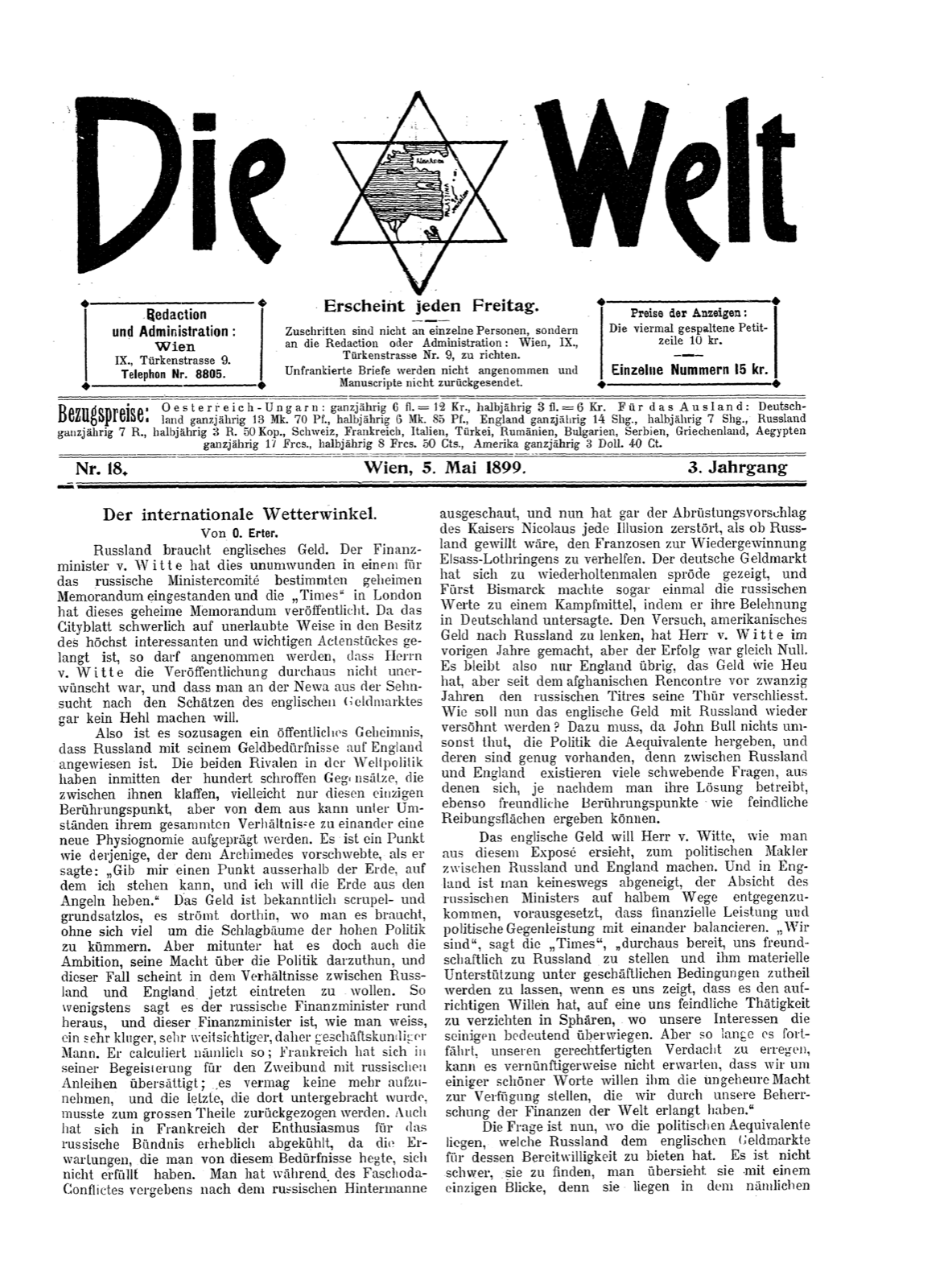
Die Welt
Editorial Office and Administration: Vienna IX., Türkenstrasse 9. Telephone No. 8805.
Published every Friday. Communications are to be addressed not to individual persons, but to the Editorial Office or the Administration: Vienna, IX., Türkenstrasse No. 9. Unstamped letters are not accepted, and manuscripts are not returned.
Advertisement rates: The four-column petit line 10 kr. Single numbers 15 kr.
Subscription rates: Austria-Hungary: 6 fl. = 12 Kr. yearly, 3 fl. = 6 Kr. half-yearly. For abroad: Germany 12 Mk. 70 Pf. yearly, 6 Mk. 85 Pf. half-yearly; England 14 Shg. yearly, 7 Shg. half-yearly; Russia 7 R. yearly, 3 R. 50 Kop. half-yearly; Switzerland, France, Italy, Turkey, Roumania, Bulgaria, Servia, Greece, Egypt 17 Frcs. yearly, 8 Frcs. 50 Cts. half-yearly; America 3 Doll. 40 Ct. yearly.
No. 18. Vienna, 5 May 1899. Third Year
The International Storm-Centre.
By O. Erter.
Russia needs English money. The Minister of Finance v. Witte has confessed this without reserve in a secret memorandum intended for the Russian Committee of Ministers, and the "Times" in London has published this secret memorandum. Since the City journal can hardly have come into possession of that most interesting and important document by illicit means, it may be assumed that the publication was by no means unwelcome to Herr v. Witte, and that on the Neva no secret whatever is to be made of the longing for the treasures of the English money market.
So it is, so to speak, an open secret that Russia, with its need of money, is thrown upon England. The two rivals in world politics have, amid the hundred harsh antagonisms that yawn between them, perhaps this single point of contact alone; but from it their whole relation to one another may under certain circumstances be stamped with a new physiognomy. It is such a point as that which floated before Archimedes when he said: "Give me a point outside the earth on which I can stand, and I will lift the earth off its hinges." Money, as is well known, is without scruple and without principle; it streams thither where it is wanted, troubling itself little about the toll-bars of high politics. But now and then it has also the ambition to display its power over politics, and this case now seems about to arise in the relation between Russia and England. So at least the Russian Minister of Finance says roundly, and this Minister of Finance is, as men know, a very shrewd, very far-sighted, and therefore business-wise man. He calculates, namely, thus; France, in its enthusiasm for the Dual Alliance, has surfeited itself with Russian loans; it is able to take up no more, and the last that was placed there had for the greater part to be withdrawn. In France, too, the enthusiasm for the Russian alliance has cooled considerably, since the expectations that were cherished of this need have not been fulfilled. During the Fashoda conflict men looked in vain for the Russian backer, and now the disarmament proposal of the Emperor Nicholas has destroyed every illusion that Russia might be willing to help the French to the recovery of Alsace-Lorraine. The German money market has repeatedly shown itself unyielding, and Prince Bismarck once even made Russian securities a weapon of combat by forbidding advances upon them in Germany. The attempt to direct American money to Russia was made by Herr v. Witte last year, but the success was nil. There remains, then, only England, which has money like hay, but which since the Afghan rencontre of twenty years ago closes its door to Russian titres. How, then, is English money to be reconciled with Russia again? For that, since John Bull does nothing for nothing, politics must furnish the equivalents; and of these there are enough, for between Russia and England there exist many pending questions out of which, according as their solution is pursued, friendly points of contact may arise as readily as hostile surfaces of friction.
English money, as one perceives from this exposé, Herr v. Witte would make the political broker between Russia and England. And in England they are by no means disinclined to meet the Russian Minister's intention half-way, provided that the financial performance and the political counter-performance balance one another. "We are," says the "Times," "entirely ready to place ourselves on a friendly footing towards Russia and to let her have material support upon business conditions, if she shows us that she has the sincere will to renounce a course of action hostile to us in spheres where our interests considerably outweigh hers. But so long as she continues to excite our justified suspicion, she cannot reasonably expect that for the sake of a few fine words we should place at her disposal the immense power which we have attained through our command of the finances of the world."
The question now is where the political equivalents lie which Russia has to offer the English money market for its readiness. It is not hard to find them; one takes them in at a single glance, for they lie in the same