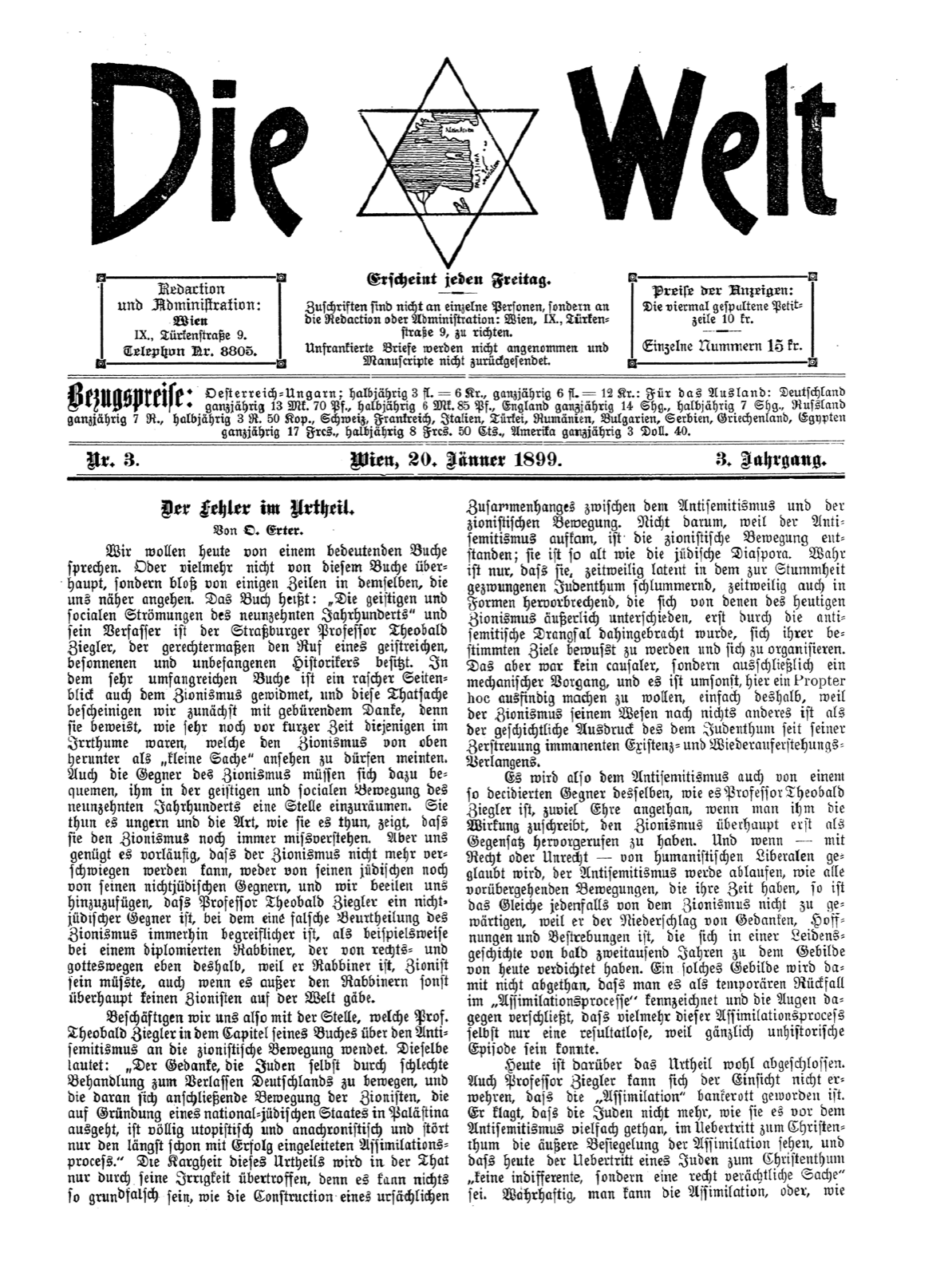
Die Welt
Appears every Friday.
Editorial Office and Administration: Vienna IX., Türkenstraße 9. Telephone No. 8805. — Communications are to be addressed not to individual persons, but to the Editorial Office or the Administration: Vienna, IX., Türkenstraße 9. Unstamped letters are not accepted, and manuscripts are not returned. — Rates of advertisement: the four-column petit line 10 kr. Single numbers 15 kr.
Subscription rates: Austria-Hungary: half-yearly 3 fl. = 6 Kr., yearly 6 fl. = 12 Kr.; for abroad: Germany yearly 13 Mk. 70 Pf., half-yearly 6 Mk. 85 Pf., England yearly 14 Shg., half-yearly 7 Shg., Russia yearly 7 R., half-yearly 3 R. 50 Kop., Switzerland, France, Italy, Turkey, Roumania, Bulgaria, Servia, Greece, Egypt yearly 17 Frcs., half-yearly 8 Frcs. 50 Cts., America yearly 3 Doll. 40.
No. 3.
Vienna, 20 January 1899.
Third Year.
The Error in the Judgment.
By O. Erter.
To-day we would speak of an important book. Or rather not of this book as a whole, but merely of a few lines in it which concern us more nearly. The book is entitled: "The Intellectual and Social Currents of the Nineteenth Century," and its author is the Strasburg professor Theobald Ziegler, who most justly enjoys the repute of a brilliant, judicious and impartial historian. In this very extensive book a rapid side-glance is devoted to Zionism as well, and this fact we acknowledge at the outset with due thanks, for it proves how greatly those were in error who but a short time ago believed they might look down upon Zionism as a "small affair." Even the opponents of Zionism must resign themselves to conceding it a place in the intellectual and social movement of the nineteenth century. They do it unwillingly, and the manner in which they do it shows that they still misunderstand Zionism. But for the present it suffices us that Zionism can no longer be passed over in silence, neither by its Jewish nor by its non-Jewish opponents; and we hasten to add that Professor Theobald Ziegler is a non-Jewish opponent, in whom a false estimate of Zionism is after all more comprehensible than, for example, in a diplomaed rabbi, who by right and by God's will ought, precisely because he is a rabbi, to be a Zionist, even if, apart from the rabbis, there were no Zionists whatever in the world.
Let us occupy ourselves, then, with the passage which Prof. Theobald Ziegler devotes to the Zionist movement in the chapter of his book upon anti-Semitism. It runs thus: "The idea of moving the Jews themselves to leave Germany by ill-treatment, and the movement of the Zionists connected therewith, which aims at the founding of a national Jewish State in Palestine, is wholly utopian and anachronistic, and only disturbs the process of assimilation long since successfully set on foot." The meagreness of this judgment is in truth surpassed only by its erroneousness, for nothing can be so fundamentally false as the construction of a causal connection between anti-Semitism and the Zionist movement. It is not because anti-Semitism arose that the Zionist movement came into being; it is as old as the Jewish Diaspora. True it is only that, slumbering at times latent in a Jewry constrained to dumbness, at times also breaking forth in forms outwardly distinct from those of present-day Zionism, it was first brought by anti-Semitic tribulation to become conscious of its definite aims and to organise itself. That, however, was no causal but exclusively a mechanical process, and it is in vain to seek here a propter hoc, simply because Zionism is in its essence nothing other than the historical expression of that craving for existence and for resurrection which has been immanent in Jewry since its dispersion.
Too much honour, then, is done to anti-Semitism, even by so decided an opponent of it as Professor Theobald Ziegler is, when one ascribes to it the effect of having called forth Zionism at all as its counterpart. And if — rightly or wrongly — it is believed by humanitarian Liberals that anti-Semitism will run its course like all transient movements which have their day, the same is at all events not to be looked for in the case of Zionism, because it is the precipitate of thoughts, hopes and endeavours which in a history of suffering of well-nigh two thousand years have condensed into the structure of to-day. Such a structure is not disposed of by characterising it as a temporary relapse in the "process of assimilation," and by closing one's eyes to the fact that this process of assimilation could itself be nothing but a resultless, because wholly unhistorical, episode.
To-day the judgment upon this is doubtless closed. Professor Ziegler too cannot resist the perception that "assimilation" has become bankrupt. He complains that the Jews no longer, as they often did before anti-Semitism, see in conversion to Christianity the outward sealing of assimilation, and that to-day the conversion of a Jew to Christianity is "no indifferent, but a right contemptible matter." Truly, one can — assimilation, or, as