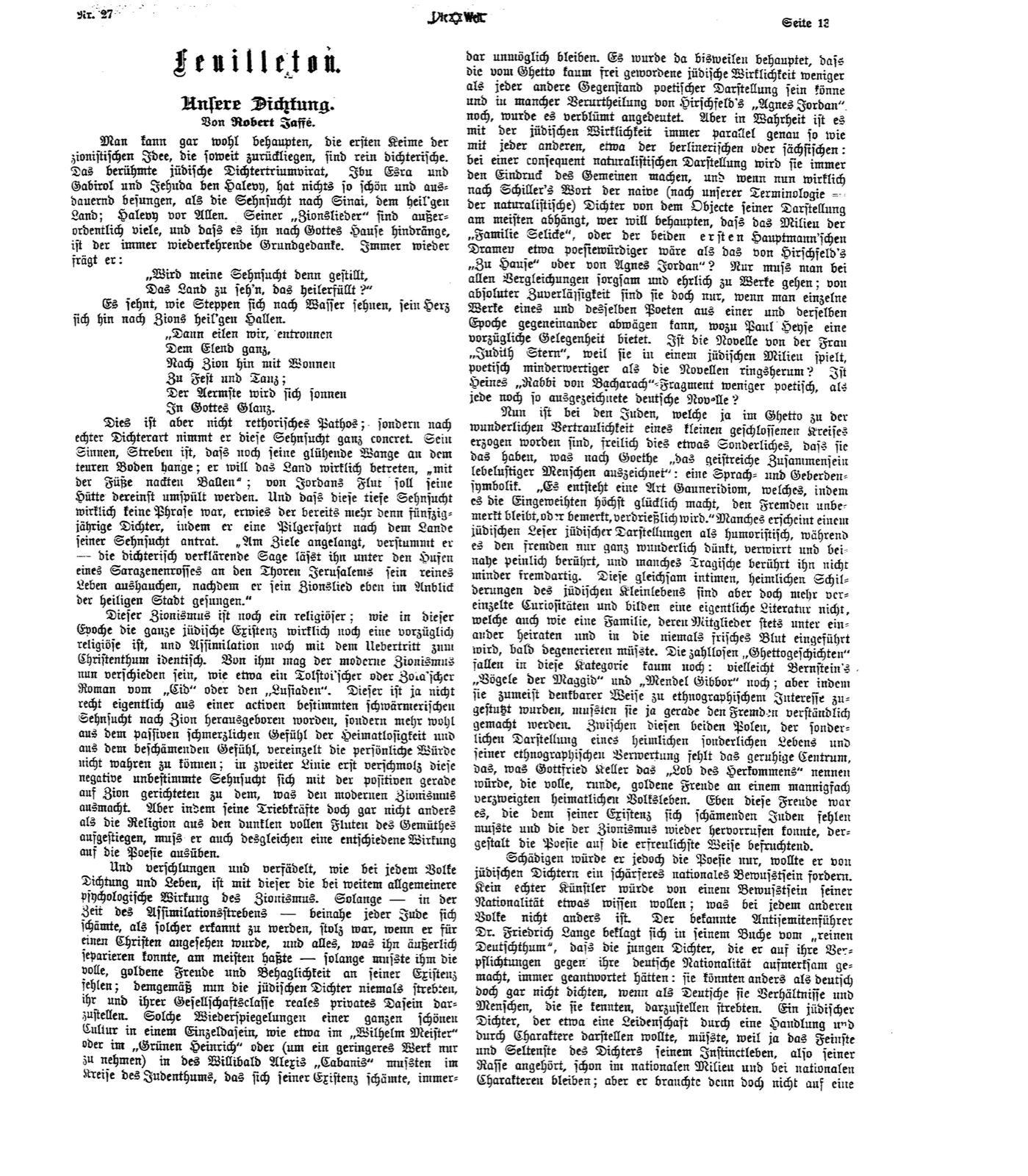
Feuilleton.
Our Poetry.
By Robert Jaffé.
One may very well maintain that the earliest germs of the Zionist idea, which lie so far back, are purely poetic ones. The famous Jewish triumvirate of poets, Ibu Esra and Gabirol and Jehuda ben Halevy, sang of nothing so beautifully and so enduringly as of the longing for Sinai, the holy land; Halevy above all. His "Zionslieder" are extraordinarily numerous, and that he is driven towards the house of God is the ever-recurring fundamental thought. Again and again he asks:
"Shall then my longing be fulfilled, To see the land with blessing filled?"
His heart longs towards Zion's holy halls as the steppes long for water.
"Then shall we haste, delivered From misery all, To Zion with rejoicing, To feast and dance; The poorest man shall bask him In God's own glow."
This, however, is no rhetorical pathos; rather, after the fashion of a true poet, he takes this longing quite concretely. His musing and his striving is that his glowing cheek may yet rest upon that precious soil; he desires really to tread the land, "with the naked soles of his feet"; the flood of Jordan shall one day wash about his hut. And that this deep longing was truly no mere phrase the poet proved, when, already more than fifty years of age, he set out upon a pilgrimage to the land of his longing. "Arrived at his goal, he falls silent — the poetically transfiguring legend has him breathe out his pure life beneath the hooves of a Saracen's horse at the gates of Jerusalem, after he had sung his song of Zion in the very sight of the holy city."
This Zionism is still a religious one; even as in that epoch the whole of Jewish existence is indeed still a pre-eminently religious one, and assimilation still identical with conversion to Christianity. From it modern Zionism may well differ as a novel of Tolstoi's or of Zola's differs from the "Eid" or from the "Lusiaden". For the latter was not properly born out of an active, definite, enthusiastic longing for Zion, but rather out of the passive, painful feeling of homelessness and out of the shaming feeling that in isolation one cannot preserve one's personal dignity; only in the second place did this negative, indefinite longing fuse with the positive longing directed precisely upon Zion into that which constitutes modern Zionism. But inasmuch as its driving forces have risen, no otherwise than religion, out of the dark, full floods of the soul, it must likewise exert a decided effect upon poetry.
And interwoven and threaded together with this effect — as poetry and life are among every people — is the far more general psychological effect of Zionism. So long as — in the age of the striving after assimilation — almost every Jew was ashamed to be recognised as such, was proud when he was taken for a Christian, and hated above all things whatever might outwardly set him apart — so long must the full, golden joy and comfort in his own existence be wanting to him; and accordingly the Jewish poets never strove to represent the real private existence of themselves and of their social class. Such reflections of an entire beautiful culture in a single existence, as in the "Wilhelm Meister" or in the "Grünen Heinrich" or (to take only a lesser work) in Willibald Alexis's "Cabanis", must ever remain impossible within the circle of a Jewry that was ashamed of its own existence. It has at times been asserted that Jewish reality, hardly yet freed from the ghetto, could less than any other subject be one of poetic representation, and in more than one judgment upon Hirschfeld's "Agnes Jordan" it was still hinted at in veiled terms. But in truth it stands with Jewish reality always precisely as with every other, with the Berlin or the Saxon, for instance: under a consistently naturalistic representation it will always make the impression of the common; and if, in Schiller's phrase, the naive (in our terminology = the naturalistic) poet is really most dependent of all upon the object of his representation, who will maintain that the milieu of the "Familie Selicke", or of Hauptmann's first two dramas, is any worthier of poetry than that of Hirschfeld's "Zu Hause" or of Agnes Jordan"? Only, in all such comparisons one must go to work carefully and honestly; they are of absolute reliability only when one can weigh single works of one and the same poet from one and the same epoch against one another, for which Paul Heyse offers an excellent opportunity. Is the novella of the woman "Judith Stern", because it is set in a Jewish milieu, poetically inferior to the novellas round about it? Is Heine's "Rabbi von Bacharach" fragment less poetic than any German novella, however excellent?
Now among the Jews, who in the ghetto were bred to the curious intimacy of a small closed circle, there is indeed this peculiar thing, that they possess what, according to Goethe, "distinguishes the witty companionship of persons fond of life": a symbolism of speech and of gesture. "There arises a kind of rogues' idiom which, while it makes the initiated exceedingly happy, remains unnoticed by the stranger, or, being noticed, becomes vexatious." Much appears humorous to a Jewish reader of Jewish representations which to the stranger seems merely odd, confuses him and touches him almost painfully; and much that is tragic affects him no less strangely. These, as it were intimate and secret depictions of Jewish small life are, however, rather isolated curiosities and do not constitute a literature proper, which indeed, like a family whose members always marry among themselves and into which fresh blood is never introduced, would soon have to degenerate. The countless "Ghettogeschichten" hardly fall into this category any longer: perhaps Bernstein's "Vögele der Maggid" and "Mendel Gibbor" still do; but inasmuch as they were for the most part trimmed, so far as was conceivable, to an ethnographic interest, they had precisely to be made intelligible to the stranger. Between these two poles, the peculiar representation of a secret and peculiar life and its ethnographic exploitation, the tranquil centre is wanting, that which Gottfried Keller would call the "praise of ancestral usage", the full, round, golden joy in a manifoldly ramified native life of the people. It was precisely this joy that must be wanting to the Jew who was ashamed of his existence, and which Zionism was able to call forth again, thus fertilising poetry in the most gratifying manner.
It would injure poetry, however, only if it were to demand of Jewish poets a sharper national consciousness. No true artist would wish to know anything of a consciousness of his nationality; and among every other people it is no otherwise. The well-known leader of the antisemites, Dr. Friedrich Lange, complains in his book on "pure Germanism" that the young poets whom he had reminded of their obligations towards their German nationality had always answered that they could not possibly write otherwise than as Germans, if as Germans they strove to represent the conditions and the men they knew. A Jewish poet who wished, say, to represent a passion through an action and through characters would — since the finest and rarest thing in the poet belongs to his instinctual life, and thus to his race — have of necessity to remain within the national milieu and among national characters; but he would not for that reason need, upon a