Page 8. — "Die Welt" — No. 18.
It has been the opinion that men were to bury in all the graves round about, and that the corpses would in time become so many that at last, from want of room, one would be compelled to take even the unclean Thopheth in hand; yet this view is by no means to be brought into accord with Jeremiah's own words, for he says that there will be no other place ("because there will otherwise be no room" 7 : 32; 19 : 11); and if the bones were to be cast forth out of all the manifold graves at the same time (8 : 1) at which men buried in Thopheth, then he cannot possibly have meant to say that men were only then to bury in Thopheth when all the remaining graves were filled with corpses.
(To be continued.)
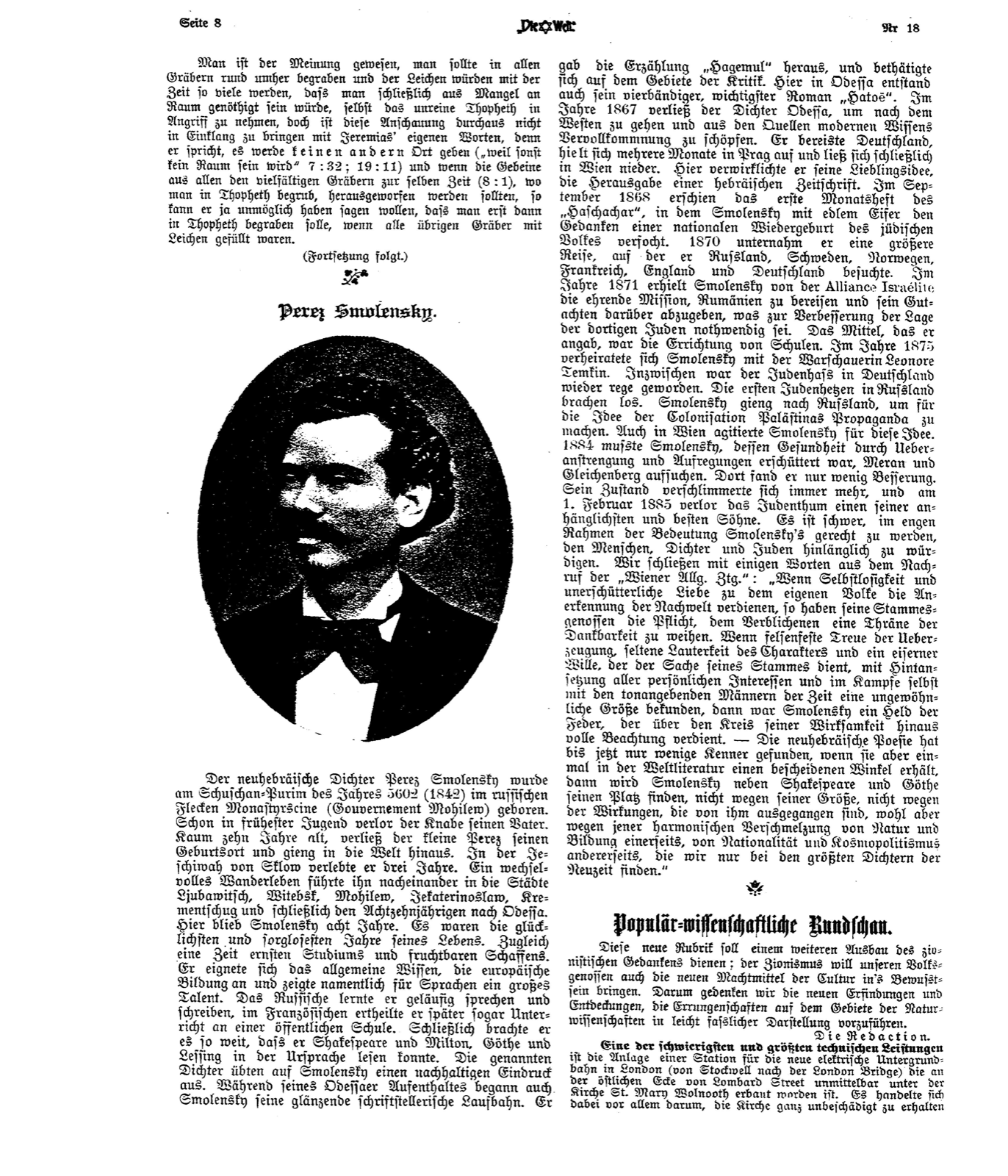
Perez Smolensky.
The neo-Hebrew poet Perez Smolensky was born on Shushan-Purim of the year 5602 (1842) in the Russian market-town of Monastyrscine (Government of Mohilew). Already in earliest youth the boy lost his father. Scarcely ten years old, little Perez left his birthplace and went out into the world. In the Yeshiba of Sklow he passed three years. A changeful wandering life led him successively into the towns of Ljubawitsch, Witebsk, Mohilew, Jekaterinoslaw, Krementschug, and finally, at eighteen years of age, to Odessa. Here Smolensky remained eight years. They were the happiest and most carefree years of his life. At the same time a period of earnest study and of fruitful creation. He made general knowledge, European culture, his own, and showed a great talent particularly for languages. Russian he learned to speak and write fluently; in French he even gave instruction later at a public school. Finally he brought it so far that he could read Shakespeare and Milton, Göthe and Lessing in the original tongue. The poets named exercised a lasting impression upon Smolensky. During his sojourn at Odessa Smolensky also began his brilliant literary career. He brought out the tale "Hagemul," and was active in the field of criticism. Here in Odessa arose also his important romance in four volumes, "Hatoë." In the year 1867 the poet left Odessa in order to go to the West and to draw perfection from the sources of modern knowledge. He travelled through Germany, stayed several months in Prague, and finally settled in Vienna. Here he realised his favourite idea, the publication of a Hebrew periodical. In September 1868 appeared the first monthly number of the "Haschachar," in which Smolensky with noble zeal championed the idea of a national regeneration of the Jewish people. In 1870 he undertook a more extended journey, upon which he visited Russia, Sweden, Norway, France, England and Germany. In the year 1871 Smolensky received from the Alliance Israélite the honourable mission of travelling through Roumania and of delivering his opinion upon what was necessary for the improvement of the condition of the Jews there. The means which he indicated was the establishment of schools. In the year 1875 Smolensky married Leonore Temkin of Warsaw. Meanwhile the hatred of Jews had again become active in Germany. The first Jew-baitings broke out in Russia. Smolensky went to Russia in order to make propaganda for the idea of the colonisation of Palestine. In Vienna too Smolensky agitated for this idea. In 1884 Smolensky, whose health had been shattered by over-exertion and agitations, was obliged to seek out Meran and Gleichenberg. There he found but little improvement. His condition grew ever worse, and on the 1st of February 1885 Jewry lost one of its most devoted and best sons. It is hard, within a narrow frame, to do justice to Smolensky's significance, to appraise sufficiently the man, the poet and the Jew. We close with a few words from the obituary notice of the "Wiener Allg. Ztg.": "If selflessness and unshakable love towards one's own people deserve the recognition of posterity, then his brethren in race have the duty of consecrating a tear of gratitude to the departed. If rock-firm fidelity of conviction, rare purity of character, and an iron will which serves the cause of his race, with the setting aside of all personal interests and in the struggle even with the men who set the tone of the time, attest an uncommon greatness, then Smolensky was a hero of the pen who deserves full attention beyond the circle of his activity. — Neo-Hebrew poetry has hitherto found but few connoisseurs; but if it once obtains a modest corner in the literature of the world, then Smolensky will find his place beside Shakespeare and Göthe, not by reason of his greatness, not by reason of the effects which have proceeded from him, but indeed by reason of that harmonious fusion of nature and culture on the one hand, of nationality and cosmopolitanism on the other, which we find only in the greatest poets of modern times."
Popular-Scientific Review.
This new rubric is to serve a further building out of the Zionist idea; Zionism desires to bring home to the consciousness of our fellow-Jews the new instruments of power belonging to culture as well. We therefore purpose to present the new inventions and discoveries, the achievements in the field of the natural sciences, in easily comprehensible exposition.
The Editors.
One of the most difficult and greatest technical achievements is the construction of a station for the new electric underground railway in London (from Stockwell to London Bridge) which has been built at the eastern corner of Lombard Street immediately beneath the church of St. Mary Woolnoth. The chief point in the matter was to preserve the church wholly undamaged