No. 5. — "Die Welt" — Page 9.
(continued from page 8)
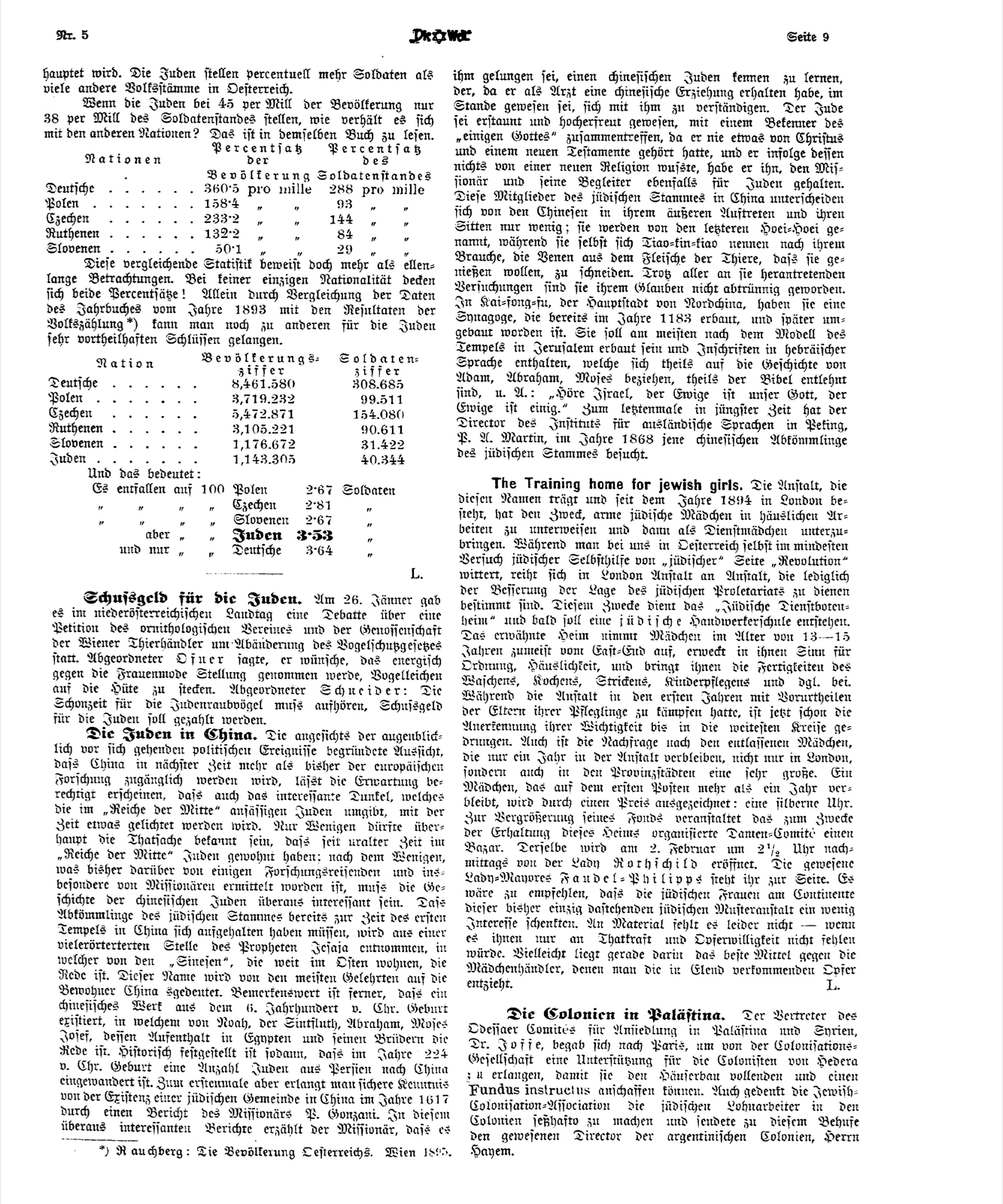
...claimed. The Jews furnish, proportionally, more soldiers than many other races of people in Austria.
If the Jews, at 45 per mille of the population, furnish only 38 per mille of the strength of the army, how does it stand with the other nations? That may be read in the same book.
| Nations | Percentage of the population | Percentage of the strength of the army |
|---|---|---|
| Germans | 360·5 per mille | 288 per mille |
| Poles | 158·4 " " | 93 " " |
| Czechs | 233·2 " " | 144 " " |
| Ruthenians | 132·2 " " | 84 " " |
| Slovenes | 50·1 " " | 29 " " |
This comparative statistic surely proves more than reflections of interminable length. In not a single nationality do the two percentages coincide! Merely by comparing the data of the yearbook of the year 1893 with the results of the census *) one may arrive at yet other conclusions very advantageous to the Jews.
| Nation | Population figure | Number of soldiers |
|---|---|---|
| Germans | 8,461.580 | 308.685 |
| Poles | 3,719.232 | 99.511 |
| Czechs | 5,472.871 | 154.080 |
| Ruthenians | 3,105.221 | 90.611 |
| Slovenes | 1,176.672 | 31.422 |
| Jews | 1,143.305 | 40.344 |
And this means:
| There fall to every 100 | Poles | 2·67 soldiers |
| " " " " | Czechs | 2·81 " |
| " " " " | Slovenes | 2·67 " |
| " " but " | Jews | 3·53 " |
| and only " " | Germans | 3·64 " |
L.
Protection Money for the Jews. On the 26th of January there took place in the Lower Austrian Diet a debate upon a petition of the ornithological society and of the guild of the Vienna animal-dealers for an amendment of the bird-protection law. Deputy Ofner said that he wished a vigorous stand to be taken against the ladies' fashion of sticking birds' feathers in their hats. Deputy Schneider: The close season for the Jewish birds of prey must cease; protection money for the Jews ought to be paid.
The Jews in China. The prospect, well grounded in view of the political events now taking their course, that China will in the near future become more accessible to European research than hitherto, makes the expectation appear justified that the interesting obscurity which surrounds the Jews settled in the "Middle Kingdom" will in time be somewhat lightened. To but few can the fact be known at all that from time immemorial Jews have dwelt in the "Middle Kingdom"; according to the little that has hitherto been ascertained upon the subject by some travelling explorers and in particular by missionaries, the history of the Chinese Jews must be exceedingly interesting. That descendants of the Jewish stock must already have sojourned in China at the time of the First Temple is inferred from a much-discussed passage of the Prophet Isaiah, in which mention is made of the "Sinese," who dwell far in the East. This name is by most scholars taken to signify the inhabitants of China. It is noteworthy, further, that there exists a Chinese work of the 6th century before the birth of Christ in which mention is made of Noah, the Flood, Abraham, Moses, Joseph, his sojourn in Egypt, and his brethren. It is then historically established that in the year 224 before the birth of Christ a number of Jews immigrated from Persia into China. For the first time, however, one obtains sure knowledge of the existence of a Jewish community in China in the year 1617, through a report of the missionary P. Gonzani. In this exceedingly interesting report the missionary relates that he had succeeded in making the acquaintance of a Chinese Jew who, having as a physician received a Chinese education, had been able to make himself understood with him. The Jew had been astonished and highly delighted to meet with a confessor of the "one God"; since he had never heard anything of Christ and of a New Testament, and consequently knew nothing of a new religion, he had taken him, the missionary, and his companions likewise for Jews. These members of the Jewish stock in China differ but little from the Chinese in their outward bearing and their customs; they are called by the latter Hoei-Hoei, while they themselves call themselves Tiao-kin-kiao, after their usage of cutting the veins out of the flesh of the animals which they mean to eat. In spite of all the temptations that come upon them, they have not proved apostate to their faith. In Kai-fong-fu, the capital of Northern China, they have a synagogue, which was built as early as the year 1183 and later rebuilt. It is said to be built most nearly after the model of the Temple in Jerusalem, and to contain inscriptions in the Hebrew tongue which relate partly to the history of Adam, Abraham, and Moses, and are partly borrowed from the Bible, among others: "Hear, O Israel, the Eternal is our God, the Eternal is One." The last to visit those Chinese descendants of the Jewish stock, and that in recent times, was the Director of the Institute for Foreign Languages in Peking, P. A. Martin, in the year 1868.
The Training home for jewish girls. The institution which bears this name, and which has existed in London since the year 1894, has for its purpose the instruction of poor Jewish girls in domestic work and their subsequent placing out as servant-maids. While with us in Austria "revolution" is scented from the "Jewish" side at the very least attempt at Jewish self-help, in London institution ranks upon institution, all of them destined solely to serve the betterment of the condition of the Jewish proletariat. This purpose is served by the "Jewish Servants' Home," and soon a Jewish trade-school is to arise. The Home in question receives girls of from 13 to 15 years of age, for the most part from the East-End, awakens in them a sense of order and of domesticity, and imparts to them the accomplishments of washing, cooking, knitting, the tending of children, and the like. Whereas in the first years the institution had to contend with the prejudices of the parents of its charges, the recognition of its importance has by now penetrated into the widest circles. The demand, too, for the girls sent out—who remain but one year in the institution—is a very great one, not only in London but also in the provincial towns. A girl who remains longer than a year in her first place is distinguished by a prize: a silver watch. For the enlargement of its fund, the Ladies' Committee organized for the purpose of maintaining this Home is arranging a bazaar. The same will be opened on the 2nd of February at 2½ o'clock in the afternoon by Lady Rothschild. The former Lady Mayoress Faudel-Philipps stands at her side. It were to be recommended that the Jewish women upon the Continent should bestow a little interest upon this hitherto unique Jewish model institution. Of material there is unfortunately no lack—if only they were not lacking in energy and in willingness to sacrifice. Perhaps precisely therein lies the best means against the traffickers in girls, from whom the victims perishing in misery are thereby withdrawn. L.
The Colonies in Palestine. The representative of the Odessa Committee for Settlement in Palestine and Syria, Dr. Josse, has betaken himself to Paris in order to obtain from the Colonization Society a subvention for the colonists of Hedera, so that they may complete the building of their houses and procure a fundus instructus. The Jewish-Colonisation-Association, too, is minded to make the Jewish wage-laborers in the colonies settled upon the land, and has sent for this purpose the former Director of the Argentine colonies, Herr Hayem.
*) Rauchberg: Die Bevölkerung Oesterreichs. Vienna 1895.