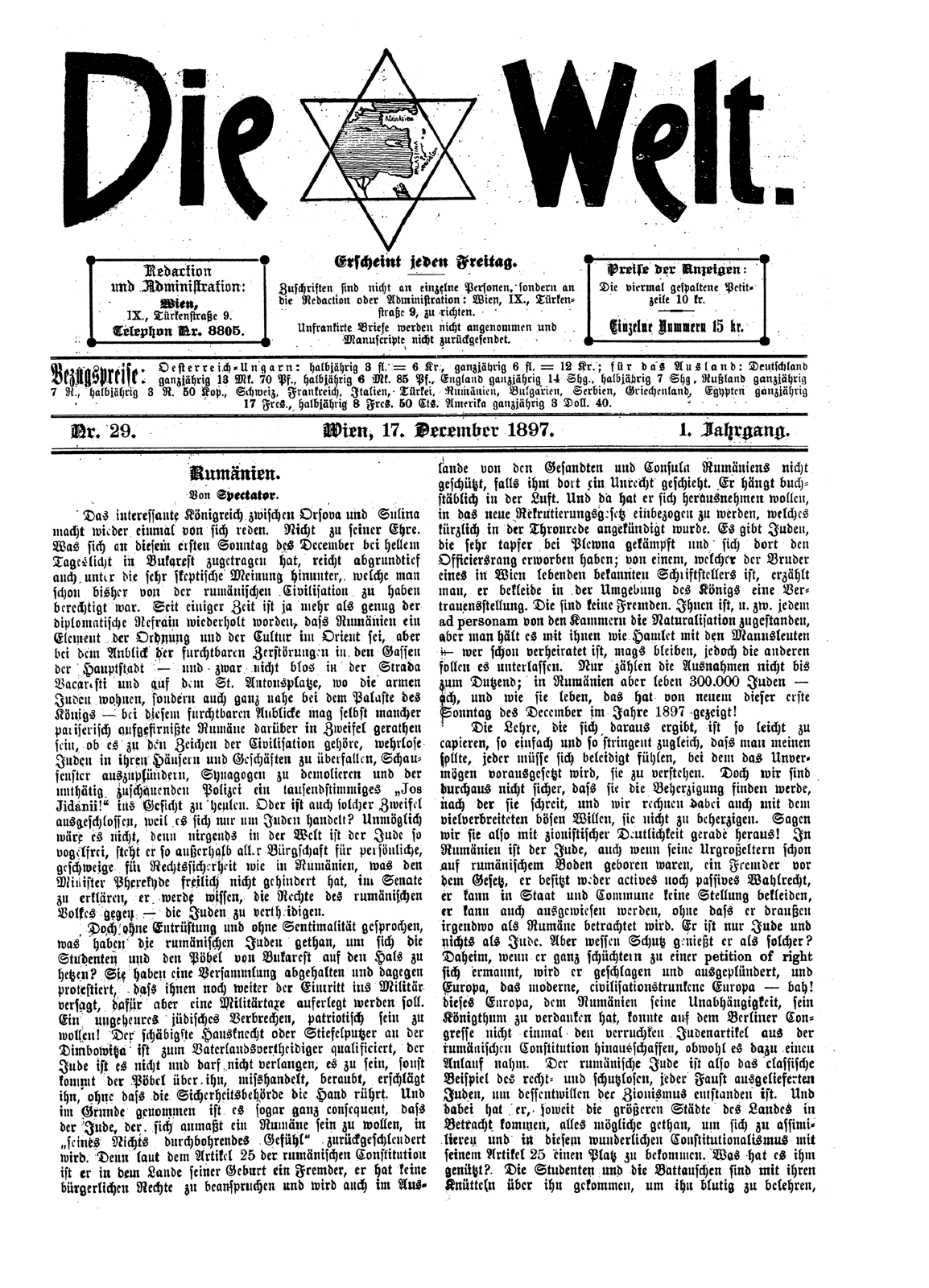
Die Welt.
Appears every Friday.
Editorial office and Administration: Vienna, IX., Türkenstraße 9. Telephone No. 8805. Communications are to be addressed not to individual persons, but to the Editorial office or Administration: Vienna, IX., Türkenstraße 9. Unstamped letters are not accepted, and manuscripts are not returned. Advertising rates: the four-column petit line, 10 kr.; single number, 15 kr.
Subscription rates: Austria-Hungary: half-yearly 3 fl. = 6 Kr., yearly 6 fl. = 12 Kr.; for abroad: Germany yearly 13 Mk. 70 Pf., half-yearly 6 Mk. 85 Pf.; England yearly 14 Shg., half-yearly 7 Shg.; Russia yearly 7 R., half-yearly 3 R. 50 Kop.; Switzerland, France, Italy, Turkey, Roumania, Bulgaria, Servia, Greece, Egypt yearly 17 Frcs., half-yearly 8 Frcs. 50 Cts.; America yearly 3 Doll. 40.
No. 29. — Vienna, 17 December 1897. — First Year.
Roumania.
By Spectator.
The interesting kingdom between Orsova and Sulina is once again making itself talked of. Not to its honour. What took place on this first Sunday of December, in broad daylight, in Bucharest, sinks abysmally deep, below even the very sceptical opinion which one was already hitherto entitled to hold of Roumanian civilisation. For some time past the diplomatic refrain has been repeated more than enough, that Roumania is an element of order and of culture in the Orient; but at the sight of the terrible devastations in the lanes of the capital — and that not merely in the Strada Vacaresti and on the St. Anton Square, where the poor Jews dwell, but also quite close to the King's palace — at this terrible sight even many a Parisian-varnished Roumanian may have fallen into doubt as to whether it belongs among the signs of civilisation to fall upon defenceless Jews in their houses and shops, to plunder shop-windows, to demolish synagogues, and to howl a thousand-voiced „Jos Jidanii!“ into the face of the idly onlooking police. Or is even such doubt ruled out, because it is only a matter of Jews? Impossible it would not be, for nowhere in the world is the Jew so outlawed, stands he so far outside all guarantee of personal, let alone legal, security as in Roumania — which, to be sure, has not prevented Minister Pherekyde from declaring in the Senate that he would know how to defend the rights of the Roumanian people against — the Jews.
Yet, speaking without indignation and without sentimentality, what have the Roumanian Jews done to bring the students and the mob of Bucharest down upon their necks? They held a meeting and protested against entry into the army being still further denied them, while in return a military tax is to be imposed upon them. A monstrous Jewish crime, to wish to be patriotic! The shabbiest house-servant or boot-black on the Dimbowitza is qualified to be a defender of the fatherland; the Jew is not, and may not demand to be, or else the mob comes upon him, maltreats, robs, slays him, without the security authority stirring a hand. And at bottom it is even quite consistent that the Jew, who presumes to wish to be a Roumanian, should be hurled back into „the piercing feeling of his own nothingness.“ For, according to Article 25 of the Roumanian Constitution, he is in the land of his birth a foreigner; he has no civil rights to claim, and neither is he protected abroad by the envoys and consuls of Roumania, should a wrong be done to him there. He literally hangs in the air. And now he has presumed to wish to be included in the new recruitment law which was lately announced in the speech from the throne. There are Jews who fought very bravely at Plevna and there earned the rank of officer; of one, who is the brother of a well-known writer living in Vienna, it is said that he holds a position of trust in the King's entourage. These are no foreigners. To them — and indeed to each one ad personam — naturalisation has been granted by the Chambers; but they are dealt with as Hamlet dealt with the menfolk — whoever is already married may remain, but the others shall refrain from it. Only, the exceptions do not number even a dozen; but in Roumania there live 300,000 Jews — ah, and how they live, this first Sunday of December in the year 1897 has once more shown!
The lesson that follows from this is at once so easy to grasp, so simple and so cogent, that one should think everyone must feel insulted in whom the incapacity to understand it is presumed. Yet we are by no means certain that it will find the heeding for which it cries, and we reckon herein also with the widespread ill will not to heed it. Let us therefore state it outright, with Zionist plainness! In Roumania the Jew, even if his great-grandparents were already born on Roumanian soil, is a foreigner before the law; he possesses neither active nor passive franchise, he can hold no office in state or commune, he can also be expelled, without his being regarded anywhere abroad as a Roumanian. He is only a Jew and nothing but a Jew. But whose protection does he enjoy as such? At home, when quite timidly he plucks up courage for a petition of right, he is beaten and plundered; and Europe, modern, civilisation-drunken Europe — bah! this Europe, to which Roumania owes its independence, its kingship, could not, at the Congress of Berlin, so much as get the infamous Jew-article out of the Roumanian Constitution, though it made a start at it. The Roumanian Jew is thus the classic example of the rightless and unprotected Jew, delivered up to every fist, for whose sake Zionism came into being. And withal he has, so far as the larger cities of the country are concerned, done everything possible to assimilate himself and to obtain a place within this curious constitutionalism with its Article 25. What has it availed him? The students and the Vattauschen have come upon him with their cudgels, to teach him bloodily,