No. 27. — "Die Welt" — Page 9.
(continued from page 8)
…foreign Jews would divert. It is difficult to understand what these gentlemen mean by this. The national idea is foreign to none of them, and they would surely never bring themselves to renounce it for the price of freedom in this free land. But these gentlemen, who wax enthusiastic for 'Anglicisation,' appear themselves to be little 'Anglicised,' for otherwise they would know that our national aspirations, as an emanation of the ancient Biblical prophecies, are through and through in accord with the English spirit, and that the demand to renounce these aspirations is tantamount to a violation of our faith and of the principles of our adopted fatherland." He then set forth the working programme resolved upon by the "Bnei Zion," which also includes the convocation of a conference of all English Zionists. After him spoke Rev. Dr. Gaster, who opposed the convocation of an English Zionist conference. He held that a Zionist organisation, with the Vienna Committee at its head, had already been created. In particular, the leadership of the movement belonged only to those who had earned it through their work. To this the "Chowewi Zion" could lay no claim. These remarks were received with great applause. Mr. de Haas, in his address in reply to Dr. Gaster, pointed out that the English conference was not a matter of a secession from the organisation already created, but rather of developing an agitation within the principles of the Basle programme and of emphasising the Zionist sentiment of the English Jews. There also spoke Mr. Guilarow, Brüll, Epstein, and Ish-Kishor. — Next Saturday Father Ignatius will speak in the same society. For Chanuka an exhibition of Palestinian olive-wood products is being prepared.
—a—
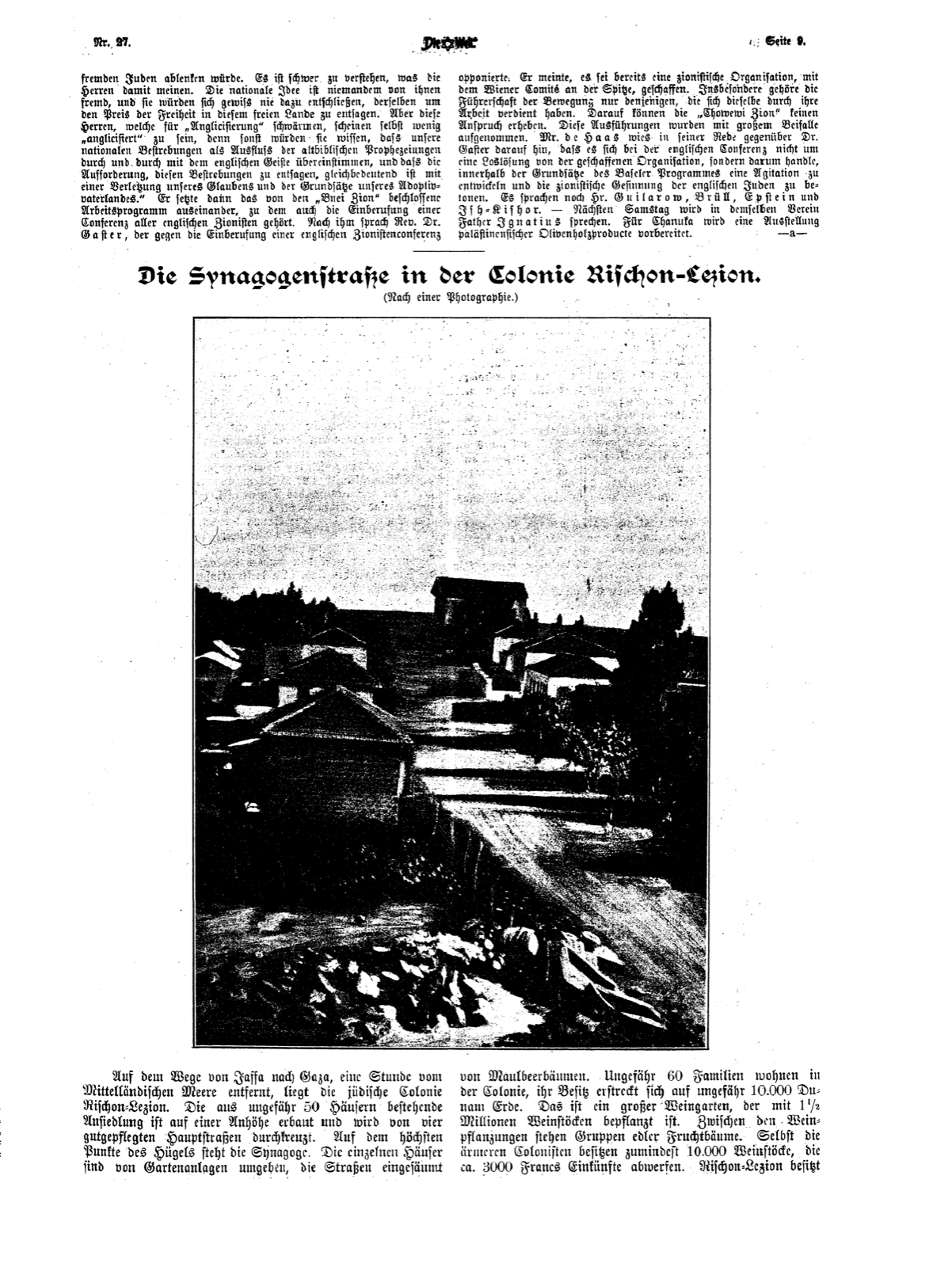
The Synagogue Street in the Colony of Rischon-Lezion.
(From a photograph.)
On the road from Jaffa to Gaza, an hour distant from the Mediterranean Sea, lies the Jewish colony of Rischon-Lezion. The settlement, consisting of about 50 houses, is built upon a rise and is crossed by four well-kept main streets. Upon the highest point of the hill stands the synagogue. The individual houses are surrounded by garden plots, the streets lined with mulberry trees. About 60 families dwell in the colony, and their holdings extend over some 10,000 dunam of land. This is a great vineyard, planted with 1½ million vines. Between the vine-plantings stand groups of noble fruit-trees. Even the poorer colonists possess at least 10,000 vines, which yield about 3000 francs of income. Rischon-Lezion possesses